
What a 409A Valuation Is and When a Startup Needs One
Why stock options need a strike at fair market value, the three safe-harbor presumptions in the 409A regulations, what a valuation costs and the events that call for a new one.
By Redbison Dev · · Updated · 10 min read

You have incorporated, split the founder shares, set aside an option pool, and your first hire is asking what their strike price will be. That number has to come from a 409A valuation: an estimate of the fair market value of one share of common stock, which a US company needs before it grants stock options so that the exercise price is never below that value. A valuation from a qualified independent appraiser, dated within 12 months and refreshed after any material event such as a new funding round, is presumed reasonable by the IRS.
This post explains the rule behind that, the three "safe harbor" routes the regulations give, how a valuation is built, and when you need a new one. It applies to US companies granting stock options or stock appreciation rights to US taxpayers, under the final Section 409A regulations issued in 2007, which remain in force. LLC profits interests and non-US plans, such as UK EMI options, follow other rules. Treat it as background for a conversation with your lawyer and your valuation provider, not as tax advice for your company.
Why options need a fair-market-value strike
Section 409A of the Internal Revenue Code governs nonqualified deferred compensation: pay earned now but received later. A stock option looks like exactly that, so the regulations carve out an exception. Under Treas. Reg. 1.409A-1(b)(5)(i)(A), an option on common stock is not deferred compensation if, among other conditions, "the exercise price may never be less than the fair market value of the underlying stock" on the date of grant. Incentive stock options have a parallel rule in Section 422(b)(4).
Set the strike below fair market value and the option becomes deferred compensation that does not meet 409A's timing rules. Section 409A(a)(1)(B) then makes the holder include the compensation in income once it vests, and adds two charges on top of ordinary income tax: an additional tax of 20% of the amount included, and interest at the underpayment rate plus one percentage point. The employee pays these, not the company, which is why a careless strike price is a serious problem for the people you are trying to reward.
The three safe harbors
The regulations allow any "reasonable valuation method" and list the factors a reasonable method weighs: the value of tangible and intangible assets, the present value of anticipated future cash flows, the market value of comparable companies' stock, recent arm's-length transactions in the company's own stock, and adjustments such as control premiums or discounts for lack of marketability. A value calculated more than 12 months earlier, or one that ignores material information that came out after it was calculated, is not reasonable.
Proving reasonableness from scratch is hard, so Treas. Reg. 1.409A-1(b)(5)(iv)(B)(2) gives three presumptions. If you meet one, the IRS can overturn the value only by showing that the method or its application was "grossly unreasonable".
- Independent appraisal. A valuation by an independent appraiser meeting the standards in Section 401(a)(28)(C), as of a date no more than 12 months before the grant. This is what most venture-backed startups buy.
- Formula valuation. A value from a formula that counts as a nonlapse restriction under Treas. Reg. 1.83-5 (typically a binding buy-sell agreement), used consistently for transfers of that class of stock to the company or to anyone owning more than 10% of its voting power, other than an arm's-length sale of substantially all the stock. Few startups use this.
- Illiquid start-up. A good-faith valuation, evidenced by a written report, by someone with significant knowledge and experience (generally at least five years in business valuation, financial accounting, investment banking, private equity, secured lending or similar). It is only available if the company has conducted its business for less than 10 years, has no publicly traded stock, does not reasonably expect a change in control within 90 days or a public offering within 180 days, and the stock is free of puts, calls and purchase obligations beyond a standard right of first refusal.
How a valuation is built
Appraisers estimate the value of the whole company with one or more approaches, then work out what one common share is worth. The regulation's factor list maps onto the usual three approaches: asset (what the company owns), income (the present value of its future cash flows) and market (prices of comparable companies and of the company's own recent financing rounds). The AICPA's accounting and valuation guide on equity issued as compensation describes these approaches and the methods used to split value between preferred and common shares.
After a priced round, the price investors paid for preferred stock is usually the anchor, because the regulation counts recent arm's-length transactions as a factor. But preferred stock carries rights common stock does not, such as a liquidation preference, and common stock in a private company cannot easily be sold. So the common share value that sets your strike is usually below the preferred price.
Worked example: from founder split to strike price
Step 1: size the pool. Two founders, a full-time CEO and a full-time CTO, want to keep 15% of the company for an employee option pool. In the Co-founder Equity Allocation tool, set Total Equity Pool to 85, choose the Role-Based method, and enter a CEO and a CTO, each at 100% time commitment. The tool gives the CEO 46.4% and the CTO 38.6%. With 10,000,000 shares on a fully diluted basis, that is 4,640,000 and 3,860,000 founder shares and a 1,500,000-share option pool. (The role weights are a starting point for a conversation, not a rule; the co-founder equity split guide covers the methods.)
Step 2: see why the inputs matter. Suppose the appraiser builds an income-approach model from your plan. Open the NPV and IRR Calculator, enter these yearly cash flows, one per line, and try three discount rates:
- Year 0:
0 - Year 1:
-1200000 - Year 2:
-400000 - Year 3:
800000 - Year 4:
2000000 - Year 5:
23500000(a $3,500,000 cash flow plus an assumed $20,000,000 exit value)
| Discount rate | Net present value |
|---|---|
| 30% | $6,233,858 |
| 40% | $4,120,396 |
| 50% | $2,748,971 |
The same plan is worth $6.2 million or $2.7 million depending on one assumption. That is why a 409A report documents its discount rate and projections, and why the regulation asks for a method applied consistently rather than a number picked to give a low strike. These figures are illustrative: an early-stage appraisal will often weight the market approach more, and this value is for the whole company before the split between preferred and common and any marketability discount.
Step 3: set the strike. Say the final report values common stock at $0.42 a share. Your first engineer is offered 40,000 options, 0.4% of the company. The board grants them at a $0.42 strike, so exercising all of them would cost $16,800. Had the board picked $0.10 instead, the options would carry a $0.32 discount per share, $12,800 in total at grant. If that were the amount included in income, the 20% additional tax alone would be $2,560, on top of ordinary income tax and interest. The amount actually included is set by proposed income-inclusion regulations, is based on the spread on vested options, and grows if the share price rises in the meantime.
How often you need a 409A, and what it costs
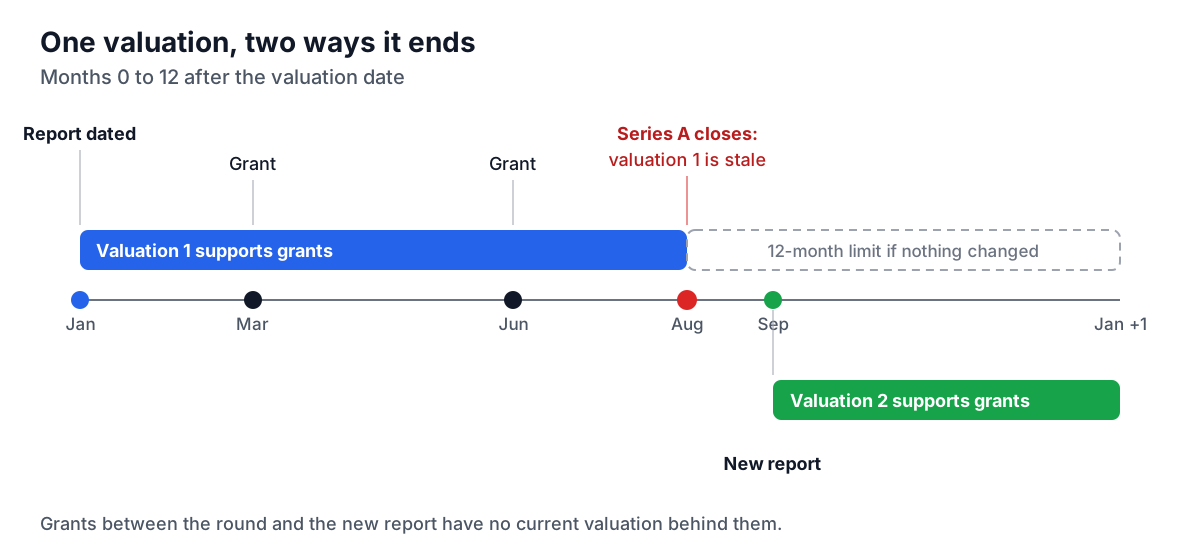
A valuation supports grants for at most 12 months from its date, and less if something material happens first. Common triggers, each tied to the regulation's requirement to reflect material information:
- A priced financing round, which is new arm's-length evidence of value. Get a fresh valuation before the next grant.
- A secondary sale or tender offer in which shares change hands at a known price.
- A large change in the business: a major contract won or lost, a sharp change in revenue, a pivot, a key acquisition.
- An acquisition offer or IPO preparation. The illiquid start-up presumption is unavailable once a change in control within 90 days or an offering within 180 days is reasonably expected.
Grant options soon after the valuation and in batches, so a single report covers several grants before something changes.
There is no official price for a 409A. Fees are set by each provider and depend on the company's stage and how complicated its share classes are; some cap table platforms include valuations in their subscription. Ask for quotes, check the appraiser's qualifications against the presumption you rely on, and confirm the report will be dated before your board approves grants.
Tools for this job
- Co-founder Equity Allocation: work out the founder split and the size of the option pool that the 409A strike price will apply to.
- NPV and IRR Calculator: rebuild the income-approach arithmetic in a valuation report and test how much the discount rate and exit value move the result.
Related reading: the co-founder equity split guide covers dividing founder shares and vesting, the time value of money guide explains net present value and discount rates, and the stock valuation guide covers how public company shares are valued with similar tools.
Frequently asked questions
Does a pre-seed startup need a 409A valuation before granting options?
If it grants stock options to US employees or contractors, it needs a fair market value for the strike price. A very early company can rely on a qualified person's written valuation under the illiquid start-up presumption, but many buy an independent appraisal because it is the clearest safe harbor.
How long is a 409A valuation valid?
At most 12 months from its valuation date for the independent appraisal presumption, and less if a material event, such as a priced round, makes it stale first. Grants made after that need a new valuation.
Who pays the 409A penalty if the strike price was too low?
The option holder. Section 409A(a)(1)(B) adds a 20% tax and interest to the holder's income tax. The company can face withholding and reporting obligations, but the additional tax falls on the employee.
Is the 409A value the same as the price investors paid?
Usually not. Investors buy preferred stock with rights such as a liquidation preference, while options are on common stock that cannot easily be sold. The 409A value of a common share is normally lower than the latest preferred price.
Sources and further reading
- 26 U.S. Code § 409A, Inclusion in gross income of deferred compensation under nonqualified deferred compensation plans, Legal Information Institute. The 20% additional tax and premium interest.
- 26 CFR § 1.409A-1, Definitions and covered plans, Legal Information Institute. Stock rights, valuation factors and the three presumptions in (b)(5)(iv)(B).
- 26 U.S. Code § 422, Incentive stock options, Legal Information Institute. The ISO exercise price rule.
- Valuation of Privately-Held-Company Equity Securities Issued as Compensation, AICPA. The accounting and valuation guide appraisers follow.
- A founder's guide to the 409A valuation, Carta. A provider's overview of the process and refresh triggers.