
Crown Molding Angles and Miter Math: From 180/n to Compound Cuts
Why a polygon miter is 180/n, how to halve any corner, the compound miter and bevel formulas for crown molding at any spring angle, and saw scale conventions.
· 10 min read

Every miter joint is two pieces sharing a corner, so each piece takes half the turn. That one idea gives the 45 degree picture frame, the 30 degree hexagon and the 22.5 degree bay window. Crown molding adds a twist, literally: it leans out from the wall, so the cut has to be made at a compound angle when the molding lies flat on the saw. This post builds up from the simple cases to the crown formulas, checks them against the charts printed in miter saw manuals, and sorts out the saw scale conventions that cause most bad first cuts. The Miter Angle Calculator gives all of these settings for your angles.
Polygons: 180 divided by the number of sides
Walk around any closed frame and you turn through 360 degrees in total. A regular polygon with n sides does it in n equal corners, so each corner turns 360 / n degrees. Two pieces meet at each corner, and each one supplies half the turn:
miter per end = 180 / n interior angle = (n - 2) x 180 / n
| Sides | Shape | Miter setting | Interior angle |
|---|---|---|---|
| 3 | Triangle | 60° | 60° |
| 4 | Square | 45° | 90° |
| 5 | Pentagon | 36° | 108° |
| 6 | Hexagon | 30° | 120° |
| 8 | Octagon | 22.5° | 135° |
| 12 | Dodecagon | 15° | 150° |
The setting here is on the miter saw scale, where 0 is a square cut. For cut lists it also helps to know the inside edge length. Stock of width w loses w x tan(180/n) at each end, so a hexagon side 12 in long on the outside, cut from 2 in stock, measures 12 - 2 x 2 x tan 30° = 9.69 in, about 9-11/16, on the inside.
Trim at any corner
Baseboard, chair rail and casing lie flat against the wall, so they are cut with a simple miter. If two walls meet at an angle A (90 for a square corner, 135 for a typical bay window), the line where the pieces meet bisects that angle, and the saw setting is what is left of a square cut:
miter = (180 - A) / 2
Square corners give 45 degrees; 135 degree bay corners give 22.5; a 120 degree corner gives 30. The trap is assuming walls are square. Plaster and drywall corners are commonly a degree or two off, and a 2 degree error leaves a visible gap at the front of the joint. Measure the corner with a sliding bevel or digital angle gauge, then halve it.
Crown molding and the spring angle
Crown molding sits across the corner between wall and ceiling, with its flat back leaning out from the wall. The angle between the back of the molding and the wall is the spring angle. The common profiles are sold as 52/38 (38 degrees from the wall, 52 from the ceiling) and 45/45. Some larger profiles use other angles, so check yours by holding a piece against a framing square in its installed position.
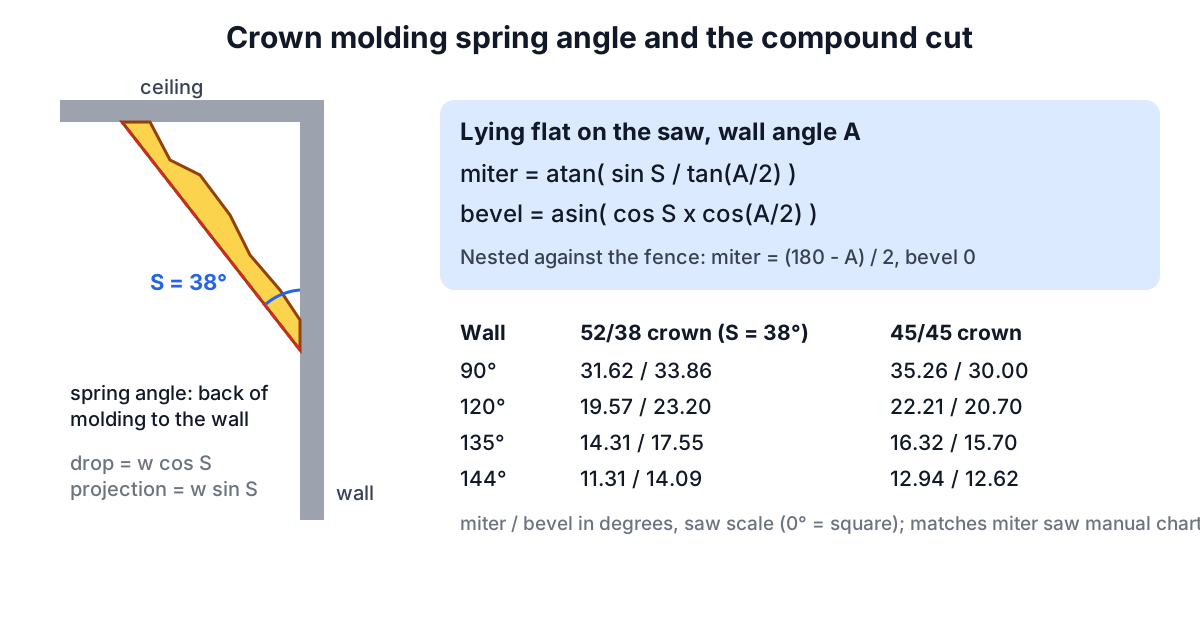
There are two ways to cut it.
Nested. Put the molding upside down on the saw, with its flats bearing on the table and the fence exactly as they would on the ceiling and wall. Now the saw sees the molding in its installed orientation, and a plain miter of (180 - A) / 2 is all you need: 45 degrees at a square corner. It is simple, but the molding has to be held at the right angle, and wide crown may not fit under the blade.
Flat (compound). Lay the molding face up, flat on the table. The cut now needs both a miter (the table rotation) and a bevel (the blade tilt), because the joint line is tilted relative to the board. With spring angle S and wall angle A:
miter = atan( sin S / tan(A/2) )
bevel = asin( cos S x cos(A/2) )
For 52/38 crown in a 90 degree corner, sin 38° = 0.6157 and tan 45° = 1, so the miter is atan(0.6157) = 31.62 degrees. The bevel is asin(0.7880 x 0.7071) = asin(0.5572) = 33.86 degrees. For 45/45 crown the same corner gives 35.26 and 30.00. These are the figures printed in miter saw manuals, and many saws have detents at 31.6 and 33.9 for this reason. The calculator's results match the Ridgid crown molding chart to within a few hundredths of a degree for corners from 72 to 144 degrees.
Checking the formulas at the extremes
Two limiting cases make the formulas easy to trust. If the walls form a straight line (A = 180), tan 90° is infinite and cos 90° is zero, so both angles drop to zero: no corner, no cut. If the spring angle is 90 degrees, the molding lies flat against the ceiling like a flat trim board; sin S is 1 and cos S is 0, so the bevel vanishes and the miter becomes atan(1 / tan(A/2)) = 90 - A/2, the plain trim formula again.
Inside and outside corners
The same corner angle gives the same numbers for inside and outside corners. What changes is which side of the blade each piece goes and which end you keep. Rather than memorising a table of which edge goes against the fence, mark the waste side on both pieces with them held in place, then cut.
For inside corners many trim carpenters cope instead of miter: one piece is cut square into the corner and the other is cut with a 45 degree miter and then back-cut along the profile with a coping saw. A cope hides out-of-square walls and seasonal movement better than a miter.
Saw scales and other conventions
Most of the confusion with miter angles comes from where the zero is.
- Miter saws read 0 for a square cut and 45 for a picture frame corner.
- Protractors and many table saw miter gauges read 90 for a square cut, so the same frame corner reads 45 (or 135 on the other side).
- Bevel scales read 0 with the blade vertical.
The calculator can show results either way. If your gauge reads 90 at square, a 30 degree saw setting for a hexagon becomes 60 on the gauge.
Layout lines for crown
With the spring angle known, the drop down the wall and the projection onto the ceiling follow from the width of the molding's back between the two flats, w: drop = w cos S and projection = w sin S. A 5-1/4 in back on 38 degree crown drops 4.14 in down the wall. Snap a line at that height around the room and the run will stay straight even where the ceiling wanders.
Related tools and reading
For the angles of a roof rather than a room, see Rafter Length, Roof Pitch and the Birdsmouth Cut. The Triangle Calculator solves any other angle problem from a few measurements, and the Fraction Calculator helps when cut lengths come in sixteenths. To buy the stock, How to Calculate Board Feet explains how hardwood is sold.