
How to Calculate Board Feet: Hardwood, Dimension Lumber and Metric
The board foot formula, why a 2x4 counts as 2 x 4, quarter thicknesses like 4/4 and 8/4, NHLA tally rules, waste allowances and converting board feet to cubic metres.
· 9 min read
A board foot is the unit hardwood dealers, sawmills and many lumber yards use to sell wood by volume. It looks simple until you meet the details that change the answer: nominal versus actual sizes, quarter thicknesses like 8/4, random widths, and how much to add for knots and checks. This post explains where the formula comes from, how each kind of lumber is tallied, and how to turn a cutting list into a buying list. You can follow every example in the Board Foot Calculator.
The formula and where it comes from
A board foot is a slab one inch thick, twelve inches wide and one foot long. That is 1 x 12 x 12 = 144 cubic inches. Any board can be measured in those units:
board feet = thickness (in) x width (in) x length (ft) / 12
board feet = thickness (in) x width (in) x length (in) / 144
The first form is the one you will use most, because lumber lengths are sold in feet and cross sections in inches. The division by 12 is there because width is in inches but the board foot is a foot wide.
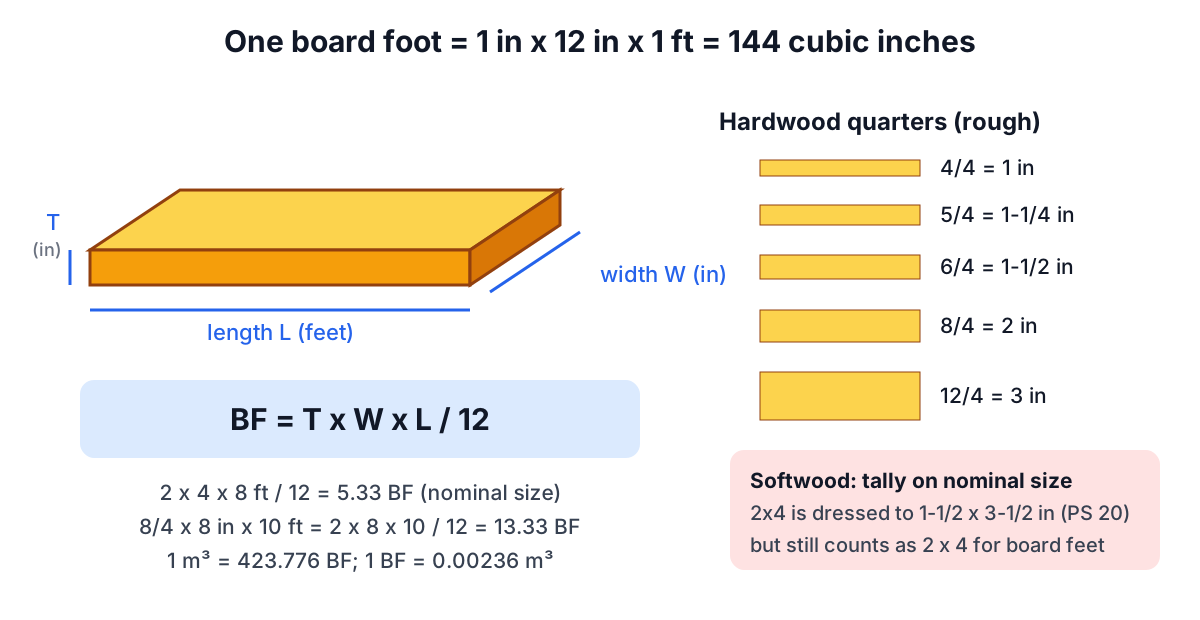
Three quick checks show the formula working. A 1x12 one foot long is 1 x 12 x 1 / 12 = 1 board foot, by definition. A 2x6 eight feet long is 2 x 6 x 8 / 12 = 8 board feet. A 4x4 ten feet long is 4 x 4 x 10 / 12 = 13.33 board feet.
Softwood: nominal sizes, not what the tape says
Construction lumber such as studs, joists and decking is sold under the American Softwood Lumber Standard, NIST PS 20. A "2x4" is the nominal size; the dry, dressed size is 1-1/2 x 3-1/2 in. A 2x8 is 1-1/2 x 7-1/4 in and a 2x12 is 1-1/2 x 11-1/4 in. The standard rule is that 2, 3 and 4 in nominal dimensions lose 1/2 in, and 5 in and up lose 3/4 in.
Board feet for softwood are calculated on the nominal numbers. Ten 2x4 studs eight feet long are 10 x 2 x 4 x 8 / 12 = 53.33 board feet, even though the wood actually in the pile is closer to 35 board feet of real volume. This matters when you compare a price per board foot with a price per piece: divide the piece price by the nominal board feet, not the actual volume, or the numbers will not match the yard's.
Hardwood: quarters, random widths and the NHLA tally
Hardwood is sold rough sawn and graded by the rules of the National Hardwood Lumber Association. Thickness is given in quarters of an inch: 4/4 (four quarter) is about 1 in, 5/4 is 1-1/4, 6/4 is 1-1/2, 8/4 is 2 and 12/4 is 3. Board feet are figured on that rough thickness. A 4/4 board planed to 13/16 in still cost you a full inch.
Widths are random, because each board is sawn to get the most clear wood out of the log. Measure each board, or ask the dealer how they tally; some round each width to the nearest inch. Lengths are usually whole feet, with the odd inch trimmed off. The NHLA rules tally stock thinner than one inch as if it were one inch, so a 3/4 in board is charged as 4/4. The calculator has a checkbox for that rule.
A worked example: a table project needs six boards of 4/4 x 6 in x 8 ft and two of 8/4 x 8 in x 10 ft. That is 6 x 4 = 24 board feet plus 2 x 13.33 = 26.67, for 50.67 board feet net.
Waste: the allowance that decides how much you buy
Rough hardwood is never all usable. You cut away end checks, knots, wane, sapwood you do not want and the snipe a planer leaves. Furniture makers typically buy 15 to 30% more than their cutting list; the higher end applies to lower grades such as No. 1 Common, where the grade rules themselves allow a larger share of defects. Clear, surfaced stock and framing lumber need far less, around 5 to 10%.
In the table example, 15% waste turns 50.67 board feet into 58.27 to buy. At $7.50 per board foot that is $437.00. Price that against a quote and you can see immediately whether the dealer's figure assumes the same allowance.
Metric volume and other units
Because an inch is exactly 25.4 mm, the conversion is exact:
| Unit | Board feet | Cubic metres |
|---|---|---|
| 1 board foot | 1 | 0.002359737 |
| 1 cubic foot | 12 | 0.028316847 |
| 1 cubic metre | 423.776 | 1 |
| 1,000 board feet (MBF) | 1,000 | 2.359737 |
Lumber sold by the cubic metre can therefore be compared with US prices by dividing the price per cubic metre by 423.776. The table example, 50.67 board feet, is 0.1196 cubic metres. The Hoppus foot you may see in older British or Asian timber trade is a log measure based on quarter girth, roughly 1.27 true cubic feet, and is not the same thing; do not mix it with board feet.
Linear feet and board feet
Trim, decking and some softwood are priced by the linear foot. To move between the two, use the cross section:
board feet per linear foot = thickness (in) x width (in) / 12
A 2x6 has 2 x 6 / 12 = 1 board foot per linear foot, so 12 linear feet is 12 board feet. A 1x6 has half a board foot per linear foot, so 100 board feet of 1x6 is 200 linear feet. The converter panel in the calculator does this both ways.
Common mistakes
Using actual instead of nominal sizes for softwood. It understates the board feet by a third and makes a yard's per-board-foot price look wrong.
Forgetting that hardwood is tallied rough. A board you want to finish at 3/4 in must be bought as 4/4; one you want at a full inch must be bought as 5/4.
Mixing inches and feet for length. If the length is in inches, divide by 144, not 12. A 96 in board is 8 ft.
Skipping the waste allowance. It is the difference between finishing the project and making a second trip to the dealer for one more board that matches.
Board feet for logs is a different problem
Log rules such as Doyle, Scribner and International 1/4-inch estimate how many board feet of lumber a sawmill can cut from a log, after kerf and slabs. They give very different answers for the same log, and Doyle in particular undercounts small logs. The calculator is for sawn boards, where the volume is measured directly.
Related tools and reading
If the lumber is for framing, the Wall Framing Calculator counts studs and plates, and How Many Studs Do I Need? explains the layout. For a deck, the Deck Calculator counts boards by stock length. Trim and frames come next: Crown Molding Angles and Miter Math covers the cuts, and the Unit Converter handles any other units on a supplier's sheet.