
Decibels Explained: 10 log, 20 log, dBm, dBu and Adding Levels
Why there are two decibel formulas, what each suffix references, how to convert dBm to volts at 50 or 600 ohms, and why 60 dB plus 60 dB is 63 dB.
· 10 min read
Decibels look simple until you need one. A datasheet says the filter attenuates 40 dB, a signal generator is set to −10 dBm, the mixer wants +4 dBu, and a noise survey adds 85 dB to 85 dB and gets 88. Each of those uses the same logarithmic idea with a different formula or reference. This post sorts them out: why there are two formulas, what each suffix means, how to convert power levels to volts, and why decibel levels do not add like ordinary numbers. The numbers come from the Decibel Calculator.
Why use a logarithm at all
Signal levels span enormous ranges. A radio receiver might handle signals from a few femtowatts to a few milliwatts, a ratio of about 10¹². The ear responds to sound intensities across a similar range. Writing those ratios in plain numbers is awkward; writing their logarithms is not. Logarithms have a second advantage: multiplying gains becomes adding decibels, so the gain of a chain of amplifiers, cables and filters is just the sum of each stage's dB figure.
Bell Telephone Laboratories defined the bel in the 1920s as the base-10 logarithm of a power ratio, named after Alexander Graham Bell. The bel turned out to be too coarse, so the decibel, one tenth of a bel, became the working unit.
10 log for power, 20 log for voltage
The definition is a power ratio:
dB = 10 × log10(P2 ÷ P1)
Doubling power is 10 × log10(2) = 3.01 dB. Ten times the power is 10 dB, a hundred times is 20 dB.
Most of the time, though, we measure voltage or current, not power. Across a resistance R, P = V² ÷ R, so a power ratio equals the square of the voltage ratio if both voltages are across the same resistance. The square comes out of the logarithm as a factor of 2:
dB = 10 × log10((V2 ÷ V1)²) = 20 × log10(V2 ÷ V1)
So doubling voltage is 6.02 dB, ten times the voltage is 20 dB. Both formulas give the same decibel figure for the same physical change; they just start from different quantities. The rule of thumb is: use 20 log for amplitudes (voltage, current, sound pressure, field strength) and 10 log for powers and intensities.
The small print matters. The 20 log formula equals a power ratio only when both voltages are across equal impedances. An op-amp stage with a voltage gain of 10 has a "gain of 20 dB" in voltage terms, and engineers say so routinely, but it is not a 20 dB power gain unless the input and output impedances match. See Op-Amp Gain Formulas for how voltage gain is set.
Absolute levels: dBm, dBW, dBV, dBu
A plain dB figure is a ratio. Add a reference and it becomes an absolute level, written with a suffix:
- dBm: power relative to 1 mW. 0 dBm = 1 mW, 30 dBm = 1 W, −30 dBm = 1 µW. Standard in RF and telecoms.
- dBW: power relative to 1 W. 0 dBW = 30 dBm. Common for transmitter power and satellite links.
- dBV: voltage relative to 1 V rms. Used for consumer audio, where line level is −10 dBV (0.316 V).
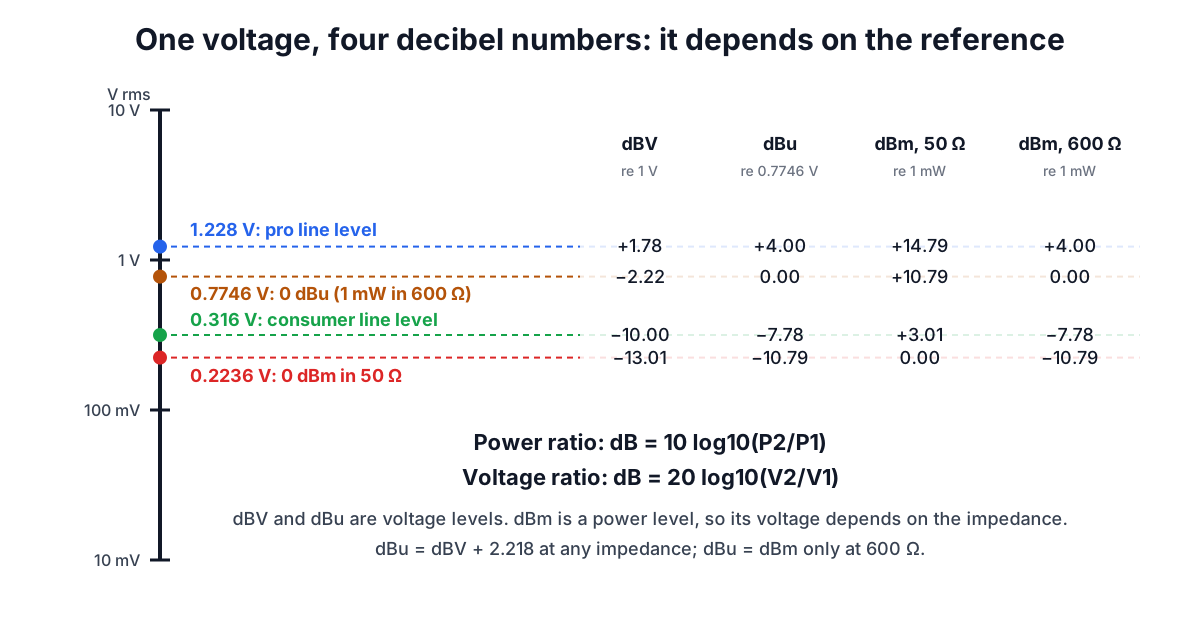
- dBu: voltage relative to 0.7746 V rms. Used for professional audio, where line level is +4 dBu (1.228 V).
- dBµV: voltage relative to 1 µV, common in EMC testing and receiver specifications.
The odd 0.7746 V comes from telephone history. Telephone lines were matched at 600 Ω, and the voltage that delivers 1 mW into 600 Ω is √(0.001 × 600) = 0.7746 V. So 0 dBu is the voltage of 0 dBm in a 600 Ω system. Older documents call it dBv with a lower-case v; the u (for "unloaded") was adopted to avoid confusion with dBV. Because both dBu and dBV are voltage references, they differ by a constant at any impedance: dBu = dBV + 20 × log10(1 ÷ 0.7746) = dBV + 2.218.
Converting dBm to volts needs an impedance
Because dBm is a power level, turning it into a voltage requires the impedance:
P = 1 mW × 10^(dBm ÷ 10), then V = √(P × R)
At 0 dBm:
- 50 Ω (RF test equipment): V = √(0.001 × 50) = 0.2236 V rms, or −13.01 dBV and −10.79 dBu
- 75 Ω (video, cable TV): 0.2739 V rms
- 600 Ω (telephone, legacy audio): 0.7746 V rms, which is 0 dBu
The same goes the other way: a 1 V rms signal is +13.01 dBm in 50 Ω but only +2.22 dBm in 600 Ω. For loudspeakers, 100 W into 8 Ω is 28.28 V rms, which is 50 dBm or 20 dBW. The calculator shows every unit at once for a chosen impedance, including peak and peak-to-peak voltage for a sine wave.
The pro and consumer line levels are a classic trap: +4 dBu is 1.228 V and −10 dBV is 0.316 V. Converting the second to dBu gives −7.78 dBu, so the two standards are 11.78 dB apart, nearly four times in voltage. Plug consumer gear into a pro input and it sounds quiet; the reverse can overload it.
Adding decibel levels
Two sources of 60 dB do not make 120 dB. What adds depends on whether the signals are related.
Uncorrelated sources (two machines, two noise sources, two independent speakers playing different material) add as powers:
L_total = 10 × log10(10^(L1 ÷ 10) + 10^(L2 ÷ 10) + …)
Two equal levels give 3.01 dB more than one: 60 + 60 = 63.01 dB. Ten equal sources give 10 dB more. Unequal sources are dominated by the loudest: 90 dB plus 80 dB is only 90.41 dB, so switching off the quieter machine barely helps. Three machines at 85 dB combine to 89.77 dB.
Coherent, in-phase signals (the same signal split and recombined, or two identical speakers at equal distance at low frequency) add as amplitudes:
L_total = 20 × log10(10^(L1 ÷ 20) + 10^(L2 ÷ 20) + …)
Two equal in-phase signals give 6.02 dB more. Out of phase they can cancel completely. Real acoustic situations fall between these limits and vary with frequency and position, which is why the calculator gives both.
Common mistakes
- Using 10 log on voltages. A voltage ratio of 10 is 20 dB, not 10 dB. If a figure looks half as big as expected, check which formula was used.
- Comparing dBu and dBV directly. They differ by 2.2 dB at any impedance.
- Forgetting the impedance with dBm. "−20 dBm" is 22.4 mV in 50 Ω and 77.5 mV in 600 Ω.
- Adding dB levels arithmetically. Add powers (or amplitudes for coherent signals), then convert back.
- Mixing ratios and levels. Gains and losses (dB) add to levels (dBm): a 0 dBm signal through a 20 dB amplifier and a 3 dB cable loss arrives at +17 dBm. Two levels do not add that way: 0 dBm plus 0 dBm is 3 dBm of combined power, not 0 dB.
- Treating sound levels as perception. A 10 dB rise sounds roughly twice as loud, not ten times, and A-weighting changes what a meter reads. The arithmetic here is about physical quantities.
Related tools and reading
- A first-order filter is 3 dB down at its corner and falls 20 dB per decade; see RC Filter Cutoff Frequency and the RC Filter Calculator.
- Amplifier gains in V/V convert to dB with 20 log; set them with the Op-Amp Gain Calculator.
- Impedance turns dBm into volts; for frequency-dependent impedances use the Reactance and Impedance Calculator.
- For power, voltage, current and resistance in one place, use the Ohm's Law Calculator.