
Engine Displacement Explained: Bore, Stroke, CC and Cubic Inches
How swept volume comes from bore and stroke, why a 0.030 in overbore adds five cubic inches to a 350, what bore/stroke ratio says about an engine, and the rounding that makes a 1998 cc engine a "2.0".
· 9 min read
Engine displacement is the one number that ends up on the badge, the registration document and, in many countries, the tax bill. It is also the easiest engine figure to calculate exactly, because it depends on nothing but three measurements: how wide each cylinder is, how far the piston travels, and how many cylinders there are. This post shows where the formula comes from, how to move between cubic centimetres, litres and cubic inches, what an overbore or a stroker crank does to the total, and what the ratio of bore to stroke says about how an engine behaves. Every number below can be reproduced in the Engine Displacement Calculator.
Swept volume: a cylinder of air
As the crankshaft turns half a revolution, the piston moves from top dead centre (TDC), the highest point of its travel, to bottom dead centre (BDC), the lowest. The space it sweeps on the way is a plain cylinder. Its diameter is the bore and its height is the stroke, so the volume of one cylinder is the area of a circle times a length:
V_cyl = (π / 4) x bore² x stroke
V_total = V_cyl x number of cylinders
That is all displacement means. It is the swept volume only. The small space left above the piston at TDC, the combustion chamber and gasket volume, is not part of it. That leftover space matters a great deal for compression, which is the subject of the companion post on static and dynamic compression ratio, but it does not change the displacement figure.
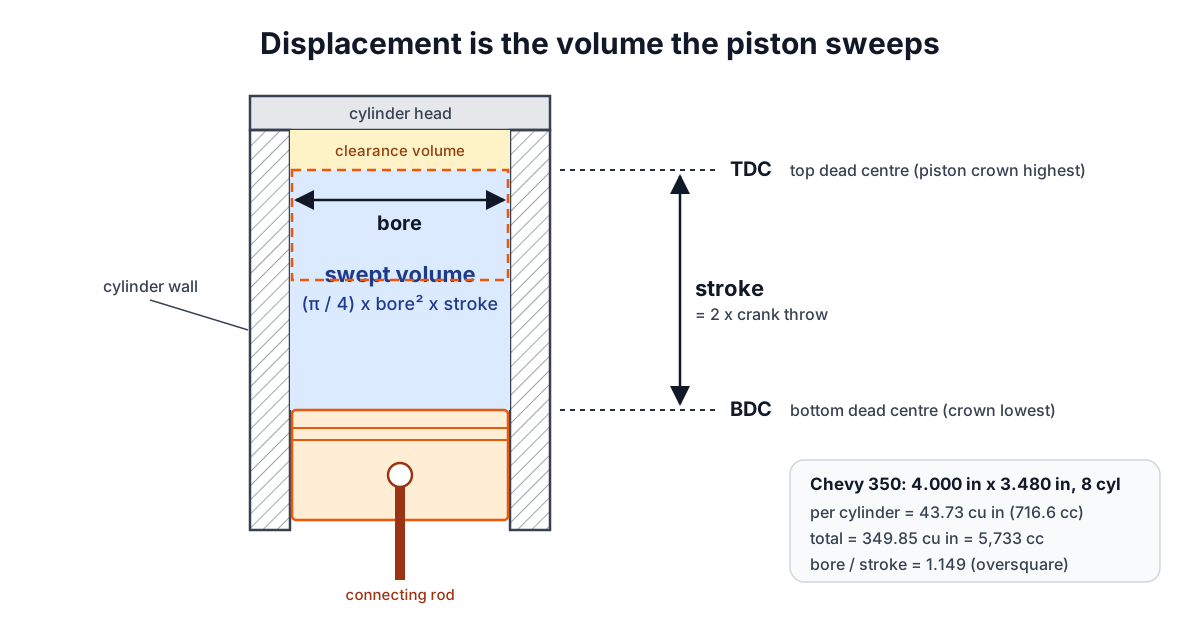
Stroke is set by the crankshaft: it is twice the crank throw, the offset between the main journal centre and the crankpin centre. Connecting rod length does not change the stroke at all. A longer rod changes how the piston moves through the stroke, which matters for dynamic compression and piston side load, but the distance from TDC to BDC is still two crank throws.
Units: millimetres, inches, cc and cubic inches
The formula works in any consistent unit. With bore and stroke in millimetres, the result is in cubic millimetres; divide by 1,000 for cubic centimetres (cc), and by 1,000,000 for litres. With bore and stroke in inches, the result is in cubic inches.
The conversions are exact by definition, because the inch has been defined as exactly 25.4 mm since 1959:
1 in        = 25.4 mm
1 cu in     = 25.4³ mm³ = 16.387064 cc
1 litre     = 1,000 cc = 61.024 cu in
So a figure in cc divided by 16.387064 gives cubic inches, and the reverse. The Unit Converter covers other volume units if you need them.
Manufacturers round displacement for marketing, and the rounding is not consistent. The Chevrolet small block known as the 350, or the 5.7 litre, has a 4.000 in bore and a 3.480 in stroke:
V_cyl   = (π / 4) x 4.000² x 3.480 = 43.73 cu in
V_total = 43.73 x 8              = 349.85 cu in = 5,733 cc
It rounds sensibly to both 350 and 5.7. The Ford 302, with a 4.00 in bore and 3.00 in stroke, works out to 301.6 cu in or 4,942 cc, and was sold as the "5.0", which is a generous rounding of 4.94 litres. Honda's K20 is 86 mm by 86 mm over four cylinders:
V_cyl   = (π / 4) x 86² x 86 / 1,000 = 499.6 cc
V_total = 499.6 x 4                  = 1,998.2 cc = 121.9 cu in
That is sold as a 2.0 litre. Many "2.0" engines sit just under 2,000 cc, partly because tax and racing classes often draw their lines at round numbers and a few cc below the line costs nothing.
Overbores, strokers and solving for a target
Because bore is squared and stroke is not, a small change in bore moves displacement more than the same change in stroke. Machining a worn block 0.030 in oversize is routine when rebuilding, and it adds a surprising amount:
350 at 4.030 x 3.480 = (π / 4) x 4.030² x 3.480 x 8 = 355.12 cu in (5,819.3 cc)
That is 5.27 cu in, or about 1.5 percent, from 0.015 in of extra radius. The calculator's overbore field shows the new figure directly.
A stroker goes the other way: a crankshaft with a longer throw. Fitting a 3.750 in stroke crank to the same overbored 4.030 in block gives the familiar 383:
(π / 4) x 4.030² x 3.750 x 8 = 382.67 cu in (6,271 cc)
The stroker gains far more than the overbore because the stroke change is 0.270 in, against 0.030 in on the bore. It also needs pistons with a shorter compression height or shorter rods, and clearance checks for the counterweights, which is why it is a bigger job.
Rearranging the formula solves for one dimension when you know the target:
bore   = √( 4 x V_total / (π x stroke x cylinders) )
stroke = 4 x V_total / (π x bore² x cylinders)
For a 2,000 cc four-cylinder with a 90 mm stroke, the bore comes out at 84.1 mm. For the same 2,000 cc with an 86 mm bore, the stroke needs to be 86.08 mm, which is why the K20, at exactly 86 mm, falls 1.8 cc short.
Bore/stroke ratio: oversquare, square and undersquare
Dividing bore by stroke gives a single number that says a lot about an engine's character:
- Oversquare (ratio above 1): bore larger than stroke. The 350 is 4.000 / 3.480 = 1.149. A big bore leaves room for large valves, and a short stroke keeps piston speed down, so these engines tend to rev freely. Most racing engines are strongly oversquare.
- Square (ratio of 1): the K20 at 86 x 86.
- Undersquare (ratio below 1), also called long-stroke: bore smaller than stroke. These tend to make good low-speed torque and have a compact combustion chamber with less surface area for heat to escape through, which helps efficiency. Many modern economy engines and large diesels are undersquare.
These are tendencies, not laws. Cam timing, port design and intake tuning shape the torque curve at least as much as the ratio does.
Mean piston speed
The stroke also sets how fast the piston travels. In one revolution the piston goes down and back up, so it covers two strokes. The average speed is
mean piston speed (m/s) = 2 x stroke (m) x rpm / 60
The K20's 86 mm stroke at 8,000 rpm gives 2 x 0.086 x 8,000 / 60 = 22.93 m/s. The 350's 3.48 in (88.4 mm) stroke at 6,000 rpm gives 17.68 m/s. The 383's 3.750 in stroke at the same 6,000 rpm gives 19.05 m/s, so the stroker works its rods and pistons harder at any given engine speed.
Piston speed is a rough gauge of mechanical and breathing stress. Ordinary road engines generally stay below about 20 m/s at their redline, and figures well above 25 m/s usually mean a purpose-built racing engine with lightweight parts. Peak piston speed partway down the stroke is higher than the mean, by roughly 60 percent depending on rod length, and that is what the rod and bearings actually feel.
Worked example from the calculator
Enter a 4.030 in bore, 3.750 in stroke, 8 cylinders and 6,000 rpm:
- Per cylinder: (π / 4) x 4.030² x 3.750 = 47.83 cu in = 783.8 cc.
- Total: 47.83 x 8 = 382.67 cu in = 6,271 cc = 6.27 litres.
- Bore/stroke ratio: 4.030 / 3.750 = 1.075, oversquare.
- Mean piston speed: 2 x 0.09525 m x 6,000 / 60 = 19.05 m/s.
To check the arithmetic by hand, cube the inch dimensions mentally: 4² x 3.75 is 60, times 0.785 is 47.1, times 8 is 377, close to the exact answer once the extra 0.030 is included. A sanity check like this catches a decimal slip in the inputs.
Common mistakes
- Using radius instead of diameter, or forgetting the π / 4. The bore is a diameter. Squaring the radius and leaving out the quarter gives the same answer, but mixing the two gives a result four times too big or too small.
- Mixing units. A bore in millimetres with a stroke in inches gives nonsense. Convert both first.
- Adding the clearance volume. Displacement is swept volume only. Chamber, gasket and deck volumes belong to the compression ratio.
- Treating rod length as stroke. Rod length changes the piston motion curve, not the travel.
- Expecting the badge to match. Badges round, sometimes generously. The calculated figure is the real one.
Where the simple model stops
The formula is exact for a reciprocating piston engine. Some engine types need different rules. Wankel rotary engines have no pistons, and their displacement is quoted under conventions that differ between manufacturers, racing bodies and tax authorities, so the same engine can carry two different figures. Two-stroke engines are quoted by swept volume like four-strokes, but because the ports uncover partway down the stroke, the trapped volume is smaller. Opposed-piston engines have two pistons per cylinder and need both strokes counted.
Displacement also says nothing directly about power. Power depends on how much air the engine moves per second and how well it burns it, which is why a turbocharged 2.0 litre can outperform an older 5.7. For that side of the story, the Horsepower Calculator and the post on estimating horsepower from quarter-mile times take over, and the Torque and Power Calculator converts between torque and power units. Gearing an engine to the road is covered in the post on road speed from rpm, gear ratio and tyre size.
Measured bore and stroke from a real block will differ from the nominal figures by a few thousandths of an inch, so treat calculated results as a close estimate of the engine in front of you, and use measured dimensions when the number matters for a class rule or a build sheet.