
Road Speed from RPM, Gear Ratio and Tire Size: The Formula
From the 336 constant to metric tyre codes: how rpm becomes road speed through gearbox, final drive and tyre, the rpm drop between gears, and speedometer error.
· 10 min read
Engine speed and road speed are tied together by three numbers: the gear ratio in the gearbox, the final drive ratio in the differential, and the size of the tyre. Know those and you can say how fast the car goes at the redline in every gear, what the tachometer shows on the motorway, and where the needle lands after each upshift. The formula is short and exact for a rigid drivetrain, and the interesting parts are the units, the tyre size code and the small reasons the speedometer disagrees. All the figures here come from the Gear Speed Calculator.
From crankshaft to contact patch
The gearbox divides engine speed by the selected gear ratio. The differential divides it again by the final drive ratio (called the axle ratio on rear-drive cars). Their product is the overall ratio, and the wheel turns at
wheel rpm = engine rpm / (gear ratio x final drive)
Each turn of the wheel moves the car forward one tyre circumference, π x diameter, assuming no slip. Multiply by 60 to go from per minute to per hour:
speed = wheel rpm x π x tyre diameter x 60
With the diameter in millimetres and the speed in km/h:
km/h = rpm x D(mm) x π x 60 / (gear x final x 1,000,000)
     = rpm x D(mm) / (gear x final x 5,305.2)
Where 336 comes from
The US form uses the tyre diameter in inches and is famous for its constant:
mph = rpm x D(in) / (gear x axle x 336.13)
It is the same formula with the units folded in. A mile is 63,360 inches, and there are 60 minutes in an hour, so
mph = rpm x π x D(in) x 60 / (gear x axle x 63,360)
336.13 = 63,360 / (60 x π)
The classic check: 3,000 rpm in a 1:1 top gear, a 3.73 axle and a 26 in tyre gives 3,000 x 26 / (3.73 x 336.13) = 62.21 mph. Rearranged, the formula gives rpm from speed, or the axle ratio needed for a target cruising rpm, which is how drag racers and off-roaders pick gears after a tyre change.
Reading a tyre size
The calculator accepts three forms.
Metric (ISO) codes such as 225/45R17. The first number is the section width in millimetres, the second is the aspect ratio (sidewall height as a percentage of width), and the last is the rim diameter in inches. The overall diameter is the rim plus two sidewalls:
sidewall = 225 x 0.45            = 101.25 mm
diameter = 17 x 25.4 + 2 x 101.25 = 634.3 mm
circumference = π x 634.3        = 1,992.7 mm
That is about 502 revolutions per kilometre or 808 per mile. Prefixes such as P (passenger) or LT (light truck) and the trailing load index and speed rating do not change the size.
Flotation sizes such as 33x12.50R15, common on off-road tyres, state the overall diameter directly: 33 in, 12.50 in wide, on a 15 in rim. The nominal 33 is often a little generous; measured tyres of that size are frequently somewhat smaller, so measure when it matters.
A plain diameter, for anything else.
For converting between sizes or checking how a new tyre changes the speedometer, the Tire Size Calculator compares two sizes side by side.
Worked example: a six-speed on 225/45R17 tyres
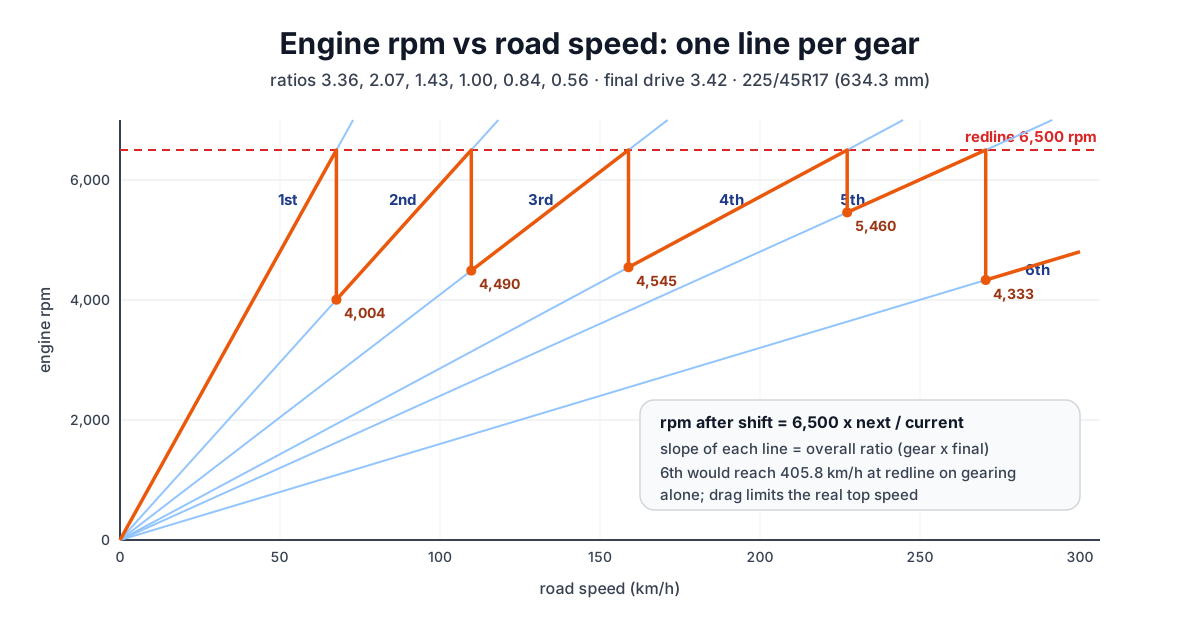
Take gear ratios of 3.36, 2.07, 1.43, 1.00, 0.84 and 0.56, a 3.42 final drive, 225/45R17 tyres and a 6,500 rpm redline.
| Gear | Ratio | Overall | Speed at 6,500 rpm | rpm at 110 km/h | rpm after upshift |
|---|---|---|---|---|---|
| 1 | 3.36 | 11.49 | 67.6 km/h | (above redline) | 4,004 |
| 2 | 2.07 | 7.08 | 109.8 km/h | (above redline) | 4,490 |
| 3 | 1.43 | 4.89 | 158.9 km/h | 4,499 | 4,545 |
| 4 | 1.00 | 3.42 | 227.2 km/h | 3,146 | 5,460 |
| 5 | 0.84 | 2.87 | 270.5 km/h | 2,643 | 4,333 |
| 6 | 0.56 | 1.92 | 405.8 km/h | 1,762 |
Two of those numbers need a comment. Second gear tops out at 109.8 km/h, so holding 110 km/h in second would need a little over the redline. And the 405.8 km/h in sixth is only what the gearing would allow if the engine could reach its redline there. It cannot: aerodynamic drag rises with the cube of speed in power terms, and long before 400 km/h the engine runs out of power to push the car any faster. A tall top gear like this is an economy gear for cruising at low rpm, not a top-speed gear. In US units, 70 mph in sixth is 1,805 rpm.
The rpm drop between gears
When you upshift at the redline, road speed is unchanged for that instant, so engine speed falls in proportion to the ratio change:
rpm after shift = shift rpm x (next ratio / current ratio)
From first to second at 6,500 rpm: 6,500 x 2.07 / 3.36 = 4,004 rpm. On the chart, each gear is a straight line through the origin whose slope is its overall ratio, and the shifts trace a sawtooth that climbs a line to the redline and drops straight down to the next line.
For acceleration, the aim is to land each shift where the engine still makes strong power, ideally keeping the rpm band between shift points as narrow as possible. In this gearbox the drops get smaller with each shift up to fifth: the engine lands at 4,004, then 4,490, 4,545 and 5,460 rpm. That is typical of a progressive gearbox: the low gears are spread wide for launching, the middle gears are closer for keeping the engine on song. The 5th to 6th step is large again (down to 4,333 rpm), the signature of an overdrive top gear meant for cruising. Close-ratio racing gearboxes keep all the drops small at the cost of a tall first gear.
Shifting at the redline is not always the fastest choice. The best shift point is where the wheel torque in the current gear falls to the wheel torque available in the next gear, which depends on the shape of the torque curve. The Torque and Power Calculator and the post on the torque, horsepower and rpm formula cover that relationship.
Why the speedometer and the maths disagree
The formula above assumes the tyre's rolling circumference equals π times its unloaded diameter, and it never does exactly:
- Load and deflection. The weight of the car flattens the tyre at the contact patch, so the distance from axle to road is shorter than the unloaded radius. The effective rolling radius sits between the loaded and unloaded radius, and the car travels slightly less per revolution than π x D suggests. Tyre makers publish measured revolutions per mile or per kilometre, and that figure is the one to trust when precision matters; it typically implies a circumference a couple of percent smaller than the geometric one.
- Tread wear. A new passenger tyre has roughly 8 mm of tread, and a worn one is legal down to 1.6 mm in many countries. Losing about 6 mm of tread from each side cuts the diameter by around 2 percent on a tyre like the 225/45R17.
- Pressure and speed. Underinflation shrinks the rolling radius; at high speed centrifugal growth enlarges it slightly.
- Speedometer calibration. Under UN ECE Regulation 39, which applies in Europe and many other markets, a speedometer must never show less than the true speed, so manufacturers calibrate them to read a little high. A GPS reading lower than the dial is normal.
- Slip. Under hard acceleration the driven tyres turn slightly faster than the road speed, and an automatic's torque converter slips below lock-up, so the engine runs higher than the formula predicts.
So the calculated rpm at a cruising speed is usually within a few percent of what the tachometer shows. If it is far off, check the ratios: many manufacturers quote different final drives for different gears or variants.
Common mistakes
- Using the rim size as the tyre diameter. A 17 in wheel carries a 25 in tyre in this example.
- Forgetting the final drive. Gear ratios alone give gearbox output speed, not wheel speed.
- Reading the aspect ratio as millimetres. The 45 in 225/45 is a percentage of 225 mm, not 45 mm.
- Assuming the top gear speed is the top speed. Drag usually limits it first.
- Mixing units in the 336 formula: it needs the diameter in inches and gives mph.
When the simple model stops
The model treats the drivetrain as rigid. It fits manual gearboxes, dual-clutch boxes and locked-up automatics well. It does not fit continuously variable transmissions, which have no fixed ratios, or a torque converter that is slipping. Electric cars usually have a single fixed reduction, so the formula still works, with motor rpm in place of engine rpm. Treat the results as close estimates for planning gearing and comparing tyre sizes, not as a calibrated speedometer.
To see what the gearing does to fuel use at a cruising rpm, the Fuel Cost Calculator estimates trip costs. For the engine at the other end of the drivetrain, see the posts on engine displacement, bore and stroke, static and dynamic compression ratio and estimating horsepower from quarter-mile times. For gear trains in machinery rather than vehicles, the Gear Ratio Calculator works from tooth counts, and the Horsepower Calculator converts power units.