
Reading Food Labels: Nutrition Facts, EU Rules and Front-of-Pack Claims
What changed in the FDA 2016 Nutrition Facts rule, what EU Regulation 1169/2011 requires, and which claims like organic, natural and cage-free are legally defined.
· 6 min read
Pick up a box of granola in a US supermarket and the front says "natural", "made with whole grains" and "good source of fiber". Turn it over and the Nutrition Facts panel says 12 g of added sugars per serving, 24% of the Daily Value. Only one of those two sides is tightly regulated, and it is not the front.
This guide walks through how to read the US Nutrition Facts label as it has looked since the FDA's 2016 rule, what the EU requires under Regulation (EU) No 1169/2011, and which front-of-pack claims carry a legal definition. The Food Labeling Guide tool lets you search 36 of those claims with a reliability rating for each. This is general information, not legal, medical or dietary advice.
The US Nutrition Facts label after the 2016 rule
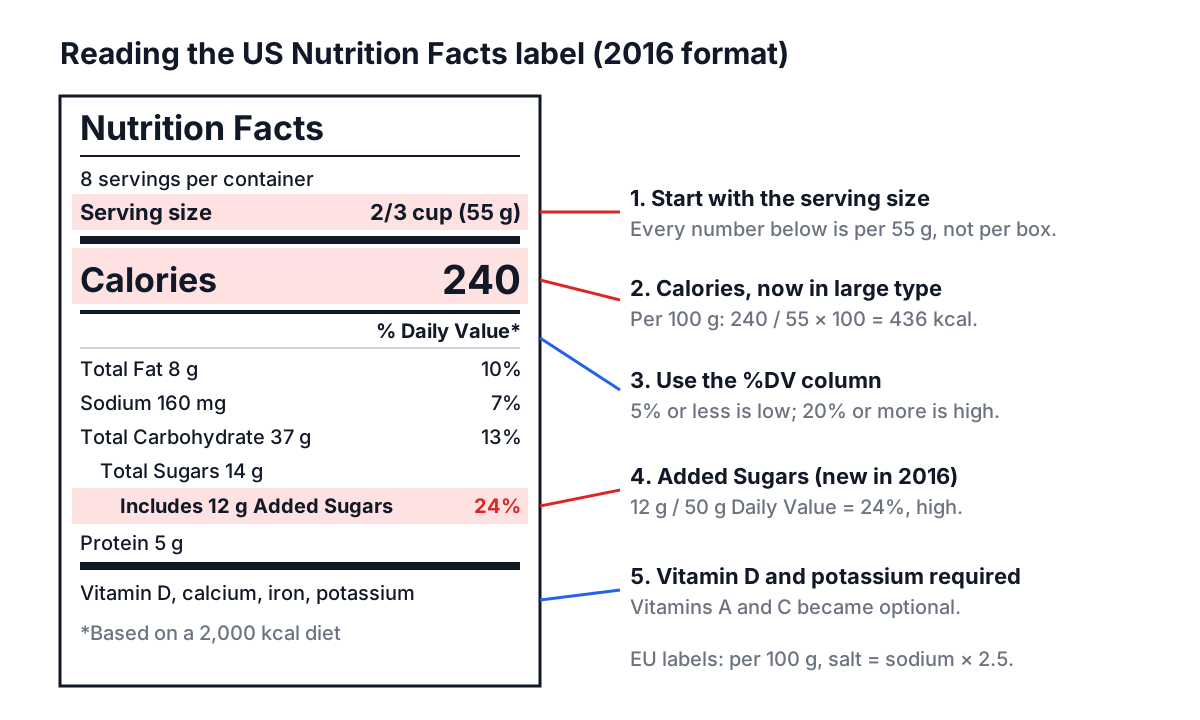
The FDA finalised a redesign of the Nutrition Facts label in May 2016, the first major update since the label became mandatory in the early 1990s. Large manufacturers had to comply by 1 January 2020 and smaller ones by 1 January 2021. The main changes:
| Change | Detail |
|---|---|
| Calories and servings | Calories in much larger, bold type; "servings per container" and serving size more prominent |
| Serving sizes | Updated to reflect what people actually eat, for example ice cream from 1/2 cup to 2/3 cup and a soda serving from 8 to 12 fl oz |
| Added sugars | New mandatory line in grams and %DV, against a Daily Value of 50 g |
| Calories from Fat | Removed, because the type of fat matters more than the amount |
| Nutrients required | Vitamin D and potassium now required (with calcium and iron); vitamins A and C now optional |
| Daily Values | Updated, for example sodium 2,300 mg, dietary fiber 28 g, vitamin D 20 mcg |
| Dual columns | Packages that could be eaten in one or several sittings show per serving and per package |
The %DV column is the quickest way to judge a number. FDA's own rule of thumb is that 5% DV or less of a nutrient per serving is low and 20% DV or more is high. Daily Values are based on a 2,000 kcal reference diet, so they are a yardstick rather than a personal target; the Calorie Calculator gives a more personal energy figure.
EU labels under Regulation 1169/2011
Regulation (EU) No 1169/2011 on the provision of food information to consumers has applied since 13 December 2014, and its mandatory nutrition declaration since 13 December 2016. Prepacked food must show, among other things:
- the name of the food and the ingredients list, in descending order of weight;
- the 14 regulated allergens, emphasised in the ingredients list (bold, capitals or a different colour);
- net quantity, a "use by" or "best before" date, and the name and address of the responsible business;
- a nutrition declaration per 100 g or per 100 ml giving energy (in kJ and kcal), fat, saturates, carbohydrate, sugars, protein and salt.
Two differences from US labels catch people out. First, EU labels declare salt, not sodium. Salt is calculated as sodium × 2.5. Second, the per-100 g basis is mandatory, which makes comparing two products straightforward; per-portion values are optional extras. Where %RI (reference intake) figures appear, they use an adult reference of 8,400 kJ / 2,000 kcal, 70 g fat, 20 g saturates, 260 g carbohydrate, 90 g sugars, 50 g protein and 6 g salt.
"Use by" is about safety and should not be ignored; "best before" is about quality, and food is often fine after it. The US has no equivalent federal rule for date labels except on infant formula.
A worked comparison
Take that granola label: a 55 g serving (2/3 cup), 240 kcal, 160 mg sodium, 12 g added sugars.
Added sugars %DV   12 g / 50 g          = 24%  (high: over 20%)
Sodium %DV         160 mg / 2,300 mg    = 7%
Per 100 g energy   240 / 55 × 100       = 436 kcal
EU salt per 100 g  160 mg × 2.5 = 0.4 g per 55 g, so 0.73 g per 100 g
The per-100 g line is what you would see on the same product in Europe. It also shows why comparing per serving can mislead: a competitor with a 40 g serving can look lower in sugar on the front while being identical per 100 g.
Front-of-pack claims: which ones mean something
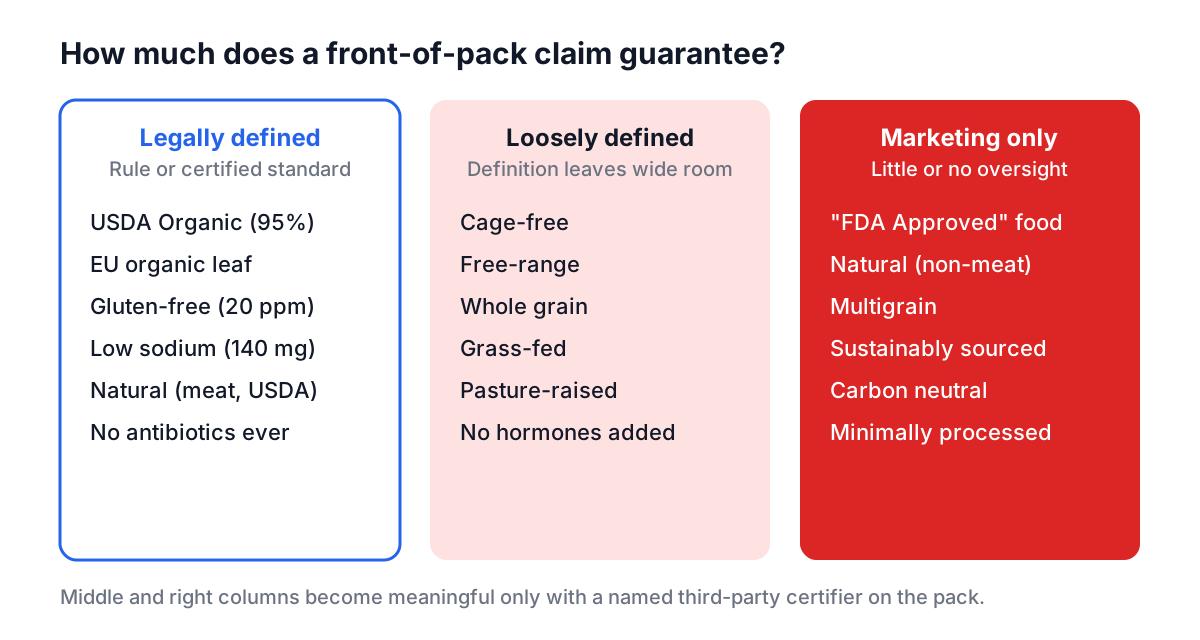
Front-of-pack wording ranges from tightly defined to almost meaningless. Roughly:
| Claim | Who defines it | What it means |
|---|---|---|
| Low sodium | FDA | 140 mg or less per reference serving |
| Gluten-free | FDA (2013), EU Reg. 828/2014 | Under 20 ppm gluten |
| USDA Organic | USDA National Organic Program | At least 95% organic ingredients, excluding water and salt |
| EU organic leaf | Regulation (EU) 2018/848 | At least 95% of agricultural ingredients organic |
| Cage-free / free-range eggs | USDA | No cages / some outdoor access |
| Natural (meat and poultry) | USDA FSIS | No artificial ingredients or added colour, minimal processing |
| Natural (other foods) | No formal rule | FDA policy only |
| Pasture-raised, sustainably sourced | No federal definition | Only meaningful with a named certifier |
| "FDA Approved" on a food | Nobody | The FDA does not approve individual foods |
"Made with organic ingredients" is a separate USDA tier: at least 70% organic and no USDA seal. On meat, "no hormones added" is allowed on beef with documentation, but because hormones are banned in US pork and poultry, a chicken label that says it must also state that federal regulations prohibit their use. The approved antibiotic wording is "raised without antibiotics" or "no antibiotics ever".
The FDA also issued an updated definition of "healthy" as a nutrient content claim in December 2024, based on food groups and limits on added sugars, sodium and saturated fat, with a multi-year compliance period.
Allergens in the US and EU
In the US the major food allergens are milk, eggs, fish, crustacean shellfish, tree nuts, peanuts, wheat, soybeans and, since 1 January 2023 under the FASTER Act, sesame. The EU list of 14 adds cereals containing gluten, celery, mustard, lupin, molluscs and sulphites above 10 mg/kg, among others. In both regions "may contain" precautionary statements are voluntary, so their absence does not mean a product is free of cross-contact.
Common mistakes
- Reading only the front. Claims are marketing within legal limits; the panel and ingredients are the facts.
- Ignoring servings per container. A 600 ml bottle may be one serving under the 2016 rule, or two on older or imported labels.
- Comparing per serving across brands. Use per 100 g, or convert.
- Confusing sodium and salt. 1 g of sodium is 2.5 g of salt.
- Assuming organic means pesticide-free or more nutritious. It limits synthetic inputs to an approved list and bans GMOs; nutrition is a separate question.
Using this in the shop
Start with the panel: servings, calories, then added sugars, sodium and saturated fat against the 5% and 20% markers. Then check the ingredients for anything you avoid. Only then read the front, and look up any claim you are unsure about in the Food Labeling Guide. If you are building a diet around protein or a calorie target, the protein guide and the TDEE guide show how to turn label numbers into a daily plan.