
The Golden Ratio in Design: The Maths, the Myths and Real Uses
Where φ = 1.618 comes from, its link to the Fibonacci sequence, how to split a length or a layout into golden sections, and which famous "golden" claims do not survive measurement.
· 9 min read

The golden ratio is a real and rather elegant piece of mathematics that has collected a large amount of folklore. It is the one proportion in which a whole relates to its larger part exactly as the larger part relates to the smaller, and that self-similarity makes it genuinely useful for laying out nested rectangles, splitting columns and building type scales. It is also claimed for temples, paintings, shells and logos that, measured carefully, do not show it. This post covers the maths, how to apply it to a layout and which famous claims hold up, with numbers you can reproduce in the Golden Ratio Calculator.
Where φ = 1.618 comes from
Divide a line into a longer part a and a shorter part b so that the whole is to the longer part as the longer part is to the shorter:
(a + b) / a = a / b = φ
Write r = a / b. The left side is 1 + b/a = 1 + 1/r, so the condition is 1 + 1/r = r, or
r² = r + 1 → r = (1 + √5) / 2 = 1.6180339887...
taking the positive root. Euclid gave the construction around 300 BC in the Elements (Book VI, Definition 3) under the name "extreme and mean ratio". The names "golden section" and "golden ratio" are much later, from the nineteenth century, and the symbol φ was adopted in the early twentieth century.
The quadratic gives φ some convenient identities that the calculator relies on:
φ² = φ + 1 = 2.618034
1/φ = φ - 1 = 0.618034
1/φ² = 1 - 1/φ = 0.381966
So splitting a total T into golden parts needs no iteration: the larger part is T/φ (61.803% of T) and the smaller is T/φ² (38.197%).
The Fibonacci connection
The Fibonacci sequence starts 1, 1 and adds the previous two terms: 1, 1, 2, 3, 5, 8, 13, 21, 34, 55... The ratio of consecutive terms approaches φ, alternating above and below it:
 5 / 3   = 1.6667
 8 / 5   = 1.6
13 / 8   = 1.625
21 / 13  = 1.6154
34 / 21  = 1.6190
55 / 34  = 1.6176
By the 20th term, 6765, the ratio 6765 / 4181 = 1.61803396 is within 1e-7 of φ. The reason is the same recurrence: if F(n+1) / F(n) settles on a limit r, then F(n+2) = F(n+1) + F(n) forces r = 1 + 1/r, the golden equation. The calculator's Fibonacci table shows the convergence term by term.
This is also why Fibonacci numbers make good practical stand-ins for φ: a 34 x 21 rectangle is within 0.1% of golden and has whole-number sides.
The golden rectangle and its spiral
A rectangle with sides in the ratio φ : 1 has a unique property. Cut off a square on the short side and the rectangle that remains is again golden. Repeat and you get an endless sequence of shrinking squares, each turned a quarter turn from the last.
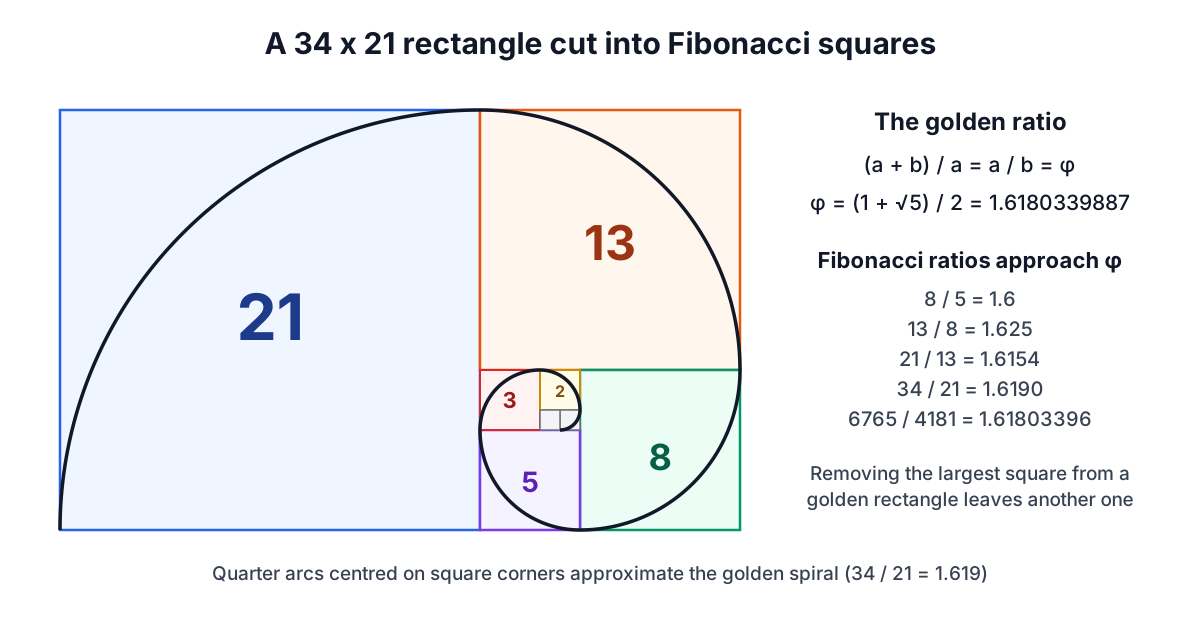
Draw a quarter circle in each square and the arcs join into a spiral. Strictly, the quarter-circle construction is an approximation: the true golden spiral is a logarithmic spiral whose radius grows by φ every quarter turn, a factor of φ⁴ = 6.854 per full turn.
To construct a golden rectangle by hand, draw a square, mark the midpoint of its base, and swing an arc centred on that midpoint through the right-hand top corner, down to the base line extended to the right. The radius is √(0.5² + 1²) = 1.118 sides, so the arc lands 0.5 + 1.118 = 1.618 sides from the start of the base, φ times the square's side. For a given width, the calculator gives the height directly: a 960 px wide golden rectangle is 960 / φ = 593.31 px tall.
Worked examples: splitting lengths and layouts
The calculator works from any one of the three lengths:
total 100    → larger 61.803, smaller 38.197
larger 100   → smaller 100/φ = 61.803, total 100φ = 161.803
smaller 100  → larger 100φ = 161.803, total 100φ² = 261.803
For a page, the common use is a two-column layout. Split a 960 px container with no gutter:
main  = 960 / φ        = 593.31 px
side  = 960 - 593.31   = 366.69 px
With a gutter, the gutter comes out first and the rest is split. A 1200 px container with a 24 px gutter:
usable = 1200 - 24      = 1176 px
main   = 1176 / φ       = 726.81 px   (60.57% of 1200)
side   = 1176 - 726.81  = 449.19 px   (37.43% of 1200)
In CSS Grid this is simply grid-template-columns: 1.618fr 1fr; gap: 24px;, because fr units share out the space left after the gap. That version also stays golden as the container resizes, which fixed pixel widths do not. The Ratio Calculator handles other proportions if 1.618 : 1 turns out too lopsided, as it often does for a sidebar.
The same ratio can drive a type scale, where each heading is φ times the one below. From a 16 px body that gives 25.89, 41.89 and 67.77 px: steps large enough for a poster or a landing page and usually too coarse for an interface. The modular type scale guide compares it with gentler ratios in the Type Scale Calculator.
Myths that do not survive measurement
Golden ratio claims are easy to make because any complex object contains many lengths, and some pair of them will be close to 1.6. A fair test asks whether the ratio was chosen in advance, which points were measured, and how close is close.
The Parthenon. Diagrams often overlay a golden rectangle on the facade. The mathematician George Markowsky examined this in "Misconceptions about the Golden Ratio" (College Mathematics Journal, 1992) and noted that the overlays leave parts of the building, such as the steps, outside the rectangle, and that published dimensions of the building vary depending on which reference points are used. Measured overall proportions he cited come out well away from 1.618. Mario Livio, in his book on the golden ratio, concludes that the claim cannot be supported with confidence. There is no ancient record that the builders intended it.
The Mona Lisa and Leonardo. Leonardo did draw the illustrations for Luca Pacioli's 1509 book De divina proportione, which is about the golden ratio, so the link is understandable. But there is no documentation that he used it to compose the Mona Lisa, and rectangles drawn on the painting depend on where the analyst chooses to put the edges.
The nautilus shell. The chambered nautilus is a genuine logarithmic spiral, which is why it is constantly paired with the golden spiral. The spiral is not golden. When Clement Falbo measured shells in the California Academy of Sciences collection, their spirals fitted rectangles with ratios around 1.33, ranging from about 1.24 to 1.43, not 1.618. A nautilus spiral roughly triples in radius per turn, against 6.85 for a golden spiral.
Aesthetic preference. Gustav Fechner reported in 1876 that people preferred golden rectangles, and the result is still repeated. Later experiments have not found a consistent preference for exactly φ over nearby ratios. Many everyday rectangles that are called golden are not: an ISO/IEC 7810 bank card is 85.60 x 53.98 mm, a ratio of 1.586, and ISO paper uses √2 = 1.414.
None of this makes the ratio useless. It means φ is a design choice you can make deliberately, not a law that good design obeys.
Common mistakes
- Rounding φ to 1.6 and calling it golden. 1.6 is 8 : 5. That is a fine ratio, but quote it as 8 : 5.
- Splitting before removing gutters and padding. The columns will not be in ratio φ if the gutter is shared out with them.
- Forcing every proportion through φ. A page where margins, columns, type and images all use one ratio tends to feel rigid. Use it where a clear dominant and subordinate pair helps.
- Drawing overlays loosely. A spiral overlay with a thick stroke on a busy image will appear to fit almost anything.
When the simple model breaks down
A golden split assumes one dominant element and one subordinate element. Layouts with three or more columns, or responsive grids that collapse to one column on phones, need their own rules; at narrow widths a 38% sidebar is too thin to hold content and should stack instead. Content length usually decides column widths more than proportion does: a main column sized for a comfortable line length of roughly 60 to 75 characters reads better than one sized for φ. Physical products are constrained by standards, as the bank card and the ISO 216 paper sizes show. Treat the golden ratio as one good proportion among several, check it against readability with tools like the Contrast Checker and PX to REM Converter, and keep it where it earns its place.