
How Long Does It Take to Heat Water? Tanks, Kettles and Recovery Rate
The energy behind heating water, the 8.34 rule, electric versus gas efficiency, why two elements do not halve the time, recovery rate and what makes real tanks slower.
· 9 min read
"How long until there is hot water again?" has a precise answer once you know four numbers: how much water, how much hotter it needs to get, how fast the heater delivers energy, and how much of that energy ends up in the water. This post works through the physics behind the Water Heating Time Calculator, using a standard 50 gallon tank and a kettle as examples, and explains why real tanks are a little slower than the ideal figure.
The energy a tank of water needs
Heating water is sensible heating, so the energy is mass times specific heat times temperature rise:
Q = m x c x ΔT
For water, c is about 4,186 J/kg·K. Mass is volume times density, which is close to 1 kg per litre but not exactly: about 0.999 kg/L at 15 °C and 0.983 kg/L at 60 °C. Since a tank is filled with cold water, the calculator uses the density at the starting temperature, from the Kell equation.
In US units the same calculation becomes the familiar plumbing rule. A gallon of cold water weighs about 8.34 lb, and one BTU raises one pound by one degree Fahrenheit, so
BTU = gallons x 8.34 x ΔT(°F)
For a 50 gallon tank heated from 55 °F to 120 °F:
50 x 8.34 x 65 = 27,105 BTU = 7.94 kWh
The calculator's SI route gives the same 7.94 kWh. A useful pair of rules of thumb: heating 1,000 litres by 1 °C takes 1.16 kWh, and heating one US gallon by 1 °F takes 0.00244 kWh.
From energy to time
The heater delivers energy at its rated power, and some fraction of that ends up in the water. The heat-up time is therefore
time = Q / (P x η)
where P is the heater power and η the efficiency. For the 50 gallon tank with a 4,500 W element:
7.94 kWh / (4.5 kW x 0.98) = 1.80 h = 1 h 48 min
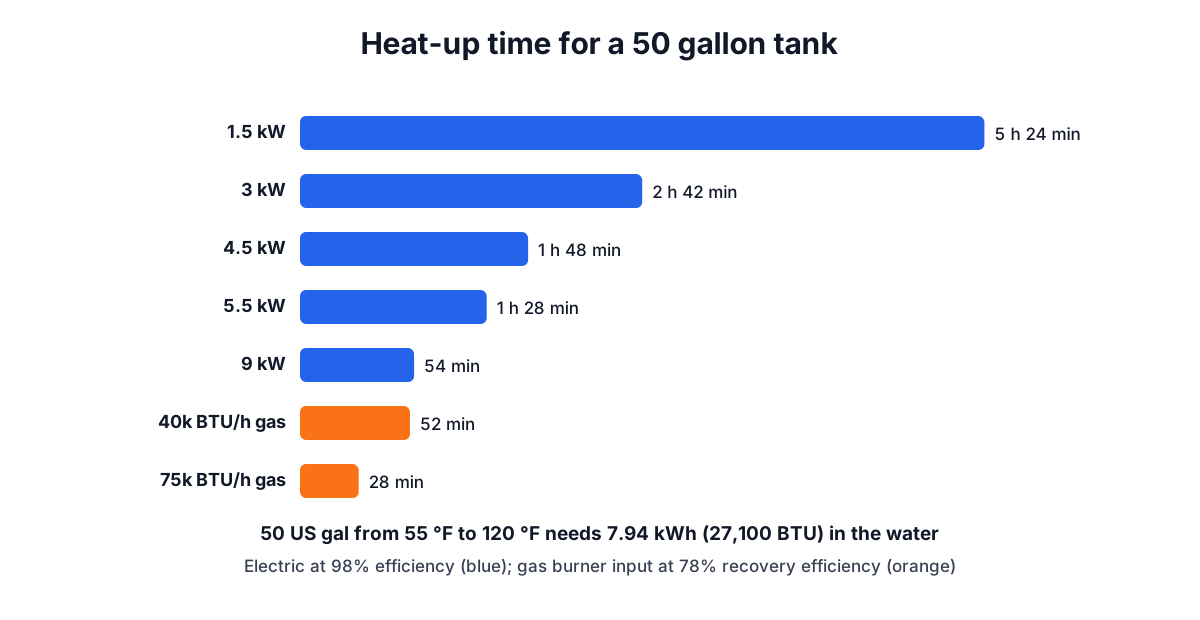
Time is inversely proportional to power, so doubling the element halves the time. Electric elements in residential tanks are usually 3,500 to 5,500 W because of the circuit size, which caps how fast an electric tank can recover.
There is a common misunderstanding here. Most US electric water heaters have two elements of, say, 4,500 W each, but they are wired non-simultaneous: a thermostat lets the upper element heat the top of the tank first, then switches to the lower element. Only one runs at a time, so the heating rate is 4,500 W, not 9,000 W. The calculator's hint reminds you to use one element's rating.
Efficiency: electric, gas and kettles
An electric element is immersed in the water, so practically all of its electrical input becomes heat in the tank. The 98% default leaves a little for losses through the tank wall while heating. A heat pump water heater is different again: it moves heat from the air instead of generating it, with a coefficient of performance of roughly 2 to 4. For those, divide the useful energy by the COP to get the electricity used.
A gas water heater burns fuel under the tank and loses heat up the flue. Its nameplate input rating, say 40,000 BTU/h, is fuel energy in. The recovery efficiency, typically 76 to 82% for a standard atmospheric gas tank and over 90% for condensing models, is the fraction that reaches the water. With 78%:
delivered = 40,000 x 0.78 = 31,200 BTU/h
time      = 27,105 / 31,200 = 0.87 h = 52 min
The gas tank recovers about twice as fast as the electric one because 40,000 BTU/h of fuel input is 11.7 kW, against 4.5 kW for the element. Energy bought is 27,105 / 0.78 = 34,750 BTU, or 0.347 therms, since one therm is 100,000 BTU.
Kettles lose heat from the body, lid and spout, and some energy goes into heating the kettle itself; 80 to 90% is a reasonable range. A 1.7 L kettle at 3 kW and 90%, from 15 °C to 100 °C:
Q    = 1.698 kg x 4,186 x 85 = 604 kJ
time = 604 / (3 x 0.9) = 224 s = 3 min 44 s
Recovery rate
US manufacturers rate tank water heaters by recovery: how many gallons per hour they can heat through a stated rise, often 90 °F. It is the same physics turned around:
recovery (gal/h) = delivered BTU/h / (8.34 x ΔT)
The 4.5 kW element delivers 4,500 x 0.98 x 3.412 = 15,047 BTU/h, which heats 15,047 / (8.34 x 65) = 27.8 gal/h through a 65 °F rise. The 40,000 BTU/h gas burner gives 57.6 gal/h through the same rise. Recovery together with the tank volume sets the first-hour rating on the EnergyGuide label, which is the better number for comparing how many back-to-back showers a heater can supply.
Why real heat-up takes longer
The calculation gives the ideal time for a well-mixed body of water with a constant heat input. Several effects stretch it in practice:
- Standby loss. Tanks lose heat through their insulation all the time. A well-insulated tank loses perhaps 1 to 2 °F per hour; an old one more. During a long heat-up, part of the heater's output just replaces that loss.
- Stratification and mixing. Hot water rises. An element near the bottom heats the whole tank through convection, but during a draw, incoming cold water mixes with the hot. Only about 70% of a tank's nominal volume is usable at full temperature in many cases.
- Scale. In hard water areas, scale on elements and on the bottom of gas tanks insulates the heat source and lowers effective efficiency.
- Inlet temperature. Mains water can be 5 to 10 °C (40 to 50 °F) in winter and 20 °C (68 °F) or more in summer, which changes the required temperature rise significantly.
- Nominal versus actual volume. A tank sold as 50 gallons often holds 45 to 48.
Storage temperature also has a safety side. Water stored at 60 °C (140 °F) limits Legionella growth, but water at that temperature can scald in seconds, so a thermostatic mixing valve at the outlet is the usual arrangement.
Putting a price on it
Cost per heat-up is energy bought times unit price. The 50 gallon electric heat-up uses 7.94 / 0.98 = 8.10 kWh; at $0.17 per kWh that is $1.38. The gas version uses 0.347 therms; at $1.50 per therm it is $0.52. Over a year, the same comparison applies to all the hot water you use, which is why fuel choice often matters more than tank efficiency. The Electricity Cost Calculator turns any kWh figure into a running cost.
For other heating problems, the Specific Heat Calculator handles any material and phase changes, explained in the post on specific and latent heat. If you are sizing a solar diversion system to run an immersion heater, the Solar Panel Calculator gives the array size, and the post on water pipe sizing covers the pipework that carries the hot water away.