
Water Pipe Sizing by Velocity and Hazen-Williams Friction Loss
Nominal size versus inside diameter for copper, PEX and Schedule 40, velocity limits for cold and hot water, the Hazen-Williams formula and C values, and a full sizing example.
· 10 min read
Two questions decide the size of a water pipe. Is the water moving slowly enough to be quiet and not erode the pipe? And is the pressure lost to friction small enough that the far fixture still gets a useful flow? The first is a velocity limit, the second a friction calculation. This post covers both, along with the detail that trips up most first attempts: a nominal pipe size is not its inside diameter. The numbers come from the Water Pipe Size Calculator.
Nominal size is not inside diameter
Every common water pipe material has its own sizing system, and the same nominal size gives a different bore in each.
Copper tube (ASTM B88) has an outside diameter 1/8 in larger than its nominal size: 3/4 in tube is 0.875 in OD. Types K, L and M share that OD and differ only in wall thickness. Type M is the thinnest wall and largest bore, type K the thickest. For 3/4 in, the inside diameters are 0.745 (K), 0.785 (L) and 0.811 (M).
PEX (ASTM F876) uses the same copper tube size (CTS) outside diameters, but with a standard dimension ratio of 9: the wall is one ninth of the OD, with a minimum of 0.070 in. For 3/4 in PEX the minimum wall is 0.097 in, leaving an inside diameter of 0.875 − 2 x 0.097 = 0.681 in. That is 13% smaller than type L copper of the same nominal size, with 25% less flow area.
Schedule 40 PVC and steel (ASTM D1785, ASME B36.10) follow iron pipe size, where nominal size is neither the OD nor the ID. 3/4 in Schedule 40 has a 1.050 in OD and a 0.113 in wall, so its ID is 0.824 in.
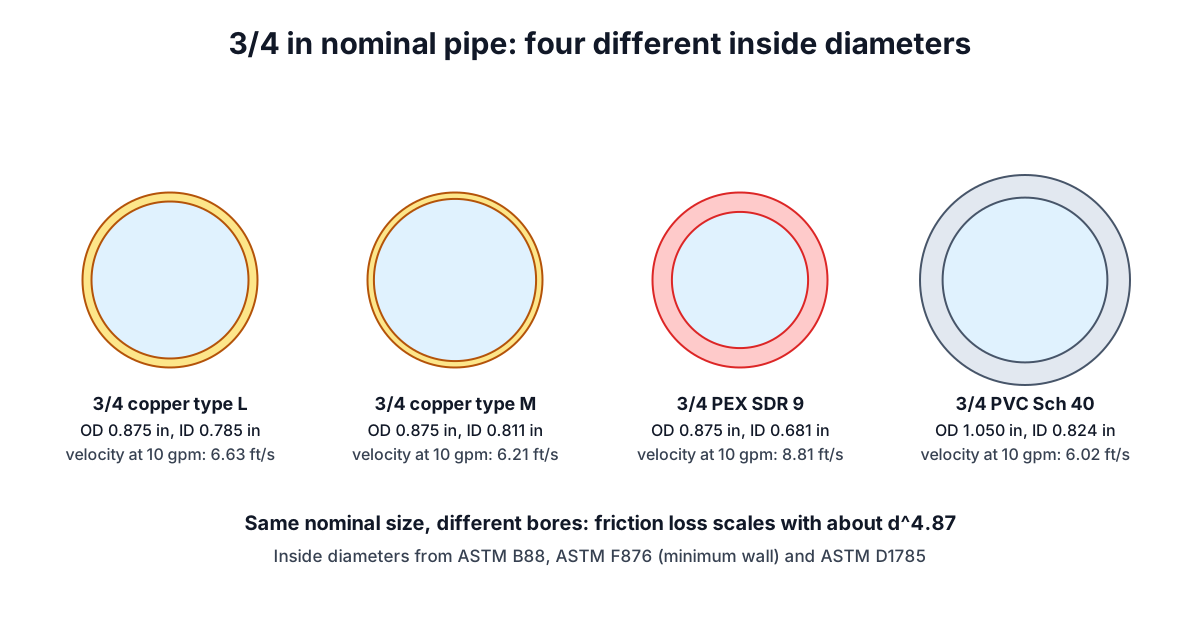
Because friction loss depends on roughly the fifth power of diameter, those small differences in bore become large differences in pressure loss. The calculator stores the published inside diameters for each material so it can pick a real size and calculate with its real bore.
Velocity limits and the minimum bore
From continuity, flow equals area times velocity. Set a maximum velocity and the minimum inside diameter follows:
d_min = √(4Q / πV_max)
US units: d (in) = √(0.4085 x gpm / V (ft/s))
What velocity? For copper systems the Copper Development Association and the Uniform Plumbing Code use 8 ft/s (2.4 m/s) for cold water and 5 ft/s (1.5 m/s) for hot water up to 140 °F (60 °C). Above 140 °F the CDA recommends 2 to 3 ft/s, because hot water erodes copper faster, especially just downstream of fittings where local velocities are higher. Many designers keep residential branches nearer 4 ft/s for quiet and to reduce water hammer when valves close quickly.
For the calculator's default of 10 gpm at 8 ft/s:
d_min = √(0.4085 x 10 / 8) = 0.715 in
The smallest type L copper tube with at least that bore is 3/4 in, at 0.785 in. The water then runs at 0.4085 x 10 / 0.785² = 6.63 ft/s. In PEX, 3/4 in (0.681 in) is too small, so the calculator picks 1 in PEX (0.875 in) at 5.34 ft/s.
Friction loss with Hazen-Williams
Passing the velocity check does not guarantee enough pressure at the end of the run. Friction loss for water in pressure pipes is commonly calculated with the Hazen-Williams formula, an empirical fit published in 1905 that remains standard in plumbing and fire sprinkler design:
US:  h (ft per 100 ft) = 0.2083 x (100 / C)^1.852 x gpm^1.852 / d^4.8655
SI:  h / L (m per m)  = 10.67 x Q^1.852 / (C^1.852 x d^4.8704)
with d in inches (US) or metres (SI) and Q in m³/s. The roughness coefficient C is higher for smoother pipe. Typical values are about 150 for PVC, CPVC and PEX, 140 for copper, 120 for new steel, and 100 or lower for old, tuberculated steel or cast iron. Convert head to pressure with 0.433 psi per foot of water (9.80 kPa per metre).
For 10 gpm through 3/4 in type L copper with C = 140:
h = 0.2083 x (100/140)^1.852 x 10^1.852 / 0.785^4.8655 ≈ 25.6 ft per 100 ft
  ≈ 11.1 psi per 100 ft
That is a lot. A house on 50 psi mains with a 100 ft equivalent run to the farthest shower, plus a story or two of rise at 0.433 psi per foot, a meter and a pressure regulator, may not have enough left for a fixture that needs 20 psi. Going up to 1 in type L (1.025 in ID) at the same flow drops the loss to about 3.0 psi per 100 ft and the velocity to 3.9 ft/s. Because loss scales with flow to the 1.85 power and diameter to the minus 4.87 power, one pipe size often cuts friction by 60 to 75%.
A worked sizing example
Size a hot water line carrying 10 gpm, 60 ft long with fittings adding an estimated 30 ft of equivalent length, in copper type L.
- Velocity limit for hot water below 140 °F: 5 ft/s. Minimum bore √(0.4085 x 10 / 5) = 0.904 in.
- Smallest type L tube at or above 0.904 in: 1 in (1.025 in ID). Velocity 3.89 ft/s.
- Friction at C = 140: about 3.0 psi per 100 ft. Over 90 ft of equivalent length, 2.7 psi.
- Check the available pressure at the fixture after elevation and other losses.
The calculator does steps 1 to 3 and lists the same flow in copper type M, PEX, PVC and steel for comparison.
Where these formulas stop being reliable
- Hazen-Williams has limits. It was fitted to water near room temperature in turbulent flow in pipes larger than about 2 in. For small tubes, hot water, other liquids, or laminar flow, the Darcy-Weisbach equation with the Colebrook friction factor is more accurate. The Pipe Pressure Drop Calculator and the Reynolds Number Calculator cover that approach.
- Peak demand is not the sum of fixtures. Plumbing codes size water supply from fixture units with a probability-based demand curve (Hunter's curve in the IPC and UPC, and newer methods such as the Water Demand Calculator in recent UPC editions). Use the code method to get the design flow before sizing.
- Fittings and valves add loss. Elbows, tees, valves and meters add equivalent length; a rough allowance of 25 to 50% of the straight length is common for domestic layouts. PEX insert fittings narrow the bore at each joint, so manifold layouts with home runs often work better than long trunk and branch runs in PEX.
- Codes set minimum sizes. Water service, distribution and fixture supply sizes have code minimums regardless of the calculation.
For related checks, the Flow Rate Calculator converts between flow, velocity and area, and the Pump Power Calculator turns head loss into pump power when a booster or circulator is involved. The post on thermal expansion covers how far these pipes move when they carry hot water, and the post on how long it takes to heat water covers the heater at the other end.