
Specific Heat and Latent Heat Explained: Q = mcΔT and the Heating Curve
What specific heat measures, where the calorie and BTU come from, why boiling takes five times the energy of heating, and how to solve calorimetry problems without unit slips.
· 9 min read
Put the same burner under a kilogram of water and a kilogram of aluminium and the aluminium is too hot to touch long before the water is warm. Keep heating the water and its temperature stops at 100 °C for a long time while it boils away. Both observations come from two properties: specific heat, which sets how much energy a degree of temperature costs, and latent heat, which sets the energy of a phase change. This post explains both, with the numbers behind the Specific Heat Calculator.
What specific heat measures
Specific heat capacity c is the energy needed to raise one kilogram of a substance by one kelvin. The heat for any mass and temperature change follows directly:
Q = m x c x ΔT
with Q in joules, m in kilograms, c in J/kg·K and ΔT in kelvin (the same size as a degree Celsius). Q is positive when heat goes in and negative when it comes out.
The calculator's default heats a 2 kg pot of water from 20 °C to 95 °C:
Q = 2 x 4,186 x 75 = 627,900 J = 627.9 kJ = 0.1744 kWh
The same equation solves for any one unknown. Rearranged: m = Q / (cΔT), c = Q / (mΔT) and ΔT = Q / (mc). If 8,970 J warms 1 kg of an unknown metal by 10 K, its specific heat is 897 J/kg·K, which identifies it as aluminium.
Typical values near room temperature, in J/kg·K:
| Substance | c | Substance | c |
|---|---|---|---|
| Water (liquid) | 4,186 | Concrete | 880 |
| Ethanol | 2,440 | Glass | 840 |
| Ice | 2,090 | Granite | 790 |
| Steam (100 °C) | 2,010 | Carbon steel | 490 |
| Wood (dry, typical) | 1,700 | Iron | 449 |
| Air (cp) | 1,005 | Copper | 385 |
| Aluminium | 897 | Lead | 129 |
Water's value is unusually high, which is why it is used for heating systems, cooling loops and thermal storage, and why coastal climates are milder than inland ones.
Calories, BTUs and the units that come from water
Two familiar energy units were originally defined by heating water. One calorie was the heat to raise one gram of water by one degree Celsius, and one British thermal unit the heat to raise one pound of water by one degree Fahrenheit. Because water's specific heat varies slightly with temperature, these definitions drifted, and both units are now fixed in joules:
1 thermochemical calorie   = 4.184 J
1 food Calorie (kcal)      = 4,184 J
1 International Table BTU  = 1,055.056 J
1 BTU/lb·°F                = 4,186.8 J/kg·K
1 kWh                      = 3,600,000 J
This is why water's specific heat is so often quoted as "1": 1 cal/g·°C or 1 BTU/lb·°F. The modern SI value, 4,186 J/kg·K, is within a fraction of a percent of both. Water's true specific heat dips to about 4,179 near 35 °C and is about 4,216 at 100 °C, a spread of under 1% that most calculations safely ignore.
For gases there are two specific heats. cp applies when the gas can expand as it is heated (air in a duct, an open room), cv when the volume is fixed (a sealed rigid tank). For air cp is about 1,005 J/kg·K and cv about 718. Use cp for HVAC work.
Latent heat and the heating curve
At a phase change the temperature stops rising. The energy goes into breaking the bonds that hold the solid or liquid together instead of into faster molecular motion. The heat is
Q = m x L
For water at atmospheric pressure, the latent heat of fusion is 334 kJ/kg and the latent heat of vaporization at 100 °C is 2,256 kJ/kg.
Take 1 kg of ice at −10 °C all the way to steam at 120 °C. The calculator splits it into five steps:
warm ice    −10 → 0 °C     1 x 2,090 x 10   =    20.9 kJ
melt ice    at 0 °C        1 x 334,000      =   334.0 kJ
warm water  0 → 100 °C     1 x 4,186 x 100  =   418.6 kJ
boil water  at 100 °C      1 x 2,256,000    = 2,256.0 kJ
heat steam  100 → 120 °C   1 x 2,010 x 20   =    40.2 kJ
total                                          3,069.7 kJ
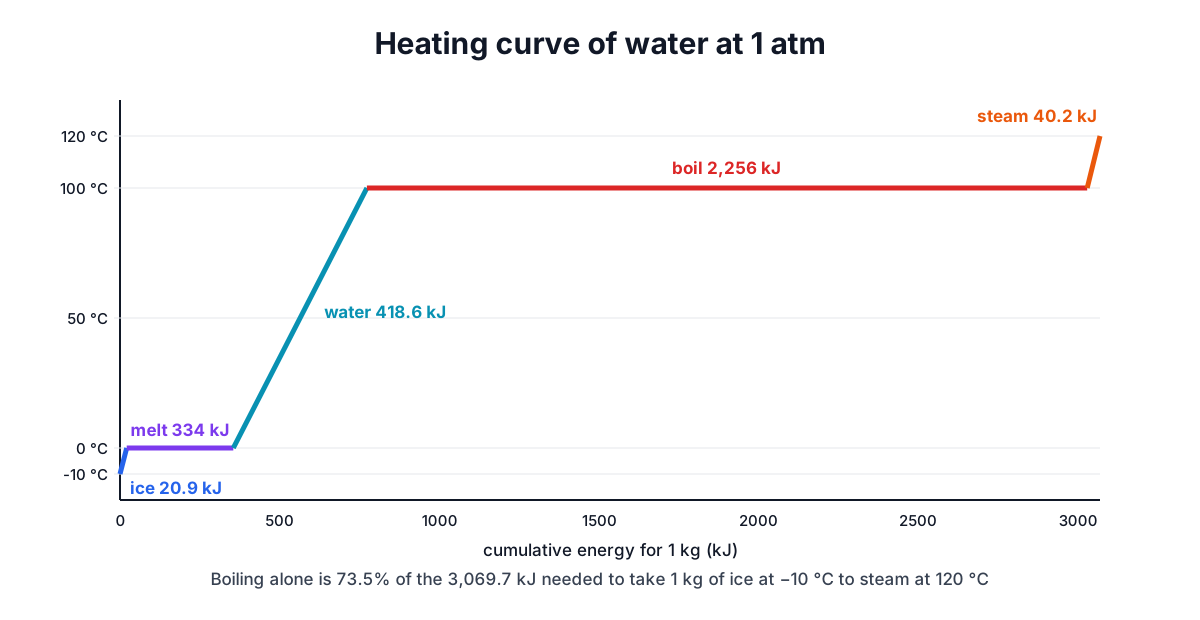
Boiling is 73.5% of the total. It takes more than five times the energy to turn water at 100 °C into steam than to heat it from freezing to boiling. This is why steam carries so much heat in heating systems and why a steam burn is worse than a hot-water burn at the same temperature: the steam gives up 2,256 kJ/kg as it condenses on the skin before it starts cooling.
Going the other way, a freezer must remove 334 kJ for every kilogram of water it turns to ice, on top of the sensible cooling. Ice packs and ice storage systems use this to hold a steady 0 °C.
Common mistakes
- Mixing temperatures and differences. A 10 °C change is a 10 K change, but a 10 °F change is only 5.56 K. Converting a temperature difference with the full °F to °C formula (subtracting 32) gives nonsense. The calculator takes start and end temperatures and handles this for you.
- Forgetting a phase change. Warming water from 20 °C to 110 °C is not 4,186 x 90. Crossing 100 °C at atmospheric pressure means boiling, and the latent heat dominates. The calculator warns when a water calculation crosses 0 or 100 °C without phase changes switched on.
- Using mass where volume is given. One litre of water is close to 1 kg, but one litre of olive oil is about 0.91 kg and one litre of air about 1.2 g. Convert volume to mass with the density first.
- Expecting all the heat to reach the material. Q is the heat absorbed. A stove, kettle or heater delivers more than that because some is lost. Divide by an efficiency to get energy supplied, as in the Water Heating Time Calculator.
- Assuming c is constant over huge ranges. Specific heat of metals rises with temperature and changes sharply near phase transitions. For furnace or cryogenic work, integrate tabulated c(T) data instead.
Where the simple model stops
Q = mcΔT assumes uniform temperature throughout the material, no chemical reaction, and constant pressure for phase changes. Large objects heat from the outside in, so their surface and core temperatures differ during heating; that is a transient conduction problem. Boiling temperature and latent heat depend on pressure: at 2 bar water boils at about 120 °C with a latent heat of about 2,200 kJ/kg, and in a pressure cooker or a steam boiler those pressure-dependent values from steam tables apply.
For heat moving between two flowing streams rather than into a batch, the LMTD Calculator and its post on log mean temperature difference take over. For heat leaving a building rather than entering a material, see the post on U-values and heat loss. The Unit Converter handles any energy unit not on the calculator.