
Hydrostatic Pressure at Depth and the Force on Walls and Gates
Why p = ρgh, gauge versus absolute pressure, the numbers to remember for water and seawater, and how to find the resultant force and centre of pressure on a wall.
· 9 min read

Fluid statics is the one part of fluid mechanics with no velocity, no friction and no empirical coefficients, so the answers are exact as long as the density is right. It still trips people up in two places: mixing gauge and absolute pressure, and working out where the force on a wall acts. This guide covers the physics behind the Hydrostatic Pressure Calculator: where p = ρgh comes from, the handy numbers for water and seawater, gauge versus absolute pressure, layered liquids, and the resultant force and centre of pressure on a vertical wall or gate.
Why pressure grows with depth
Take a thin horizontal slice of liquid at rest. The pressure underneath it must hold up the pressure above it plus its own weight. Shrinking the slice to zero thickness gives:
dp/dz = ρ g (z measured downward)
For a liquid of constant density this integrates to:
p = p_surface + ρ g h
where h is the vertical depth below the free surface. Nothing else enters: not the width of the tank, not its shape, not the amount of liquid. Blaise Pascal made the point in the 1640s with the demonstration that a tall thin tube of water fitted to a barrel could burst it. A narrow standpipe and a reservoir with the same depth exert the same pressure at the bottom. The total force on the base does differ, because force is pressure times area.
Numbers worth remembering
With standard gravity, 9.80665 m/s²:
| Liquid | Density (kg/m³) | Pressure per metre | Pressure per foot |
|---|---|---|---|
| Fresh water, 4 °C | 1000 | 9.81 kPa | 0.433 psi |
| Fresh water, 20 °C | 998.2 | 9.79 kPa | 0.432 psi |
| Seawater (typical) | 1025 | 10.05 kPa | 0.444 psi |
| Diesel | 835 | 8.19 kPa | 0.362 psi |
| Mercury, 20 °C | 13,546 | 132.8 kPa | 5.87 psi |
So 10 m of fresh water is about 98 kPa, roughly one atmosphere, and 2.31 ft of water is one psi. Seawater density varies with salinity and temperature, typically 1020 to 1030 kg/m³ at the surface, so 1025 kg/m³ is a reasonable design value. Divers use the rule that each 10 m (33 ft) of seawater adds one atmosphere. At 10 m the gauge pressure is 100.5 kPa and the absolute pressure about 202 kPa, double the surface value.
Gauge versus absolute pressure
Absolute pressure is measured from a perfect vacuum. Gauge pressure is measured from the local atmosphere, so an open tank's surface is zero gauge.
p_abs = p_gauge + p_atm
Standard sea-level atmosphere is 101.325 kPa (14.696 psi, 1.01325 bar). It falls with altitude, to roughly 84 kPa at 1,500 m, and changes a few percent with weather.
Most pressure gauges, tank ratings and pipe pressure classes are gauge. Thermodynamic properties, vapour pressure and NPSH calculations need absolute. Instruments are often marked "psig" and "psia" or "barg" and "bara" to make the difference explicit. In a closed tank with gas above the liquid, replace p_atm with the gas pressure. The calculator lets you edit the surface pressure for exactly this reason.
Layered liquids
When liquids of different density sit in layers, add the contribution of each layer:
p_bottom = p_surface + Σ ρᵢ g hᵢ
Two metres of oil at 870 kg/m³ over three metres of water gives 17.1 + 29.4 = 46.5 kPa gauge at the bottom. A pressure-based level transmitter in that tank cannot tell the two apart unless it knows where the interface is, which is why interface measurement uses two transmitters or a displacer. Manometers rely on the same sum: the difference in height of a liquid column of known density measures a pressure difference.
Force on a vertical wall or gate
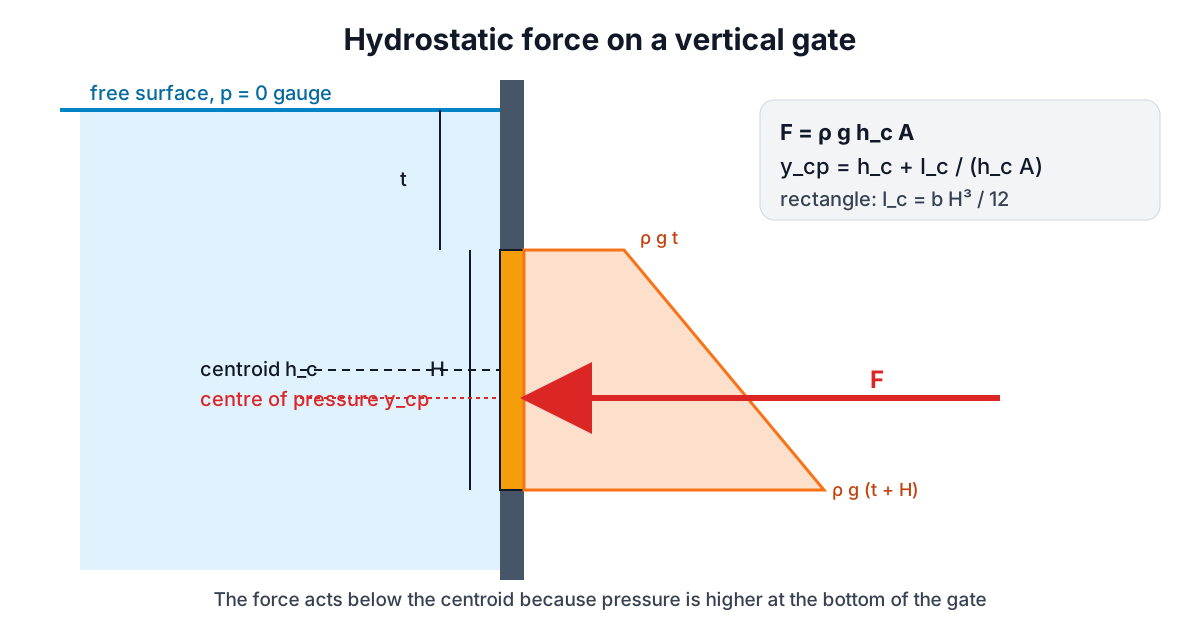
Pressure acts at right angles to a surface and increases with depth, so on a vertical wall it forms a triangular or trapezoidal distribution. The resultant force is the average pressure times the area, and for a plane surface the average pressure is the pressure at the centroid:
F = ρ g h_c A
where h_c is the depth of the centroid. Because the bottom of the wall sees more pressure than the top, the force acts below the centroid, at the centre of pressure:
y_cp = h_c + I_c / (h_c A)
I_c is the second moment of area of the surface about a horizontal axis through its centroid. For a rectangle of width b and height H, I_c = bH³/12.
Two cases cover most walls and gates.
Wall from the free surface down (top edge at the surface). Here h_c = H/2 and the distribution is a triangle:
F = ρ g b H² / 2, acting at 2H/3 below the surface
A 2 m wide, 3 m tall wall holding water to its top: F = 1000 × 9.80665 × 2 × 9 / 2 = 88.3 kN, acting 2.0 m down (1.0 m above the base). Note that F grows with the square of depth. Double the water depth and the force on the wall quadruples, while the overturning moment about the base grows eightfold.
Submerged gate (top edge at depth t). Then h_c = t + H/2. For a 1 m wide, 2 m tall gate whose top is 4 m below the surface: h_c = 5 m, F = 1000 × 9.80665 × 5 × 2 = 98.1 kN, and y_cp = 5 + (1 × 8/12) / (5 × 2) = 5.067 m. The deeper the gate, the closer the centre of pressure moves to the centroid, because the pressure becomes more uniform over its height.
In US units the same 4 ft wide, 6 ft tall gate with its top 2 ft under water at 62.4 lb/ft³ carries about 7,490 lbf at 5.6 ft below the surface.
Why gauge pressure for walls? Because the atmosphere usually presses on both faces and cancels out. If one side is sealed and evacuated, or the tank is pressurised, include the extra pressure times the area.
Worked example with the calculator
A rectangular steel water tank is 3 m deep. The designer wants the pressure at the base and the load on one 2 m wide side panel.
- Fresh water at 20 °C, 998.2 kg/m³, depth 3 m.
- Base pressure: 998.2 × 9.80665 × 3 = 29.4 kPa gauge, 130.7 kPa absolute.
- Side panel 2 m × 3 m from the top: F = 998.2 × 9.80665 × 1.5 × 6 = 88.1 kN at 2.0 m depth.
- For stiffener design the line load at the base is ρgH × width per metre of height; the bottom of the panel carries the most.
The Tank Volume Calculator gives the contents for the same tank, and the Beam Deflection Calculator can check a stiffener under the resulting load, using a triangular or uniform approximation.
Common mistakes
- Using slant length instead of vertical depth. Pressure depends only on vertical distance below the surface.
- Mixing gauge and absolute when comparing to vapour pressure or gas laws.
- Applying the force at the centroid. The centre of pressure is always lower on a vertical or inclined surface.
- Forgetting dynamic loads. Sloshing, filling surges, earthquakes and waves add to the static pressure; codes for tanks and retaining structures include them.
- Assuming the density. Brines, slurries and hot liquids can differ several percent from water.
Beyond vertical rectangles
Inclined plane surfaces use the same formulas with distances measured along the slope for I_c and the centroid. Curved surfaces such as tank walls, domes and radial gates are handled by splitting the force into a horizontal part (the force on the vertical projection) and a vertical part (the weight of liquid above the surface). Buoyancy, Archimedes' principle, follows from the same integration: the upward force equals the weight of displaced liquid.
When the liquid starts moving, static pressure becomes one term in a bigger balance. The Bernoulli guide shows how pressure, velocity and height trade off, and the pump power guide uses ρgh to turn static lift into the head a pump must provide.