
Pump Power, Head and Efficiency: From ρgQH to the Electricity Bill
Hydraulic, brake and motor power, why head is not pressure, picking a motor that survives run-out, yearly energy cost and how NPSH available is worked out.
· 11 min read

A pump is an energy converter. Electricity goes into a motor, the motor turns a shaft, and the impeller hands some of that energy to the liquid as pressure and flow. Each step loses a share, and the losses add up to real money over a pump's life. This guide follows the chain the Pump Power Calculator uses, from the hydraulic power the liquid receives to the electricity bill, and explains the parts that cause trouble in practice: head versus pressure, choosing efficiencies, sizing the motor so it survives the whole curve, and checking NPSH so the pump does not cavitate.
Hydraulic power: ρgQH
The power delivered to the liquid is its weight flow times the head it gains:
P_hydraulic = ρ × g × Q × H
- ρ is density (kg/m³), g is 9.80665 m/s²
- Q is volumetric flow (m³/s)
- H is the total dynamic head the pump adds (m)
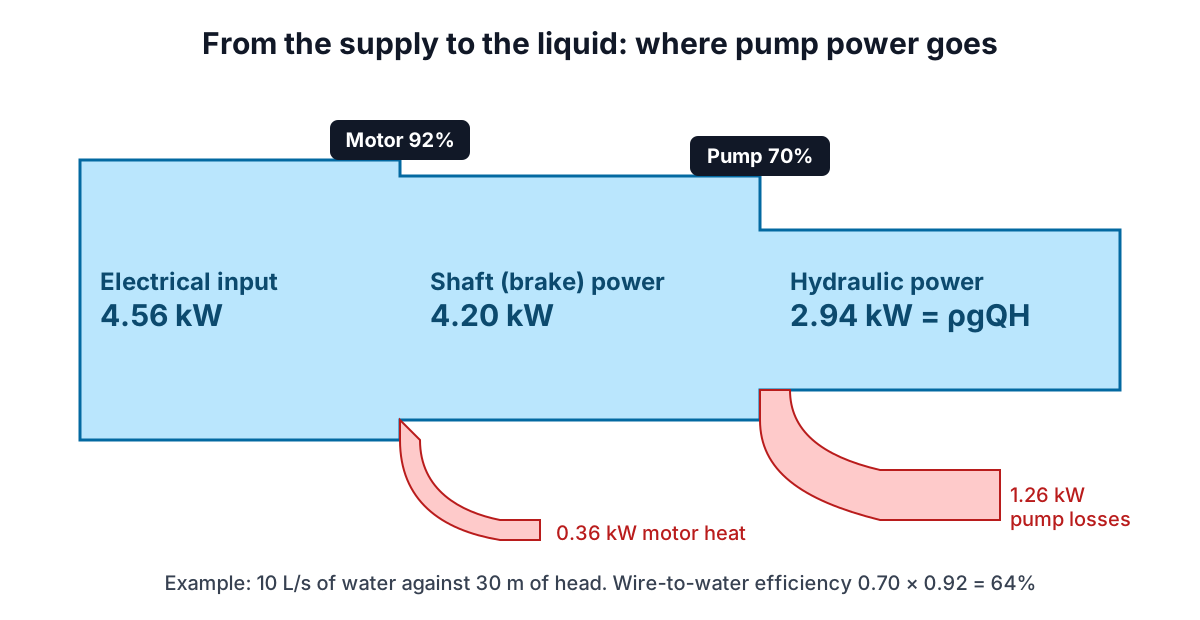
For 10 L/s of water (998.2 kg/m³) against 30 m: 998.2 × 9.80665 × 0.01 × 30 = 2,937 W, or 2.94 kW.
In US customary units the same thing is usually written:
water hp = Q (gpm) × H (ft) × SG / 3960
The 3960 is 33,000 ft·lbf/min per horsepower divided by 8.33 lb per US gallon of water. One mechanical horsepower is 745.7 W. For 100 gpm at 100 ft of water: 100 × 100 / 3960 = 2.53 hp.
Head is not pressure (but it converts)
Pump curves are drawn in head, metres or feet of the liquid being pumped, because a given impeller at a given speed and flow adds roughly the same head whatever the liquid's density. The pressure rise does depend on density:
Δp = ρ g H H = Δp / (ρ g)
A pump giving 30 m of head raises water pressure by 2.94 bar, but brine at 1200 kg/m³ by 3.53 bar, and needs 20% more power to do it. This is why a pump tested on water and installed on a denser liquid can overload its motor. If you only know gauge readings at the suction and discharge flanges, enter the pressure rise and the calculator converts it to head using your density. Strictly, the total head also includes the difference in velocity head and gauge elevation between the two flanges, which is usually small but not always.
Total dynamic head for a system is the sum of:
- the static lift (difference in liquid level, or in pressure as head between the two tanks)
- friction losses in pipe and fittings, from the Pipe Pressure Drop Calculator
- any required residual pressure at the outlet
Shaft and electrical power
Two efficiencies take you from the liquid back to the supply:
P_shaft = P_hydraulic / η_pump
P_electrical = P_shaft / η_motor
Pump efficiency comes from the manufacturer's curve at your duty point, not a catalogue headline. Small end-suction pumps commonly run 50 to 70%, larger well-selected pumps 75 to 90%. The best efficiency point (BEP) sits somewhere in the middle of the curve; running far to the left or right of it lowers efficiency and raises vibration and wear.
Motor efficiency depends on size and class. IEC 60034-30-1 defines IE1 to IE4 classes, and premium IE3 motors range from about 85% at small kW to above 95% for large ones. Variable speed drives add a further 2 to 3% loss but often save far more at part load.
With a 70% pump and a 92% motor, the 2.94 kW hydraulic duty needs 4.20 kW at the shaft and 4.56 kW from the supply. Overall wire-to-water efficiency is 0.70 × 0.92 = 64%.
Choosing the motor size
The calculator rounds the shaft power up to the next standard rating: IEC 60072 sizes in kW (…, 3, 4, 5.5, 7.5, 11 …) and NEMA MG 1 sizes in hp (…, 3, 5, 7.5, 10 …). For the example, 4.20 kW calls for a 5.5 kW IEC motor or, at 5.63 hp, a 7.5 hp NEMA motor.
That is only the starting point. A centrifugal pump's power usually rises with flow, so if the system resistance is lower than designed, or a downstream valve opens, the pump runs out along its curve and draws more power. Common practice is to size the motor for the maximum power on the impeller's curve (a "non-overloading" selection), or at least at the end-of-curve flow you might plausibly reach. Many specifications also add a margin, often 10 to 25% depending on size, and some rely on the NEMA service factor; follow your project standard.
Denser or more viscous liquids raise power further. ANSI/HI 9.6.7 gives correction factors for head, flow and efficiency when pumping viscous liquids with a pump rated on water.
Energy cost: usually the biggest number
Annual energy is the electrical input times running hours:
kWh/year = P_electrical (kW) × hours
cost/year = kWh/year × price per kWh
At 4.56 kW for 4,000 hours, that is 18,240 kWh. At 0.15 per kWh the pump costs 2,736 a year to run. Over a 15 to 20 year life the electricity can be many times the purchase price, so a few points of efficiency are worth paying for. In this example, raising pump efficiency from 70% to 80% saves about 2,280 kWh a year.
Speed control is often the bigger win. The affinity laws say flow scales with speed, head with speed squared and power with speed cubed, for the same impeller. On a system that is mostly friction, running at 80% speed delivers 80% flow for about 51% of the power. On systems dominated by static lift the savings are smaller, because head cannot drop below the lift.
NPSH: keeping the pump out of cavitation
If the pressure at the impeller eye falls to the liquid's vapour pressure, vapour bubbles form and then collapse as pressure rises through the impeller. The result is noise, lost head and pitted impellers. Net positive suction head available is the margin, expressed as head:
NPSHa = (p_surface − p_vapour) / (ρ g) + z_s − h_loss,suction
- p_surface is the absolute pressure on the liquid surface (101.325 kPa for an open tank at sea level)
- p_vapour is the vapour pressure at the liquid temperature
- z_s is the static height of the liquid surface above the pump inlet (negative for a suction lift)
- h_loss is the friction loss in the suction line
The pump's NPSH required (NPSHr) comes from its curve and rises with flow. NPSHa must exceed it with margin. ANSI/HI 9.6.1 recommends margins that depend on the application and energy level; a common rule of thumb is at least 1 m (3 ft) or 10 to 35% above NPSHr, more for hot or volatile liquids.
Temperature is the trap. Water vapour pressure is 2.34 kPa at 20 °C but 47.4 kPa at 80 °C. With an open tank, a 2 m suction lift and 0.5 m of suction loss, NPSHa is 7.6 m on cold water and only 3.2 m on 80 °C water. Hot water, condensate and volatile liquids usually need a flooded suction, a pressurised tank or a low-NPSHr pump. Altitude matters too: atmospheric pressure at 1,500 m is about 84 kPa, which costs roughly 1.7 m of NPSHa on cold water.
Worked example, start to finish
A booster moves 10 L/s of water at 20 °C from an open tank to a building header.
- Static lift 20 m, pipe and fittings 8.5 m, residual pressure 1.5 m: H = 30 m.
- Hydraulic power: 998.2 × 9.80665 × 0.010 × 30 = 2.94 kW (3.94 hp).
- Pump curve says 70% at the duty point: shaft power 4.20 kW (5.63 hp).
- IE3 motor at 92%: electrical input 4.56 kW.
- Motor: 5.5 kW IEC or 7.5 hp NEMA, after checking power at run-out.
- 4,000 h a year at 0.15 per kWh: 18,240 kWh, about 2,736 a year.
- Suction: open tank 2 m below the pump, 0.5 m suction loss: NPSHa 7.6 m, comfortably above a typical NPSHr of 2 to 3 m at this size.
Common mistakes
- Using pressure where head is meant, or forgetting density when converting.
- Taking efficiency from the brochure rather than the curve at the duty point.
- Sizing the motor at the duty point only, then tripping it when the pump runs out.
- Ignoring vapour pressure on hot liquids or at altitude.
- Leaving out the suction side losses and lift when computing total head.
For the head side of the calculation see Darcy-Weisbach and Colebrook; for the static part, hydrostatic pressure at depth. For motor current and supply sizing, the Three-Phase Power Calculator takes over from the electrical input.