
Structuring a Mentorship: From First Meeting to Last Session
How mentors and mentees set goals, run each session, track what was promised and decide when a mentorship has done its job. With agendas and sample questions.
· 5 min read
A senior engineer agrees to mentor someone from another team. They meet for coffee, talk for an hour about careers in general, agree it was great, and promise to "do this again soon". The second meeting happens six weeks later and covers the same ground. By the fourth month neither of them is sure what the mentorship is for, and it quietly stops. Nobody did anything wrong. It just never had a shape.
Mentorships that work look different. The mentee arrives with a goal and a question. Each session ends with a short list of things each person will do. Every few months they step back and decide whether to continue. This guide covers how to set that up, from both sides.
Mentoring, managing and coaching are different jobs
| Manager | Mentor | Coach | |
|---|---|---|---|
| Authority over your work | Yes | No | No |
| Shares own experience | Sometimes | Yes, that is the point | Rarely |
| Who sets the agenda | Shared | Mentee | Client |
| Typical scope | Current role and performance | Career and long-term direction | A specific skill or behaviour |
Because a mentor has no authority over the mentee's work, the mentee can be candid about things they would not tell their manager: that they are thinking of leaving, that they don't respect a decision, that they are scared of the promotion they want. That candour is the main value of the relationship. It also means the mentee has to drive it.
Kathy Kram's research in Mentoring at Work (1985) described two kinds of help mentors give. Career functions include sponsorship, introductions, visibility and stretch opportunities. Psychosocial functions include encouragement, honest counsel and acting as a role model. The best mentors do both. If yours only gives advice and never opens a door, ask for one specific introduction.
The shape of a mentorship
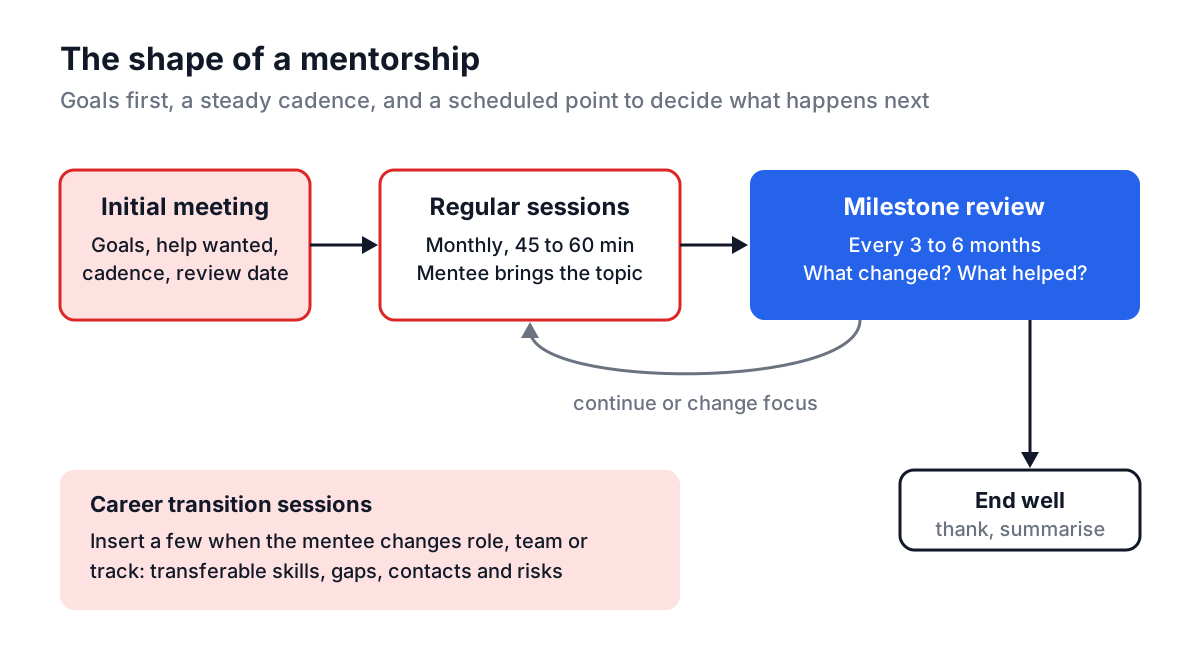
Initial meeting (60 minutes). Get to know each other, then agree on four things: the mentee's goals for the next one to three years, what kind of help they want, how often you will meet, and when you will review whether it is working. Agree on confidentiality explicitly.
Regular sessions (monthly, 45 to 60 minutes). Progress since last time, what the mentee is dealing with now, one skill or decision in focus, and the mentor's perspective. Short messages in between are fine.
Milestone review (every three to six months). Look back at the original goals. What changed? What helped? Then choose: continue, change focus, or end.
Career transition sessions (as needed). When the mentee is changing role, team, company or track, a few focused sessions on transferable skills, gaps, contacts and risk are worth more than general monthly check-ins.
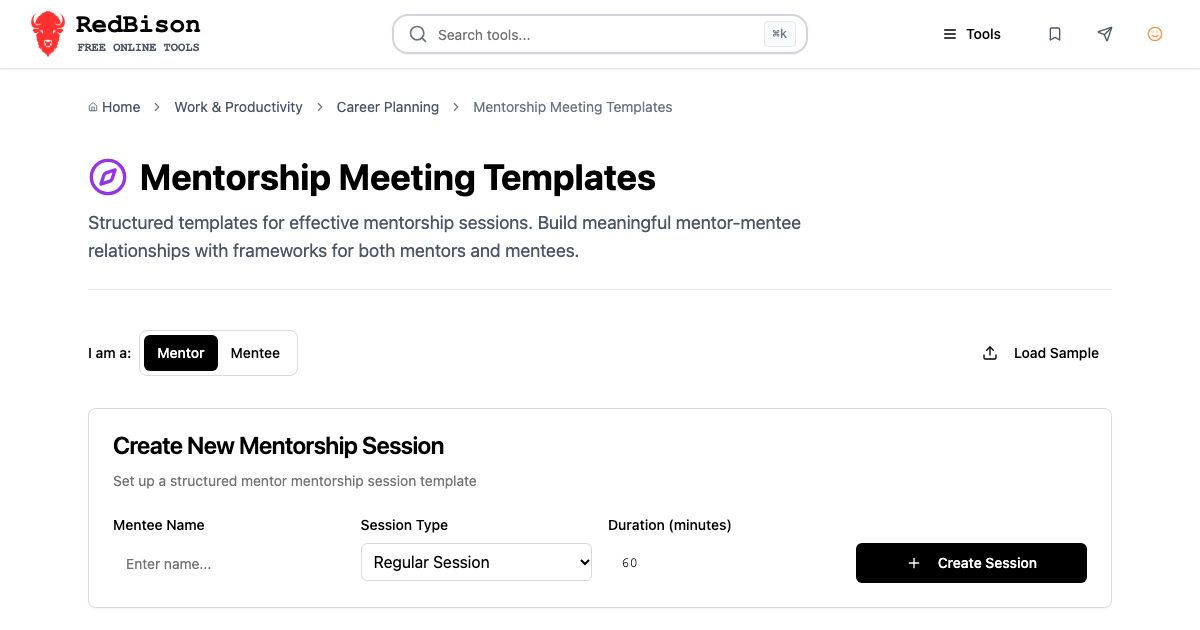
These four map directly to the session types in the Mentorship Meeting Templates, with a mentor and a mentee version of each.
Questions worth asking
For mentees to ask
- "When you were at my level, what did you misjudge about what mattered?"
- "How did you decide between [two options like mine]? What would you do differently?"
- "Here is my promotion doc / design proposal / plan. Where is it weakest?"
- "Who else should I talk to about this? Would you introduce me?"
- "What do people at the level above me do that I'm not doing yet?"
For mentors to ask
- "What are you hoping is different six months from now?"
- "What have you already tried?"
- "What would you do if I weren't here to ask?"
- "What is the real worry underneath this question?"
- "What will you do before we next meet, and how will I know?"
Notice that the mentor's questions mostly push the mentee to think. Mentors who answer every question with a story from their own career end up doing 80% of the talking. A good split is closer to 30% mentor, 70% mentee.
Worked example: a mentee preparing a session
Sam is a mid-level backend engineer considering a move to engineering management, and Lee, a director in another org, has agreed to mentor them.
- In the Mentorship Meeting Templates, Sam chooses Mentee, enters "Lee", picks Career Transition, sets Duration to 45 and clicks Create Session.
- Four topics appear: Transition Goals, Self-Assessment, Market Research Needs, and Concerns and Fears.
- The day before, Sam clicks the pencil and fills in each topic. Under Concerns and Fears: "Worried I'll lose technical depth and can't come back to IC work."
- During the session, Sam adds Key Insights ("Lee has seen three people switch back to IC within two years; it was normal"), Action Items ("Shadow an EM's week in November") and Resources ("Lee to introduce me to Priya, who switched back").
- At the bottom, Sam adds Next Steps and a Follow Up note, then downloads the Markdown and sends it to Lee so both have the same record.
The session is stored in Sam's browser only. Sharing is deliberate, by sending the file.
Common mistakes
No goal. "General career advice" is not a goal. "Decide by March whether to apply for the EM opening" is.
The mentor sets the agenda. If the mentor plans every session, the mentee is a passenger. The mentee should bring the topic.
Advice without follow-up. The mentee nods, does nothing, and the next session repeats. End each session with one action each and start the next by reviewing them.
Broken introductions. Mentors often offer to "connect you with someone" and forget. Write it down as a Resource and do it within a week.
Confusing mentoring with managing. A mentor in your reporting chain cannot be fully neutral. For candid career conversations, look outside your manager's line. Your manager's job is covered in one-on-ones, and they can still help you find a mentor.
Never ending. A mentorship that has achieved its goal should end or change focus. Ending well, with thanks and a summary of what changed, keeps the door open for later.
For mentors: what good looks like
Be on time and keep the cadence. Ask before advising. Share failures as readily as successes, because they are more useful. Give honest feedback on real artefacts (a design doc, a promotion packet, a difficult email draft) rather than in the abstract. Make the introductions you promise. And once in a while, ask the mentee directly whether the sessions are useful and what should change.
Where mentorship fits with reviews and 1:1s
A mentor is a complement to a manager, not a replacement. Development goals from a performance review are often a good starting agenda for a mentorship, and a mentor can help someone prepare for a hard conversation with their manager. The 1:1 templates cover the manager side.
If you are starting a mentorship this month, write the goal in one sentence before the first meeting, agree on a monthly slot and a date for a milestone review, and create the first session in the template. Three months from now you will have a record that shows whether it is working.