
Pipe Flow Rate, Velocity and Diameter: Using Q = vA Properly
Continuity in one line, the unit factors that trip people up, design velocity ranges for water, and how to size a pipe bore from a flow without fooling yourself.
· 9 min read

Every pipe, duct and hose calculation starts from one line of algebra: the volume flowing past a section each second equals the mean velocity times the area of that section. It is so simple that people skip past it, and so it is where many sizing mistakes start. Nominal sizes get used instead of bores, US and imperial gallons get swapped, and a velocity that looks reasonable in feet per second turns out to be outrageous in metres per second. This guide walks through the relationship behind the Flow Rate Calculator, the unit factors worth memorising, the velocity ranges designers actually use and how to go from a design flow to a pipe size.
Continuity: Q = v × A
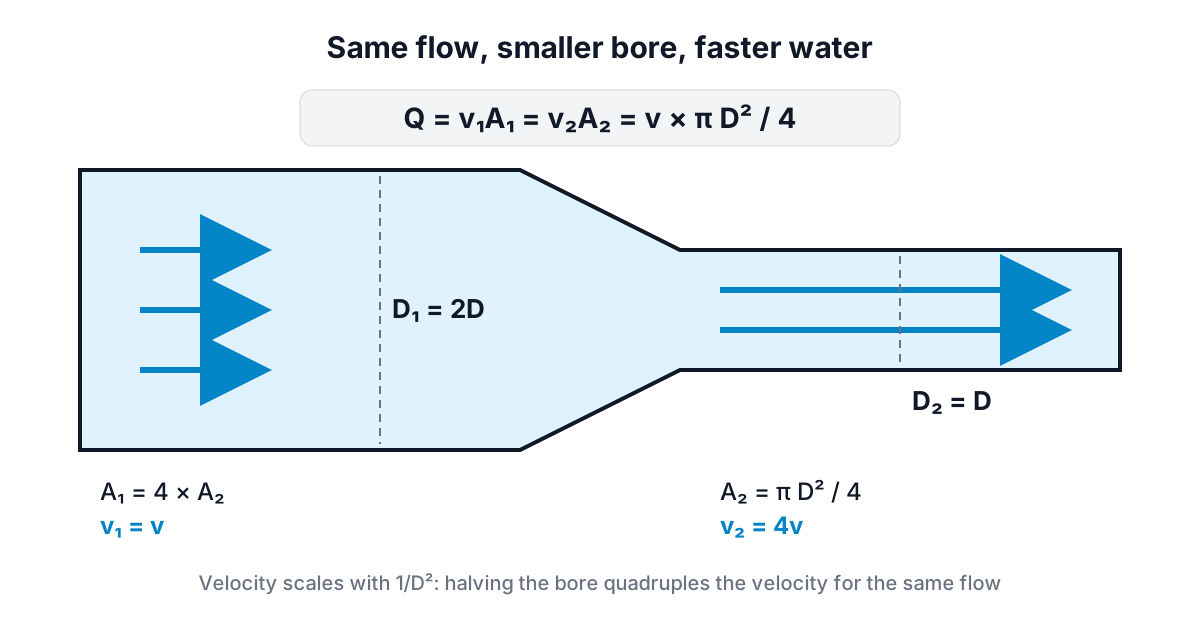
For a liquid that does not compress, mass in equals mass out, so the volumetric flow Q is the same at every cross-section of a pipe without branches. Across any section:
Q = v × A
where v is the mean velocity over the section and A is the flow area. For a full round pipe:
A = π D² / 4
v = 4Q / (π D²)
D = √(4Q / (π v))
The square on D is the whole story of pipe sizing. Halve the bore and the area falls to a quarter, so the same flow has to move four times as fast. Go from 50 mm to 40 mm, a change that looks small on a drawing, and velocity rises by 56%.
"Mean" matters. In laminar flow the velocity profile is a parabola and the centreline moves at twice the mean. In turbulent flow the profile is flatter, with the centre around 1.2 times the mean. A pitot tube or insertion probe at the centreline does not give v directly; it gives a point velocity that has to be corrected or traversed.
Units and the factors worth knowing
Most errors in flow calculations are unit errors. These factors are exact by definition, and the calculator uses them:
| Unit | In litres per second |
|---|---|
| 1 m³/h | 0.27778 L/s |
| 1 L/min | 0.016667 L/s |
| 1 US gpm (231 in³ per gallon) | 0.0630902 L/s |
| 1 UK (imperial) gpm | 0.0757682 L/s |
| 1 ft³/min (cfm) | 0.471947 L/s |
| 1 oil barrel per day (42 US gal) | 0.00184014 L/s |
Two traps deserve a mention. First, US and imperial gallons differ by 20%: 1 imperial gallon is 4.54609 L, 1 US gallon is 3.785411784 L. Pump curves from British, Irish, Australian and some Asian makers sometimes still use imperial gallons. Second, cfm is common for air and gas, where the volume also depends on pressure and temperature. A "standard" cfm (scfm) is referenced to a defined pressure and temperature, while an actual cfm (acfm) is at line conditions, and they can differ by a factor of several in a compressed-air line.
US engineers often use a shortcut that falls out of the definitions:
v (ft/s) = 0.4085 × Q (gpm) / d² (in²)
The constant is 231 / (60 × 12 × π/4). For 100 gpm through a 2.067 in bore, v = 0.4085 × 100 / 4.272 = 9.56 ft/s.
Use the bore, not the nominal size
"Two-inch pipe" is a name, not a dimension. For steel pipe the nominal size fixes the outside diameter, and the schedule fixes the wall, so the bore changes with schedule:
- 2 in Schedule 40 steel: 2.067 in bore
- 2 in Schedule 80 steel: 1.939 in bore
- 2 in Type L copper tube: 1.985 in bore
The same 100 gpm gives 9.56 ft/s in Schedule 40, 10.87 ft/s in Schedule 80 and 10.37 ft/s in Type L copper. Plastic pipe in SDR (standard dimension ratio) sizes and metric DN sizes have their own tables. If you plug in the nominal 2.000 in you get 10.21 ft/s, which is wrong for all of them. The calculator asks for inside diameter for this reason; look up the bore for your actual pipe specification.
What velocity should a pipe run at?
There is no universal rule, but there are well-worn ranges and the reasons behind them:
- Too slow (below about 0.6 m/s, 2 ft/s): suspended solids settle, air pockets do not clear, and the pipe is bigger and dearer than it needs to be.
- Typical pumped water: about 1 to 2.5 m/s (3 to 8 ft/s) in discharge lines, often lower on pump suction, around 0.6 to 1.5 m/s, to protect NPSH.
- Too fast (above about 3 m/s, 10 ft/s): noise, erosion at elbows (especially in copper), high friction loss and large water hammer pressures when a valve closes. Surge pressure rises in direct proportion to the velocity change.
Building services standards and plumbing codes often set lower limits for occupied spaces, and hot water in copper tube is commonly kept slower to avoid erosion-corrosion. For slurries the minimum matters more than the maximum, because solids must stay suspended. For gases, velocities of 10 to 30 m/s are common in ducts and pipes, and the limit is usually noise or pressure drop. Treat all these as starting points and check the standard that governs your job.
Worked example: sizing a pumped line
Suppose a process needs 50 m³/h of water and you want about 1.5 m/s.
- Convert the flow: 50 m³/h ÷ 3600 = 0.01389 m³/s.
- Required area: A = Q / v = 0.01389 / 1.5 = 0.009259 m².
- Required bore: D = √(4A/π) = 0.1086 m, or 108.6 mm.
No pipe has exactly that bore, so check the neighbours. A 100 mm bore runs at 1.77 m/s and a 125 mm bore at 1.13 m/s. Both are inside the usual band. The choice now depends on pressure drop, which falls steeply with diameter (roughly with D to the fifth power at constant flow), and on cost. Run each option through the Pipe Pressure Drop Calculator and the Pump Power Calculator and compare the yearly energy against the extra pipe cost. The bore table under the result in the flow calculator shows the velocity in fourteen common bores at once, which makes this comparison quick. For building water supply, the Water Pipe Size Calculator applies plumbing fixture loads instead.
Mass flow and density
Energy and material balances need mass flow, ṁ = ρQ. Ten litres per second of water at 20 °C (998.2 kg/m³) is 9.98 kg/s, or about 35.9 tonnes per hour. For water the density changes by only about 4% between 0 and 100 °C, but for gases it changes in direct proportion to absolute pressure and inversely with absolute temperature. That is why gas flows are best compared as mass flow or at stated standard conditions. The Reynolds Number Calculator has water density from 0 to 100 °C if you need it.
Common mistakes
- Nominal size instead of bore. As above, this alone can be a 10% error.
- Diameter in the wrong unit. Millimetres entered as metres give velocities a million times too low, so sanity-check the answer against the typical range.
- US versus imperial gallons. A 20% error that hides in plain sight.
- Treating a partly full pipe as full. Drains, sewers and gravity lines often run part full; use open-channel methods such as Manning's equation.
- Comparing gas flows at different conditions. Convert to mass flow or to the same reference state first.
Where Q = vA stops being enough
Continuity itself never fails, but the simple form assumes one inlet and one outlet, a full pipe, and a fluid whose density does not change between the points you compare. Branches need a flow balance at each junction (the flows in equal the flows out). Compressible gas at high velocity needs density at each section, ρ₁v₁A₁ = ρ₂v₂A₂. Once the velocity is known, the next questions are usually the flow regime, the friction loss and the pump power. The sibling guides on Reynolds number, Darcy-Weisbach friction loss and pump power pick up from here.