
Steel Weight Formulas for Plate, Bar, Pipe and Sections (kg/m and lb/ft)
Area formulas for every common steel shape, the densities behind them, why tube tables disagree with simple maths, and the quick rules estimators use.
· 9 min read

Steel is drawn in millimetres and inches but bought, shipped, craned and often priced by the kilogram or pound. Getting from one to the other is a single multiplication, cross-section area times length times density, yet estimates are regularly a few percent out, and sometimes far more. This guide collects the area formulas for every common shape, explains the density values behind them, shows why a hollow section never weighs what simple geometry says, and gives the quick rules estimators carry in their heads. The Steel Weight Calculator applies all of them.
The one formula
weight = area x length x density
In SI units: area in m², length in m and density in kg/m³ gives kilograms. Working in millimetres, it is often easier to compute the area in mm², multiply by the density in kg/m³ and divide by 10⁶ to get kilograms per metre. In US units: area in in², length in inches and density in lb/in³ gives pounds, and multiplying the area in in² by 12 x 0.2836 = 3.4 gives the weight in lb/ft for carbon steel.
Area formulas for each shape
Every standard shape reduces to a short expression. With t for wall or plate thickness:
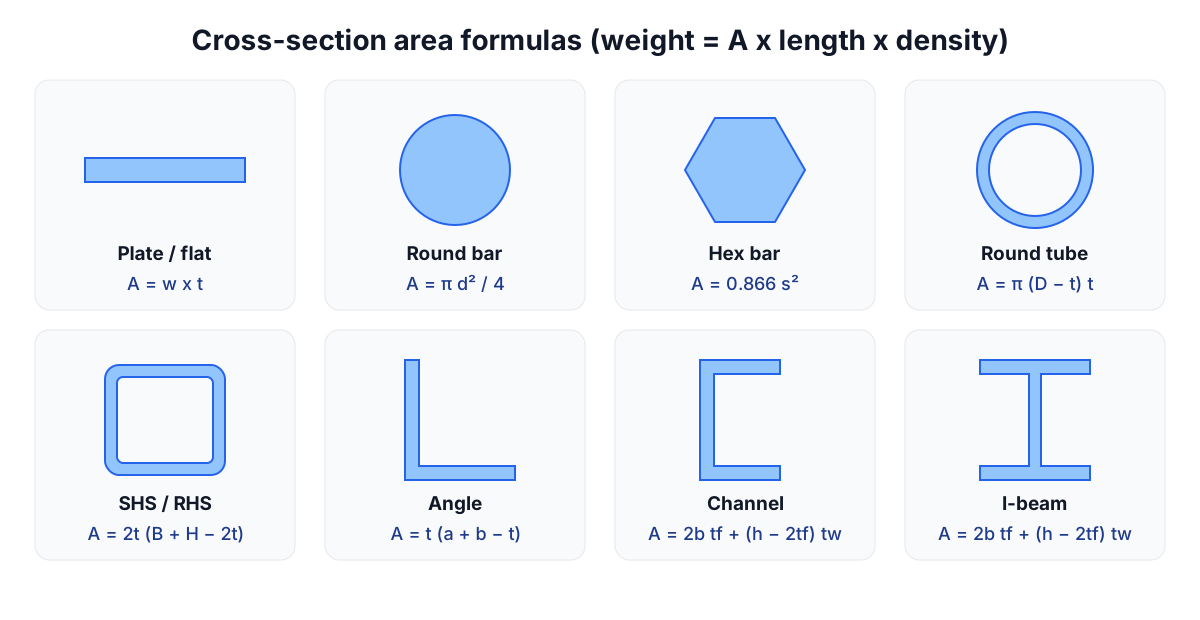
- Plate, sheet and flat bar: A = w x t.
- Round bar: A = π d² / 4.
- Square bar: A = a².
- Hex bar (measured across the flats s): A = (√3 / 2) s² ≈ 0.866 s².
- Round tube or pipe: A = π (D − t) t, which is the mean circumference times the wall. It is exactly equal to π(D² − d²)/4.
- Square or rectangular hollow section with sharp corners: A = 2t (B + H − 2t).
- Angle: A = t (a + b − t); the corner square is counted once.
- Channel and I-beam with parallel flanges: A = 2 b tf + (h − 2 tf) tw.
The pipe formula is worth remembering in its US form. ASME B36.10 tabulates plain-end weight as 10.69 (D − t) t lb/ft with D and t in inches; the 10.69 is just π x 12 x 0.2836. A 2 in Schedule 40 pipe (2.375 in OD, 0.154 in wall) works out to 3.657 lb/ft, and the standard lists 3.66. In metric the equivalent constant is 0.02466 for kg/m with millimetres.
Density values and where they come from
Carbon and low-alloy structural steels are taken as 7,850 kg/m³ (0.2836 lb/in³, 490 lb/ft³). That is the figure EN 10025, EN 10219 and almost every section table use, and the variation between grades is well under 1%. Other metals differ enough to matter:
| Material | Typical density |
|---|---|
| Carbon and structural steel | 7,850 kg/m³ |
| Stainless 304 (1.4301) | 7,900 kg/m³ |
| Stainless 316 (1.4401) | 8,000 kg/m³ |
| Grey cast iron | about 7,200 kg/m³ |
| Aluminium 6061 / 6082 | 2,700 kg/m³ |
| Copper C11000 | about 8,890 kg/m³ |
| Brass C26000 (70/30) | about 8,530 kg/m³ |
| Titanium Ti-6Al-4V | about 4,430 kg/m³ |
The stainless figures are from EN 10088-1. Aluminium at 2,700 kg/m³ is 34% of steel, the familiar "a third of the weight". These are room-temperature typical values; a supplier's data sheet beats any table.
Why hollow sections weigh less than the simple formula
Square and rectangular hollow sections have rounded corners, and the radius removes material. With outer radius ro and inner radius ri, the area becomes
A = 2t (B + H − 2t) − (4 − π)(ro² − ri²)
The radii are set by the product standards. Hot-finished sections to EN 10210-2 have ro = 1.5t and ri = t. Cold-formed sections to EN 10219-2 have ro = 2t for walls up to 6 mm, 2.5t up to 10 mm and 3t above, with ri = ro − t.
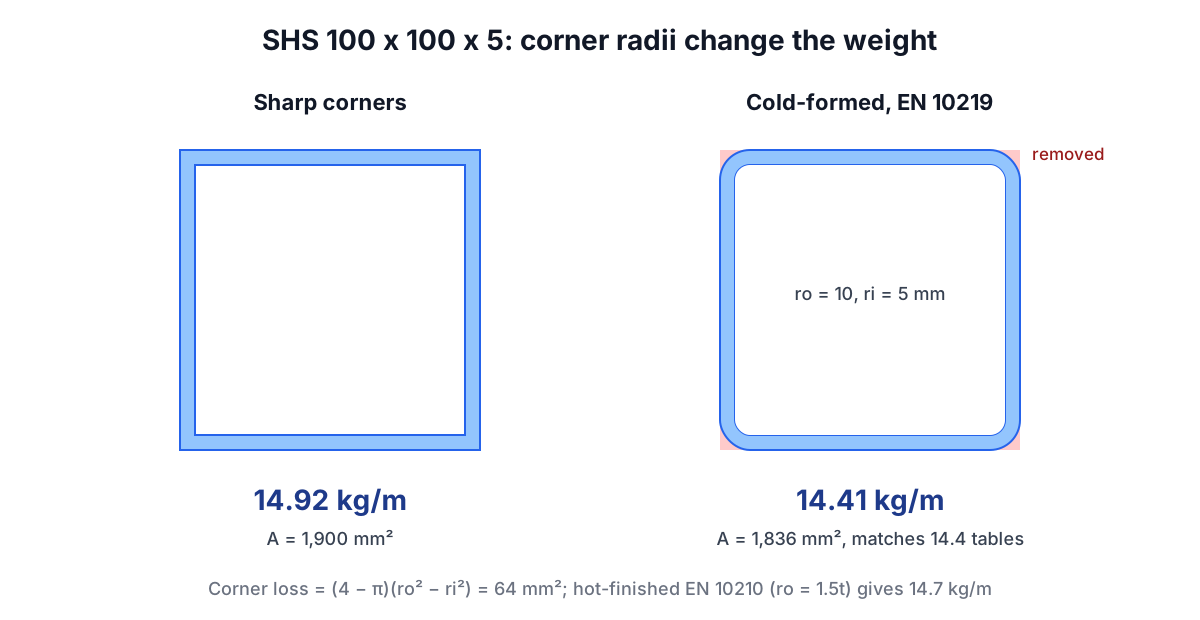
For a 100 x 100 x 5 mm SHS the difference is visible in any stockist's catalogue: the sharp-corner formula gives 14.92 kg/m, the hot-finished radii 14.7 kg/m and the cold-formed radii 14.41 kg/m, which matches the 14.4 kg/m in EN 10219 tables. On a truckload of 6 m lengths the 3.5% gap is real money and real lifting capacity.
Rolled beams, channels and angles go the other way. Their root fillets add a little area that the parallel-flange formula ignores, and tapered-flange channels and older beam profiles differ more. For those, use the kg/m printed in the section table (UB, UC, IPE, HEA, W, C, MC) rather than a formula.
Worked examples
Plate. A 2,000 x 1,000 x 10 mm plate is 0.02 m³, so 0.02 x 7,850 = 157 kg. Every millimetre of plate thickness weighs 7.85 kg/m², which is the fastest check there is.
Bar for an order. Ten 6 m lengths of 20 mm round bar: area 314.2 mm², so 314.2 x 7,850 / 10⁶ = 2.466 kg/m, 14.8 kg per length and 148 kg in total.
Imperial plate. A 4 x 8 ft sheet of 1/4 in plate: 48 x 96 x 0.25 = 1,152 in³, times 0.2836 = 326.7 lb. A quarter-inch plate weighs 10.2 lb/ft².
Angle. A 50 x 50 x 5 mm angle has A = 5 x (50 + 50 − 5) = 475 mm² and weighs 3.73 kg/m with sharp corners; tables list about 3.77 kg/m because of the root fillet.
Quick rules and common mistakes
- Plate: 7.85 kg/m² per mm, or 40.8 lb/ft² per inch of thickness.
- Round bar: 0.006165 d² kg/m with d in mm (a 16 mm bar is 1.58 kg/m, a 25 mm bar 3.85 kg/m). In US units, 2.67 d² lb/ft with d in inches.
- Pipe size is not the outside diameter. "2 inch pipe" has a 2.375 in OD. Always take the OD and wall from the schedule table.
- Mixing mm and m. Squaring a dimension in millimetres and multiplying by 7,850 gives a number a million times too large. Convert first or divide by 10⁶.
- Galvanising adds weight. Hot-dip zinc adds a few percent to light sections, more on thin sheet.
- Tolerances. Plate to EN 10029 or ASTM A6 can be over-thickness, and real bar diameters vary slightly. Theoretical weights are for estimating; use certified weights for lifting plans.
Related tools and reading
The same cross-section area drives axial stress and section stiffness, covered in the guide to moment of inertia and section modulus and the Section Properties Calculator. Self-weight in kg/m is one of the loads in the beam deflection formulas guide, the Beam Deflection Calculator and the Shear and Bending Moment Calculator. For flat stock in gauges, the Sheet Metal Weight Calculator handles gauge tables directly, and the Column Buckling Calculator checks the same tubes as columns.
Weights here are theoretical, from nominal dimensions. For lifting, rigging and transport limits, use the supplier's certified figure with a margin, and have lifting plans reviewed by a competent person.