
Stress, Strain and Young's Modulus: Hooke's Law for Real Bars
Where σ = F/A and ΔL = FL/AE come from, what typical modulus and yield values look like, how to read a tensile test and when the linear model stops telling the truth.
· 10 min read
Most strength checks in mechanical and structural work begin with one question: how hard is the material being pulled or pushed, and how much does it move? For a straight bar carrying a load along its axis, the answer takes three short formulas and one material constant. This post walks through where those formulas come from, what the numbers look like for real metals, how to get Young's modulus out of a tensile test, and the places where the simple model quietly stops being true. Every example can be reproduced in the Stress and Strain Calculator.
Stress, strain and the bar that started it all
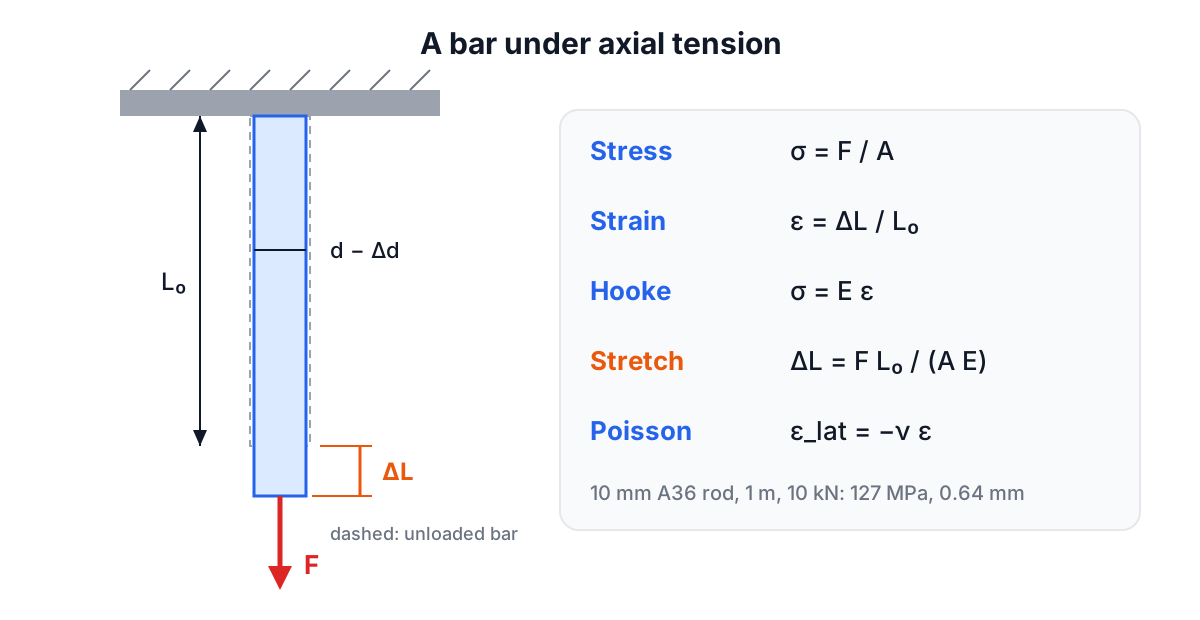
Picture a steel rod hanging from a beam with a weight on the end. The weight pulls with a force F. Cut the rod anywhere along its length and the two halves must pull on each other with that same force, spread over the cross-section area A. That intensity of internal force is the stress:
σ = F / A
In SI units newtons over square millimetres gives N/mm², which is exactly the same as megapascals (MPa). In US units pounds-force over square inches gives psi, and engineers usually quote thousands of psi as ksi.
The rod also gets longer. If its original length is L₀ and it stretches by ΔL, the strain is the stretch per unit length:
ε = ΔL / L₀
Strain has no units. A value of 0.001 can be written as 0.1% or as 1,000 microstrain (µε), the unit strain gauges report.
Hooke's law and Young's modulus
Robert Hooke noticed in 1678 that a spring stretches in proportion to the force on it. Thomas Young turned that into a material property in 1807: for small strains, stress is proportional to strain, and the constant of proportionality depends only on the material.
σ = E ε
E is Young's modulus, also called the modulus of elasticity. Put the three formulas together and you get the elongation of a bar under axial load:
ΔL = F L₀ / (A E)
That one line explains a lot of design decisions. Stretch is proportional to length and load, and inversely proportional to area and stiffness. Double the diameter and the area goes up four times, so the stretch drops to a quarter. Swap steel for aluminium and the stretch roughly triples, because E falls from about 200 GPa to about 69 GPa.
Typical values worth remembering:
| Material | E (GPa) | E (ksi) | Typical yield (MPa) | Poisson's ratio |
|---|---|---|---|---|
| Structural steel ASTM A36 | 200 | 29,000 | 250 (min.) | 0.26 |
| Stainless 304, annealed | 193 | 28,000 | 215 | 0.29 |
| Aluminium 6061-T6 | 68.9 | 10,000 | 276 | 0.33 |
| Titanium Ti-6Al-4V | 113.8 | 16,500 | 880 | 0.34 |
| Copper C11000, annealed | 115 | 16,700 | 69 | 0.31 |
The modulus barely changes with heat treatment or cold work, so a soft and a hardened steel stretch the same amount under the same load. What changes is how much load they can take before yielding. That is why the calculator treats E and yield strength as separate inputs and labels the presets as typical: take yield from the specification or the mill certificate when it matters.
A worked example
Take a 10 mm round A36 tie rod, 1 m long, carrying 10 kN.
- Area: A = π × 10² / 4 = 78.54 mm².
- Stress: σ = 10,000 / 78.54 = 127.3 MPa.
- Strain: ε = 127.3 / 200,000 = 0.000637, or 637 µε.
- Elongation: ΔL = 0.000637 × 1,000 = 0.637 mm.
- Safety factor against yield: 250 / 127.3 = 1.96.
The calculator gives the same numbers and adds the lateral contraction. With a Poisson's ratio of 0.26, lateral strain is −0.26 × 0.000637 = −0.000166, so the 10 mm diameter shrinks by 0.0017 mm. Small, but a strain gauge mounted around the circumference would see it.
The same rod in 6061-T6 aluminium would stretch 0.637 × 200 / 68.9 = 1.85 mm. Its yield strength is a little higher than A36, so it is not weaker in the sense of yielding sooner; it is simply less stiff.
Getting E from a tensile test
Reverse the formula and a tensile test gives the modulus:
E = (F / A) / (ΔL / L₀)
Suppose a 12.5 mm aluminium specimen with a 50 mm extensometer gauge length extends 0.118 mm under 20 kN. The stress is 20,000 / 122.7 = 163.0 MPa, the strain is 0.118 / 50 = 0.00236, and E = 163.0 / 0.00236 = 69.1 GPa. That matches the handbook value for 6061-T6 closely, which is a good sanity check on the load cell and extensometer.
Two practical points. Measure strain over a defined gauge length with an extensometer, not from crosshead movement, which includes grip slip and machine compliance and can understate E by a large margin. And take readings well inside the elastic region; once the curve starts to bend, the slope no longer represents the modulus. ASTM E111 describes the formal procedure.
Safety factor, yield and the limits of the straight line
On a real stress-strain curve the straight line ends at the proportional limit, and soon after that the material yields. For steels with a sharp yield point the curve flattens into a plateau; for aluminium and stainless it bends gradually, so yield is defined by the 0.2% offset method. Past yield, the elongation formula is not just inaccurate but unconservative: the bar stretches much more than ΔL = FL₀/(AE) predicts, and it does not spring back.
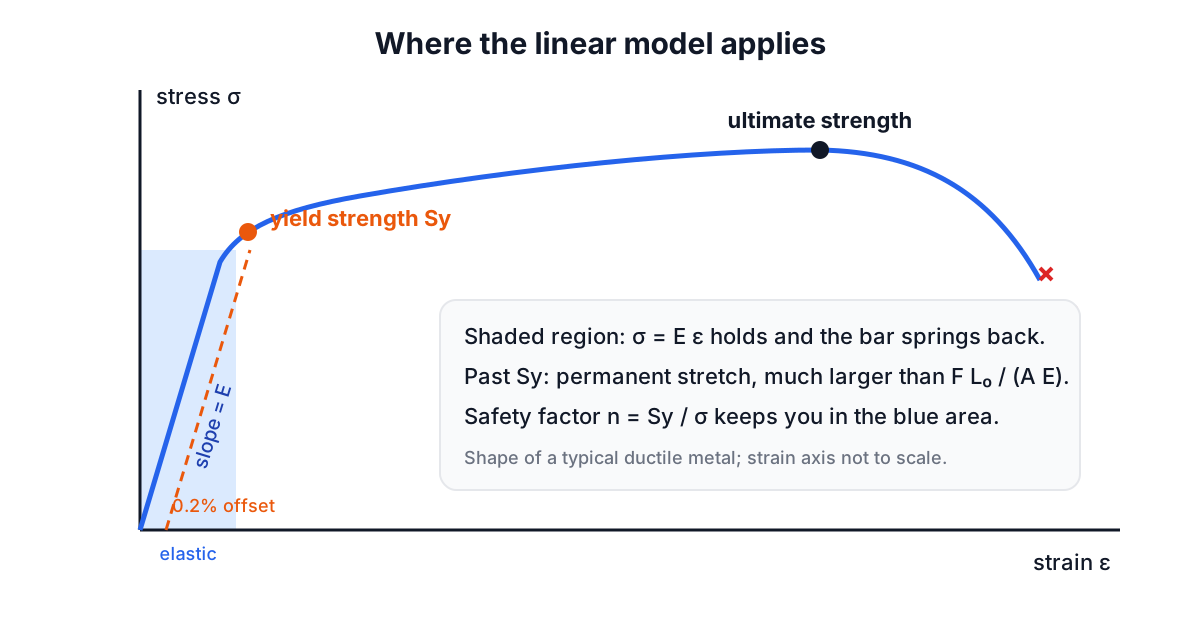
The safety factor compares the stress to the yield strength: n = Sy / σ. How large it needs to be depends on the governing document. In US steel building design the ASD factor on tension yielding works out to 1.67; machine designers often use 2 to 4 depending on how well the loads are known; lifting gear and pressure equipment have their own codes. The calculator reports the ratio and warns when it falls below 1, but the required value is a code decision.
When the simple model breaks down
The axial formulas assume a straight, uniform bar of one isotropic, linear-elastic material, loaded exactly along its axis, at room temperature. Each assumption has a common way to fail:
- Stress concentrations. Holes, threads, grooves and shoulders raise local stress by a factor Kt of 2 or 3. For static loads in ductile metals local yielding redistributes it; for fatigue it governs. Use the net area at a hole and a Kt chart.
- Threads. A threaded rod carries load on its tensile stress area, which for an M10 coarse thread is 58 mm², not the 78.5 mm² of a 10 mm circle. The Bolt Torque Calculator uses the right area for preload.
- Compression and buckling. A short block crushes at its yield strength; a slender strut buckles at a much lower load set by its length, end conditions and second moment of area. Check slender members with the Column Buckling Calculator and get the section properties from the Section Properties Calculator.
- Temperature. A bar that is restrained and heated develops stress with no external load at all, σ = E α ΔT. The Thermal Expansion Calculator gives the free expansion; multiply the restrained strain by E for the stress. Stiffness also falls with heat: Eurocode 3 Part 1-2 reduces structural steel's modulus by 10% at 200 °C and 30% at 400 °C.
- Bending. If the load is off the axis by an eccentricity e, the bar also bends, adding M c / I to the axial stress on one side. A 10 mm rod loaded 1 mm off centre sees about 80% more stress on one face.
- Non-metals. Polymers creep and their modulus depends on time and temperature; concrete and cast iron behave very differently in tension and compression; wood depends on grain direction. The straight-line model is a poor fit for all of them.
Common mistakes
The errors that show up most often in checks are unit slips rather than theory. Mixing GPa with MPa gives answers a thousand times out; using diameter instead of radius in πr² gives a four-fold error in area; and quoting strain in percent in one place and as a ratio in another produces a factor of 100. Keep everything in N and mm (so stress is MPa and E is MPa, 200 GPa = 200,000 MPa), or in lbf and inches with psi throughout, and convert only at the end.
The second most common mistake is treating a calculated elongation as acceptable without checking stress against yield, or checking stress without asking whether stiffness matters. A long aluminium link may be perfectly strong and still stretch enough to throw a mechanism out of adjustment.
Related reading
Axial stress is one piece of a larger set of checks. Spring rates and bolt preload use the same idea of stiffness, covered with the Spring Calculator. For machine elements that see rolling contact rather than simple tension, see the bearing L10 life guide, and for fluid power members that push and pull, the hydraulic cylinder sizing guide. The calculator itself is for preliminary design: anything safety-critical should be checked against the governing code by a qualified engineer.