
Tank Volume Formulas and Dip Charts for Horizontal, Vertical and Odd Shapes
Circular segments, spherical caps and cones: the geometry behind partial tank volumes, why a quarter-full horizontal tank holds less than a quarter, and how to build a dip chart.
· 10 min read

Working out the capacity of a tank is school geometry. Working out how much is in it from a dipstick reading is where people go wrong, because most tanks are not boxes. A horizontal cylinder, a sphere or a cone-bottom hopper fills unevenly: a centimetre of depth near the bottom holds far less than a centimetre near the middle. This guide explains the geometry inside the Tank Volume Calculator, from the circular segment to the spherical cap, gives the fill-fraction numbers worth remembering, and shows how to build and use a dip chart.
Full capacity: the easy part
For the shapes the calculator covers, with inside radius r = D/2:
| Shape | Full volume |
|---|---|
| Vertical or horizontal cylinder, flat ends | π r² L |
| Rectangular tank | L × W × H |
| Sphere | (4/3) π r³ |
| Capsule (cylinder with hemispherical ends) | π r² L + (4/3) π r³ |
| Vertical cylinder with cone bottom | π r² H_cyl + π r² H_cone / 3 |
L for a capsule is the straight cylindrical length only; the two hemispheres together make one sphere. Always use inside dimensions. On a large steel tank, using the outside diameter can overstate capacity by a percent or more.
Unit factors are exact by definition: 1 m³ = 1,000 L, 1 US gallon = 231 in³ = 3.785411784 L, 1 imperial gallon = 4.54609 L, and 1 oil barrel = 42 US gallons = 158.987 L. A classic check: a horizontal tank 48 in in diameter and 120 in long holds π × 24² × 120 / 231 = 940 US gallons.
Partial fill in a horizontal cylinder
Lay a cylinder on its side and the liquid cross-section is a circular segment: the part of a circle below a chord at height h. Its area is:
A(h) = r² cos⁻¹((r − h) / r) − (r − h) √(2 r h − h²)
and the volume is A(h) × L. The first term is the area of the circular sector, and the second subtracts the triangle between the chord and the centre (for h above r it adds instead, which the same formula handles automatically).
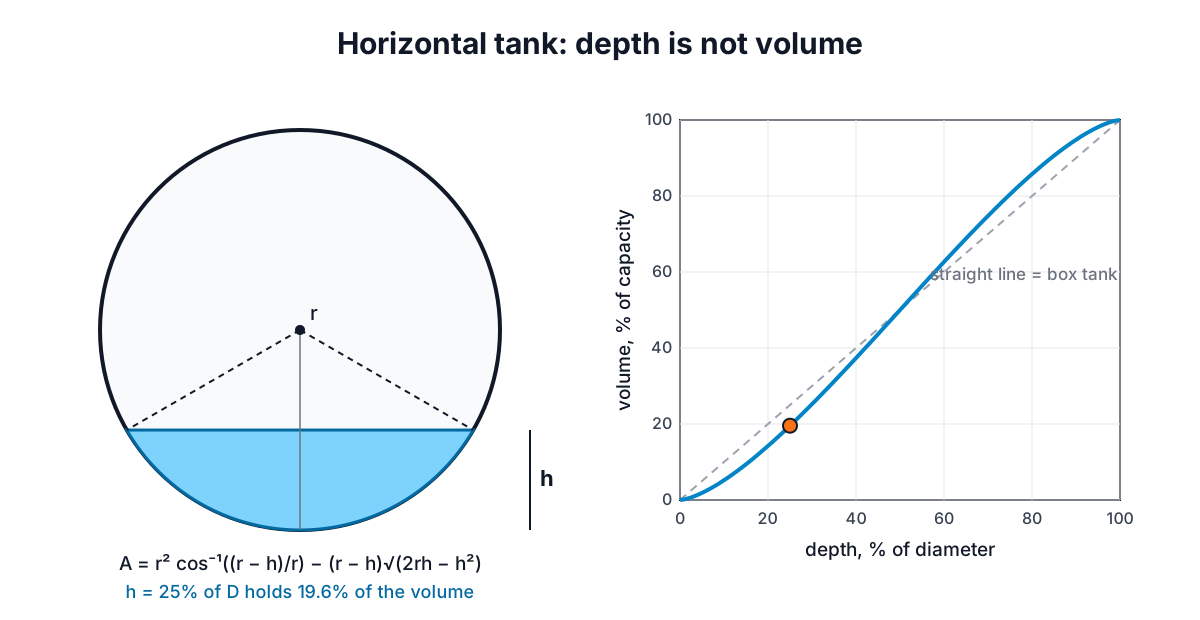
The result is S-shaped against depth. Near the bottom and top the liquid surface is narrow, so volume changes slowly; around the middle the surface is as wide as the tank, so volume changes fastest. Numbers worth remembering:
| Depth as % of diameter | Horizontal cylinder % full | Sphere % full |
|---|---|---|
| 10% | 5.2% | 2.8% |
| 20% | 14.2% | 10.4% |
| 25% | 19.6% | 15.6% |
| 30% | 25.2% | 21.6% |
| 50% | 50.0% | 50.0% |
| 70% | 74.8% | 78.4% |
| 75% | 80.4% | 84.4% |
| 90% | 94.8% | 97.2% |
So a dipstick reading of "a quarter" on a horizontal tank means under a fifth of the contents. On the 2 m × 5 m tank in the calculator's default case, 500 mm of depth is 3,071 L of a 15,708 L capacity. Assuming 25% would overstate the contents by about 860 L, enough to run out of fuel on a generator or misstate stock for an audit.
Spheres, capsules and spherical caps
Liquid in a sphere to a depth h fills a spherical cap:
V_cap = π h² (3r − h) / 3
At h = r that gives half the sphere, (2/3)πr³, and at h = 2r the whole sphere. As a fraction of the sphere it is x²(3 − 2x), with x = h/D, which is where the right-hand column above comes from.
A horizontal capsule (a cylinder with hemispherical heads, as on many LPG and air receivers) combines the two: segment area times the straight length, plus a spherical cap for the two ends together. A vertical capsule fills as a cap in the bottom hemisphere, then as a plain cylinder, then as the top hemisphere.
Many real vessels have dished heads, torispherical or 2:1 ellipsoidal rather than hemispherical. Those hold less than a hemisphere of the same diameter (a 2:1 ellipsoidal head is half as deep, so it holds half the volume of a hemisphere). Treat the capsule result as an upper bound for dished heads, or calculate the heads separately.
Cone-bottom tanks
Hoppers, settling tanks and many brewing and chemical vessels have a conical bottom. Below the top of the cone, the liquid forms a smaller cone whose radius grows in proportion to depth:
r(h) = r × h / H_cone
V(h) = π r(h)² h / 3     for h ≤ H_cone
V(h) = π r² H_cone / 3 + π r² (h − H_cone)     above it
Volume in the cone grows with the cube of depth, so the bottom of a cone fills (and drains) very quickly in height terms. A 3 m diameter tank with a 1.5 m cone holds only 3.53 m³ in the cone, about 11% of its 31.8 m³ total, even though the cone is more than a quarter of the height. Level switches set in the cone react quickly, which is useful for low-level alarms.
Dip charts and strapping tables
A dip chart (also called a strapping or calibration table) lists the volume at each graduation of depth for one specific tank. To build one:
- Measure the inside dimensions carefully, including the diameter at several places if the tank may be out of round.
- Decide the depth step to match the dipstick or gauge: 10 mm, 50 mm, 1 inch, or whatever is marked.
- Calculate the volume at each step from the shape formula, starting at the lowest inside point.
- Note any deadwood: internal pipes, heating coils and ladders displace liquid and should be subtracted at the depths where they sit.
The calculator does steps 2 and 3 at any interval up to 200 rows and draws the volume-depth curve. It also inverts the problem: give a target volume and it returns the depth that holds it, by bisection on the volume formula. That is handy for marking a sight glass at 25%, 50% and 75% of contents rather than of height, or setting a high-level switch at 90% of capacity.
For fiscal and custody-transfer measurement (selling fuel, paying duty) tanks are calibrated by recognised methods such as the API Manual of Petroleum Measurement Standards Chapter 2, using physical strapping, optical methods or liquid calibration, and corrected for temperature. A geometric dip chart is fine for operations and inventory, not for billing.
Common mistakes
- Measuring depth from the wrong reference. Depth is from the lowest inside point. If the dipstick rests on a sump or a striker plate, correct for it.
- Using outside dimensions or ignoring wall and insulation thickness.
- Assuming volume is proportional to depth in round or conical tanks.
- Ignoring tilt. A horizontal tank on a 1% slope over 10 m has a 100 mm difference end to end, which matters at low levels. Level the tank or dip at the centre.
- Filling to 100%. Liquids expand with temperature; diesel expands about 0.08% per °C. Leave freeboard, typically 5 to 10% for fuel.
Worked example
A rainwater tank is a vertical cylinder 2.5 m in diameter and 3 m tall.
- Capacity: π × 1.25² × 3 = 14.73 m³ = 14,726 L.
- At 1.2 m of water: π × 1.25² × 1.2 = 5.89 m³, exactly 40% because volume is linear with depth in a vertical cylinder.
- If the house uses 400 L a day, that is about 14.7 days of supply.
Swap it for a horizontal tank of similar capacity and the 40% depth would hold only about 37.4%, which is why the shape matters when you read a level gauge.
For the pressure at the bottom of the tank, see hydrostatic pressure at depth; for how fast a tank empties through an outlet, see the orifice flow equation guide. For general solids and shapes outside tanks, the Volume Calculator covers prisms, cones and more.