
Tap Drill Sizes and Percent of Thread: Choosing the Right Hole
Why charts use 75% thread, where the 0.01299 and 0.0068 constants come from, metric versus UNC and UNF, form taps, and how to pick between two drills.
· 10 min read
Every tap drill chart is a list of compromises that someone else made for you. It picks one drill per thread, nearly always aimed at about 75% thread, and assumes a cutting tap in an ordinary material. That works most of the time. It stops working when the chart drill is missing from the index, when the part is stainless or titanium and taps keep snapping, when you switch to a form tap, or when a drawing calls for a thread percentage instead of a drill. This guide explains the geometry behind the numbers, so you can choose a drill on purpose. The Tap Drill Size Calculator does the arithmetic for metric, UNC and UNF threads and any drill series.
What percent of thread actually measures
An ISO metric or Unified inch thread is built on a 60° triangle. The full height of that triangle, H, is 0.866 × pitch, but the real thread is truncated at the crest and root, so the basic depth of engagement between a nut and a bolt is 5H/8 = 0.5413 × pitch per side.
The percent-of-thread convention used in Machinery's Handbook and on shop charts takes a slightly larger reference: 0.6495 × pitch per side, which is 3H/4. On the diameter that is twice as much, 1.299 × pitch. A hole drilled to the major diameter minus that full amount would give "100% thread"; a hole drilled to the major diameter would give 0%. Percent of thread is simply where your drill lands on that scale:
%thread = (D − drill) / (0.01299 × P)
drill   = D − 0.01299 × %thread × P
D is the basic major diameter and P is the pitch, in millimetres for metric threads or 1 / TPI in inches for Unified threads. The constant 0.01299 is 1.299 divided by 100 so that the percentage can be entered as a whole number.
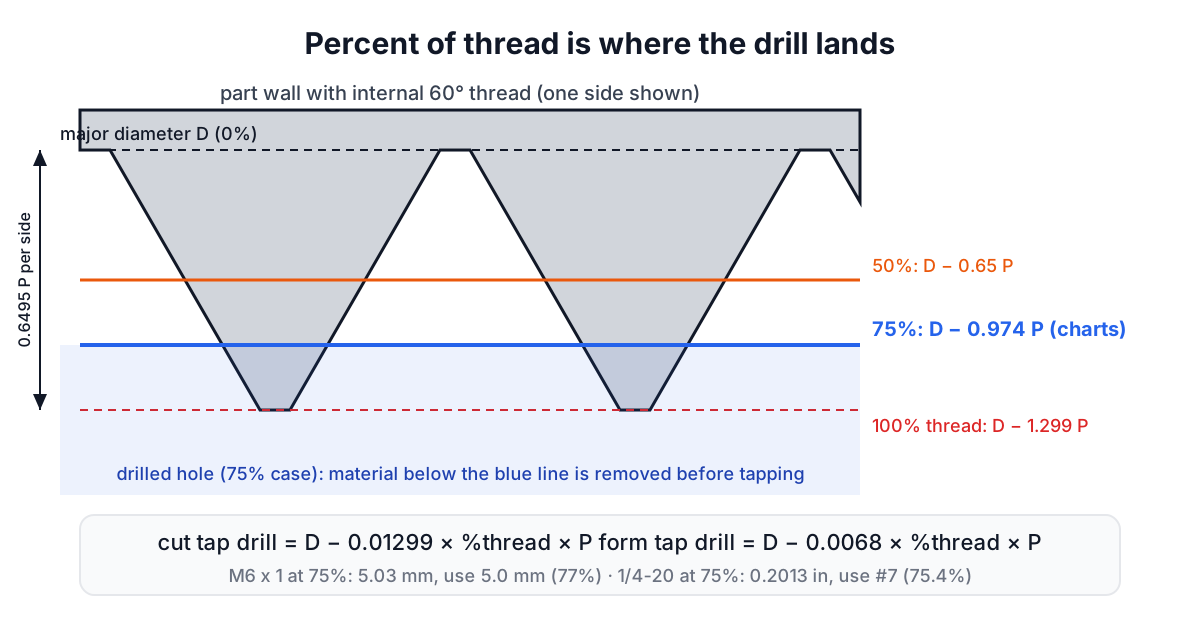
Because the reference depth is a bit deeper than the real engagement, a 75% thread by this convention still fills most of the flank that a mating screw can use, which is part of why it is strong enough.
Why 75% is the default
Tapping torque rises steeply as thread percentage goes up, because the tap has to remove the material near the root where the flanks are widest. Tap makers commonly cite that going from 75% to 100% thread roughly triples the torque, while adding only a few percent to the strength of the joint. In most steel joints the screw breaks before the internal thread strips, so the extra engagement buys almost nothing.
That leads to a set of practical ranges:
| Situation | Typical %thread |
|---|---|
| General work in steel, cast iron, brass | 70 to 75% |
| Tough or work-hardening alloys (stainless, titanium, nickel alloys) | 55 to 65% |
| Soft aluminium, plastics, thin sheet | 75 to 85% |
| Form (roll) taps | 60 to 70% |
The longer the engagement, the less each thread has to carry, so a deep thread in a hard material can drop to 50 to 60% without losing strength. A shallow thread in soft material benefits from going higher.
Worked examples with real drills
M6 x 1, cutting tap, 75%. Drill = 6 − 0.01299 × 75 × 1 = 5.026 mm. The nearest metric drill is 5.0 mm, which gives (6 − 5.0) / 0.01299 = 77.0%. That is why "major minus pitch" works as a rule of thumb for metric threads: it always lands at 1 / 1.299 = 77%.
1/4-20 UNC, cutting tap, 75%. P = 1 / 20 = 0.05 in. Drill = 0.25 − 0.01299 × 75 × 0.05 = 0.2013 in. The #7 drill is 0.201 in and gives 75.4%. Every chart lists a #7, and now you can see why.
1/2-13 UNC. The theoretical drill is 0.4251 in. The chart choice, 27/64 in (0.4219), gives 78.2%. A 10.8 mm metric drill measures 0.4252 in and gives 74.9%, closer to the target. The thread does not know what system the drill is labelled in, so if you have both sets, use whichever lands nearest.
M12 x 1.75. Theory says 10.295 mm. Charts list 10.2 mm (79.2%); 10.3 mm gives 74.8% and is a little easier on the tap. Both are acceptable for a 6H thread.
Number, letter, fractional and metric drills
Inch drills come in three overlapping series. Number drills run from #80 (0.0135 in) up to #1 (0.228 in). Letter drills pick up at A (0.234 in) and run to Z (0.413 in). Fractional drills go in 1/64 in steps. Together they give a drill every few thousandths of an inch below half an inch, which is why Unified tap charts are full of odd sizes like #29, F and Q. Metric jobber sets usually step in 0.1 mm, with 0.05 mm steps in the small sizes and 0.5 mm steps above 13 mm.
The calculator searches whichever series you choose, or all of them, and lists the three drills either side of the target with the thread percentage each gives. Rows in the usual band are highlighted so you can pick the closest drill you actually own.
Form taps need a bigger hole
A form tap (also called a roll or fluteless tap) does not cut. It pushes the material sideways and up into the shape of the thread, so the crests of the internal thread are formed by displaced metal. The pilot hole must be larger to leave room for that flow. Machinery's Handbook and the tap makers use:
form tap drill = D − 0.0068 × %thread × P
with 60 to 70% thread typical. For 1/4-20 at 65%: 0.25 − 0.0068 × 65 / 20 = 0.2279 in, which is a #1 drill at 0.228 in. For M6 x 1 at 65%: 5.56 mm, so a 5.5 or 5.6 mm drill depending on the tap maker's chart. A cutting tap drill in a form tap hole is the fastest way to break a form tap; the torque climbs sharply as the formed crest runs out of space.
Form taps work in ductile materials such as aluminium, copper, brass and low-carbon or stainless steel up to moderate hardness. The threads are stronger because the grain is not cut, and there are no chips, which suits blind holes. They are a poor choice in cast iron or brittle plastics.
Common mistakes and how to avoid them
- Ignoring drill oversize. Twist drills cut slightly larger than their nominal size, often by 0.02 to 0.05 mm in steel and more in a worn drill or a sloppy setup. The thread you get is a few percent below the calculated value.
- Forgetting the minor diameter tolerance. For class 2B (inch) or 6H (metric) internal threads, the tapped minor diameter must fall between limits set in ASME B1.1 or ISO 965. A hole that gives 85% thread may be below the minimum minor diameter for a 6H fit.
- Wrong engagement length. One diameter of engagement is a common target in steel; aluminium and cast iron often need 1.5 to 2 diameters to avoid stripping the weaker internal thread.
- Blind holes too shallow. Plug taps have 3 to 5 pitches of chamfer that do not cut a full thread. Drill deep enough for the tap's chamfer plus the full thread length you need.
- Mixing up TPI and pitch. P = 25.4 / TPI mm. A 20 TPI thread has a pitch of 1.27 mm, not 20 or 0.05 mm.
Related tools and guides
Once the hole is drilled, the drilling and tapping speeds come from the Speeds and Feeds Calculator, and the reasoning behind them is in the speeds and feeds guide. For the fastener side of the joint, the Bolt Torque Calculator gives tightening torque and preload, and the stress and strain guide shows how to check the bolt's tensile stress. Percent of thread is a geometric estimate; for critical threads follow the tap maker's chart and the applicable thread standard.