
Thermal Expansion in Pipes and Structures: ΔL = αLΔT in Practice
Linear and volumetric expansion explained, typical coefficients for steel, copper and plastics, why restrained members build stress, and how water breaks the simple rule.
· 10 min read

A steel pipe that carries hot water is a few centimetres longer in service than the day it was installed. A plastic one may be a few hundred millimetres longer. If nothing is done about that, pipes bow, brackets crack, joints leak and, in the worst case, anchors pull out of the wall. This post explains the expansion formulas behind the Thermal Expansion Calculator, the typical coefficients for common materials, what happens when expansion is blocked, and why water is the exception to the simple rule.
The linear expansion formula
Heat makes atoms vibrate with larger amplitude, and because the forces between them are not symmetric, the average spacing grows. For a solid over a moderate temperature range the growth is proportional to the original length and the temperature change:
ΔL = α x L x ΔT
α is the coefficient of linear thermal expansion, the fractional change in length per kelvin. A 1 K change is the same as a 1 °C change; a 1 °F change is 5/9 of that, so α per °F is α per K divided by 1.8.
The calculator's default is a 30 m carbon steel pipe heated from 10 °C to 70 °C:
ΔL = 12 x 10⁻⁶ /K x 30 m x 60 K = 0.0216 m = 21.6 mm (0.85 in)
The result has the same unit as L. Diameters grow by the same fraction, which matters for shrink fits: a 100 mm steel bore opens by 1.2 µm per kelvin, so heating a hub by 150 K gives about 0.18 mm of clearance.
Typical coefficients
These are typical values near room temperature from materials handbooks and pipe manufacturers, in millionths per kelvin. Specific alloys and products vary by a few percent; plastics vary more.
| Material | α (10⁻⁶ /K) | α (10⁻⁶ /°F) |
|---|---|---|
| Invar 36 | 1.3 | 0.7 |
| Borosilicate glass | 3.3 | 1.8 |
| Titanium Ti-6Al-4V | 8.6 | 4.8 |
| Soda-lime glass | 9 | 5.0 |
| Concrete | 10 | 5.6 |
| Grey cast iron | 10.8 | 6.0 |
| Carbon steel | 12 | 6.7 |
| Copper | 17 | 9.4 |
| Stainless 304/316 | 17.3 | 9.6 |
| Brass | 20 | 11.1 |
| Aluminium 6061 | 23.6 | 13.1 |
| PVC | 54 | 30 |
| CPVC | 61 | 34 |
| HDPE | 120 | 67 |
| PEX | 165 | 92 |
Concrete and steel happen to have similar coefficients, which is one reason reinforced concrete works at all: the bars and the concrete around them move together. Aluminium moves twice as much as steel, so aluminium cladding on a steel frame needs slotted fixings. PEX moves about ten times as much as copper. Manufacturers state it as roughly 1.1 in per 100 ft per 10 °F, which matches α = 165 x 10⁻⁶ /K. A 50 ft PEX run that warms 70 °F grows 3.85 in.
Volume: three times linear, except for liquids
An isotropic solid grows by the same fraction in every direction, so its volume grows by
ΔV = V x [(1 + αΔT)³ − 1] ≈ 3αVΔT
The approximation drops terms in (αΔT)², which are negligible: for steel over 100 K the volume change is 0.3604% exactly against 0.3600% from the shortcut, a relative difference of about 0.1%. The calculator uses the exact form anyway.
Liquids do not keep a shape, so they are described directly by a volumetric coefficient β. Typical values near 20 °C are about 9.5 x 10⁻⁴ /K for petrol, 8.3 x 10⁻⁴ for diesel and 1.1 x 10⁻³ for ethanol. That is why fuel tanks are never filled to the brim on a cold morning: 1,000 L of petrol warming 20 K grows by 19 L.
Water is a special case. It is densest near 4 °C and contracts slightly as it warms from 0 to 4 °C, then expands at an increasing rate. Its β is 2.07 x 10⁻⁴ /K at 20 °C but about 5.2 x 10⁻⁴ at 60 °C. A constant β therefore underestimates hot-water expansion badly. The calculator instead computes the volume change of a fixed mass of water from its density at the two temperatures, using the Kell (1975) equation:
ΔV = V x (ρ(T1) / ρ(T2) − 1)
100 L from 10 °C to 60 °C: 100 x (999.70 / 983.20 − 1) = 1.68 L
A constant β would have predicted 1.04 L, 38% too little. This is the volume an expansion vessel on a hot water or heating system has to absorb.
When expansion is restrained
If a member is held so it cannot move, the strain it would have had becomes stress. For a linear-elastic material with modulus E:
σ = E x α x ΔT
Length does not appear. A short bar and a long pipe develop the same stress for the same temperature change. For the default steel pipe:
σ = 200,000 MPa x 12 x 10⁻⁶ x 60 = 144 MPa (about 20,900 psi)
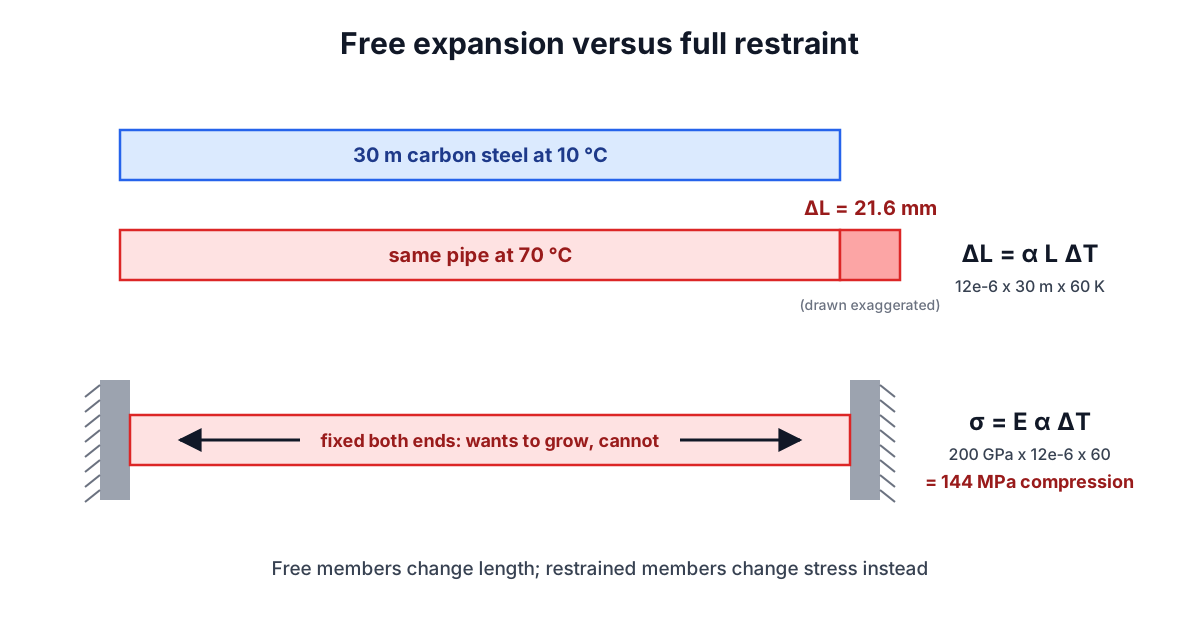
That is more than half the 250 MPa yield strength of A36 steel, from a temperature rise well within normal hot-water service. A slender pipe will buckle sideways long before it reaches that stress, and the anchors at each end must resist the full thrust, which is stress times the metal cross-section. This is why piping systems combine anchors with expansion loops, offsets or bellows, and why bridges and long buildings have expansion joints.
Plastics behave differently. Their α is large but their E is tiny, about 2.8 GPa for PVC and well under 1 GPa for PEX, so a restrained plastic pipe develops modest stress. The problem is movement instead: hot PEX snakes between clips, and PVC pulls out of solvent joints if a long straight run has no room to move.
Practical design notes
- Use the right temperature range. Take the installation temperature as the starting point and the extreme service temperatures as the end points, both hot and cold. A pipe installed in summer contracts in winter.
- Mean coefficients for large ranges. α rises slowly with temperature for metals. For ranges of several hundred kelvin, such as steam or exhaust systems, take the mean coefficient for that range from ASME B31.3 or the material standard.
- Mixed materials. Where two materials are fixed together, the difference in α drives the stress. Bimetallic strips use this deliberately; glass in aluminium frames and copper pipe in steel brackets need allowance for it.
- Anchors flex. The fully restrained stress is an upper bound. Real anchors and supports deflect a little, lowering stress and raising anchor loads in exchange.
- Leave it to the piping code for design. Loop sizing, allowable stress range and fatigue belong to ASME B31.1, B31.3 or B31.9, or the pipe maker's design manual.
Related calculations
For the stiffness side of the problem, the Stress and Strain Calculator relates stress, strain and modulus for common materials. If the expansion is in a hot-water system, the Water Pipe Size Calculator helps choose the pipe itself and the Tank Volume Calculator gives the system volume that the expansion vessel must handle. The energy needed to cause the temperature change is covered in the post on specific and latent heat, and the companion post on water pipe sizing explains why PEX and copper of the same nominal size are not interchangeable.