
Dipole and Whip Lengths for Australian Bands, in Metres
Cut lengths in metres for Australian amateur bands and UHF CB: why 80 m stops at 3.7 MHz, a Foundation operator's first dipole, trimming and coax stubs.
By Redbison Dev · · 10 min read
Australia edition. Metric lengths for the bands in the Radiocommunications (Amateur Stations) Class Licence 2023, the Foundation band list without 20 m, and UHF CB channels from the 2025 CB class licence. US edition
Most antenna articles are written for American bands, and that is a trap in Australia. A US guide will tell you to cut an 80 m dipole for 3.75 MHz, which is resonant above the top of every Australian 80 m segment open to Foundation and Standard operators. This guide starts from the Australian band limits, converts the classic 468/f rule to metres, and works through the antennas Australians most often build: a 40 m or 80 m dipole for the backyard, a 15 m dipole for a Foundation station, and a quarter-wave UHF CB whip. Every length comes from the Australian antenna length calculator.
The 468 rule in metres
A radio wave's free-space wavelength is 299.79 / f metres, with f in MHz. A dipole wants to be half that, but a real wire resonates when it is about 5% shorter, because the capacitance at its ends makes it act electrically longer. Multiply the half wave by an end-effect factor of 0.95 and you get 142.4 / f metres. The old 468 / f feet converts to 142.6 / f metres, the same thing within 0.2%.
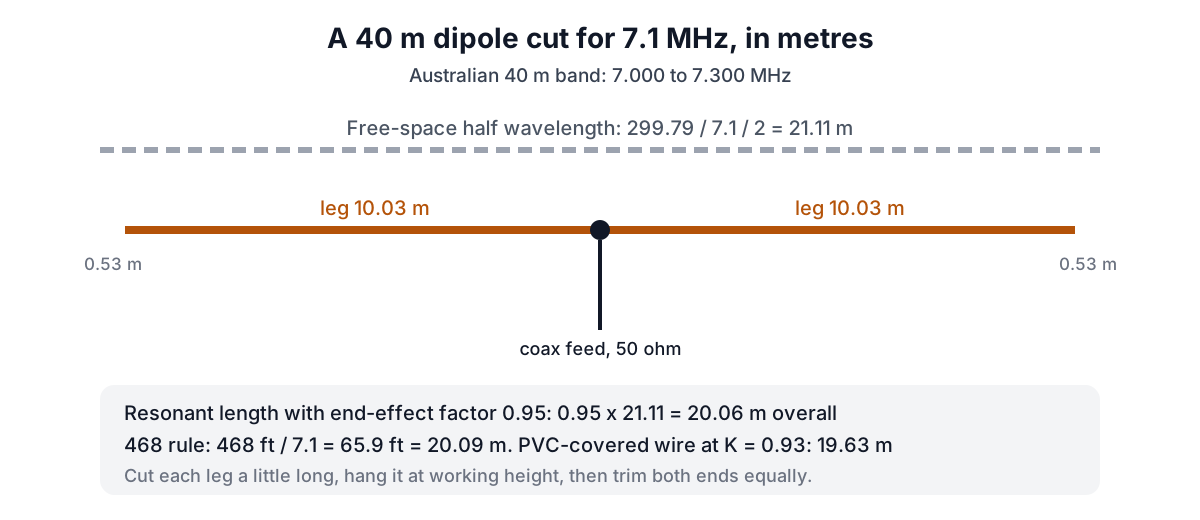
Height, nearby trees, a metal roof and insulation all move the resonant point by a few per cent, so the formula gives a length to cut long, not a length to trust.
Australian band limits change the cut
Amateur stations have operated under the Radiocommunications (Amateur Stations) Class Licence 2023 since 19 February 2024. Schedule 2 lists the bands and power for each qualification. Two HF bands differ sharply from the US:
- 80 m is 3.500 to 3.700 MHz for every qualification, with 3.776 to 3.800 MHz added for Advanced operators. The middle of the common segment is about 3.6 MHz.
- 40 m is 7.000 to 7.300 MHz, 300 kHz wide. Foundation operators above 7.1 MHz are limited to emissions no wider than 8 kHz.
Cutting 80 m for the US habit of 3.75 MHz gives 37.97 m. Cutting for 3.6 MHz gives 39.56 m, about 1.6 m longer. A dipole cut for 3.75 MHz has its lowest SWR above 3.7 MHz, so most of the segment you can use sits on the high-SWR side of its curve.
| Band | Cut for | Dipole overall | Each leg | Who can use it |
|---|---|---|---|---|
| 80 m | 3.6 MHz | 39.56 m | 19.78 m | All qualifications |
| 40 m | 7.1 MHz | 20.06 m | 10.03 m | All qualifications |
| 20 m | 14.175 MHz | 10.05 m | 5.02 m | Standard and Advanced |
| 15 m | 21.2 MHz | 6.72 m | 3.36 m | All qualifications |
| 10 m | 28.5 MHz | 5.00 m | 2.50 m | All qualifications |
A first HF antenna for a Foundation station
Table A of the class licence gives Foundation operators 3.5 to 3.7 MHz, 7.0 to 7.3 MHz, 21.0 to 21.45 MHz, 28.0 to 29.7 MHz, 144 to 148 MHz and 430 to 450 MHz, at up to 10 watts. It does not include 20 m, which only Standard and Advanced qualifications get. So the 20 m dipole that features in so many overseas beginner articles is the wrong first build here.
Two better choices:
- A 15 m dipole: 6.72 m overall, two legs of 3.36 m at 21.2 MHz. It fits between a pergola and a fence in most backyards, and a 10 m dipole of 5.00 m can share the same feed point as a fan dipole.
- A 40 m dipole or inverted V: 20.06 m overall at 7.1 MHz. As an inverted V hung from a single mast near the house, it fits a typical suburban block more easily than a flat-top. Inverted Vs usually resonate 3 to 5% lower than the same wire stretched straight, so start long and trim.
At 10 watts there is no power to spare, so losses matter: a full-size resonant dipole on good coax, kept clear of a metal roof, wastes less of the signal than a shortened or badly matched antenna.
Trimming
Cut each leg 2 to 3% long, hang the antenna at its working height and find where the SWR is lowest. If a dipole cut to 20.06 m for 7.1 MHz resonates at 6.95 MHz, it is too long by the ratio of the two frequencies: 20.06 x 6.95 / 7.1 = 19.64 m. Remove about 0.21 m from each leg and check again. Trimming one side only pulls the feed point off centre.
Insulated wire resonates lower than bare copper of the same length, so a 40 m dipole in PVC-covered wire typically finishes nearer 19.6 m. The calculator gives 19.63 m with an end-effect factor of 0.93.
UHF CB whips
Many readers are not amateurs at all but are fitting UHF CB to a ute, a 4WD, a boat or a farm vehicle. The Radiocommunications (Citizen Band Radio Stations) Class Licence 2025 puts UHF channel 1 at 476.425 MHz and channel 40 at 477.400 MHz, so the middle of the band is near channel 20 at 476.900 MHz:
| UHF CB element | Length at 476.9 MHz |
|---|---|
| Quarter-wave whip | 14.9 cm |
| 5/8-wave whip (radiator only) | 37.3 cm |
| Half-wave dipole | 29.9 cm |
A quarter-wave whip on a metal roof is the simple home-made option. Commercial fibreglass CB antennas are usually longer, higher-gain designs with their own matching, so do not cut one down to these figures. The class licence limits UHF CB transmitters to 5 watts, reserves channels 5 and 35 (and 27 MHz channel 9) for emergencies, and bans speech on UHF channels 22 and 23, so test a new antenna on a general channel.
VHF and UHF amateur antennas
The Australian 2 m band runs from 144 to 148 MHz, wider than in Europe, so use the frequency your local repeaters actually use rather than a generic 146 MHz. At 146.5 MHz a quarter-wave ground plane radiator is 48.6 cm. On 70 cm, which runs from 430 to 450 MHz, a quarter wave at 438 MHz is 16.3 cm. Thick rod has a lower end-effect factor than wire, so cut a few millimetres long and file back.
Velocity factor: stubs, not elements
Inside coax a signal travels at a fraction of the speed of light, the velocity factor, so electrical quarter waves of cable are physically shorter. In solid polyethylene coax such as RG-58 or RG-213 (0.66), a quarter-wave stub is 6.97 m at 7.1 MHz and 33.8 cm at 146.5 MHz. Use velocity factor for stubs, matching sections and phasing lines. It never applies to the wire of the dipole itself, and the feeder to a dipole can be any length.
Tools for this job
The Australian antenna length calculator gives dipole, quarter-wave, 5/8-wave and loop lengths with Australian band and UHF CB presets. The Reactance and Impedance Calculator covers matching, the Decibel Calculator feeder loss and gain, and the Wavelength and Frequency Calculator general conversion. The US edition of this guide has more on loops and 5/8-wave verticals.
Frequently asked questions
What frequency should I cut an 80 m dipole for in Australia?
About 3.6 MHz, the middle of the 3.500 to 3.700 MHz segment open to every qualification. A dipole for 3.6 MHz is 39.56 m overall, two legs of 19.78 m, at an end-effect factor of 0.95.
Can a Foundation licensee build a 20 m antenna?
They can build one, but Foundation operators may not transmit on 14 MHz: Table A of the class licence does not include it. A 15 m dipole of 6.72 m or a 40 m dipole of 20.06 m suits the Foundation bands.
How long is a UHF CB quarter-wave whip?
About 14.9 cm at 476.9 MHz, channel 20, the middle of the UHF CB band. A 5/8-wave radiator is about 37.3 cm before its base matching coil.
Does the 468 formula work in metres?
Yes: 468 feet is 142.6 metres, so a half-wave dipole is about 142.6 / f metres with f in MHz. At 7.1 MHz the rule gives 65.9 ft, or 20.09 m, against 20.06 m from the 0.95 end-effect factor.
Sources and further reading
- Radiocommunications (Amateur Stations) Class Licence 2023, Federal Register of Legislation (ACMA instrument). Commencement on 19 February 2024 and the Schedule 2 band and power tables.
- Radiocommunications (Citizen Band Radio Stations) Class Licence 2025, Federal Register of Legislation (ACMA instrument). UHF and 27 MHz channel frequencies, the 5 W limit, emergency channels and the ban on speech on channels 22 and 23.
- ARRL Antenna Book, American Radio Relay League. The 468 and 234 rules of thumb.
- ARRL Handbook Reference, American Radio Relay League. Transmission line velocity factors.
- CODATA value: speed of light in vacuum, National Institute of Standards and Technology.
Open the Antenna Length Calculator
More Electronics
Every tool in the Electronics section, free and in your browser.