
Dipole Length in Metres for UK Amateur Bands
Dipole lengths in metres for the UK amateur bands, the metric 142.6 rule behind 468/f, fitting 80 m and 40 m into a garden, trimming to resonance and coax stubs.
By Redbison Dev · · 10 min read
United Kingdom edition. Lengths in metres for the RSGB band plans, which are narrower than the US allocations (80 m to 3.800 MHz, 40 m to 7.200 MHz, 2 m to 146 MHz), plus the UK 4 m band, garden-sized layouts and Ofcom's EMF check. US edition
British radio amateurs meet the 468/f formula in every Foundation course, then measure their wire with a metric tape and wonder how the two connect. The short answer is that 468 feet is 142.6 metres, so a half-wave dipole is about 142.6 divided by the frequency in MHz, in metres. The longer answer matters more, because UK band edges are not the American ones most antenna articles assume, and because a typical British garden rarely has room for a straight 80 m dipole. This guide covers both, using the UK antenna length calculator for every figure.
Where 142.6 comes from
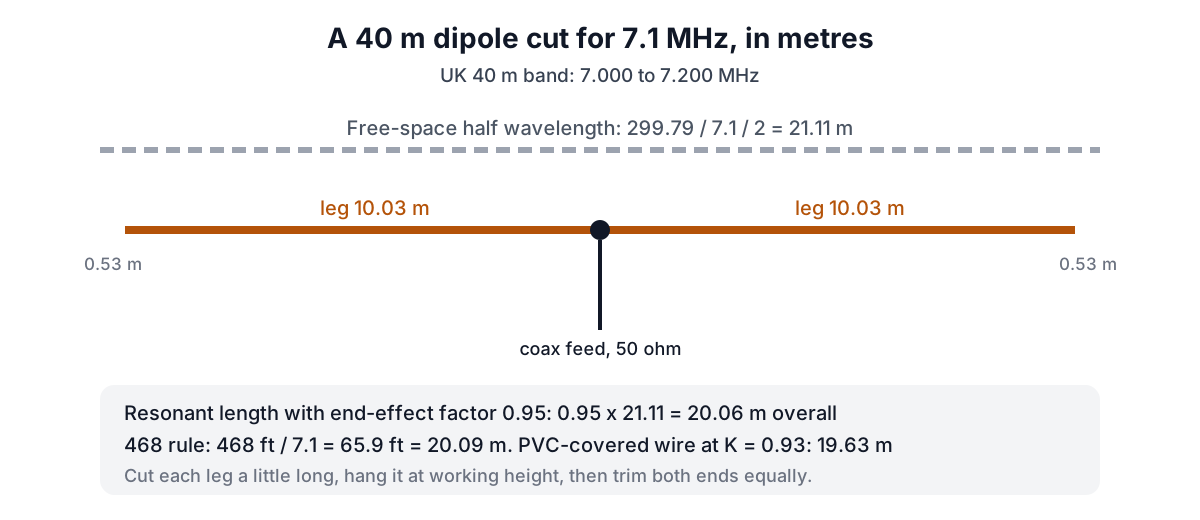
A wave in free space has a wavelength of 299.79 divided by the frequency in MHz, in metres. Half of that at 7.1 MHz is 21.11 m. A real wire dipole resonates when it is a little shorter, because the ends have capacitance to their surroundings and behave as if the wire carried on slightly further. The usual correction for thin HF wire is an end-effect factor of 0.95:
- Half wave in free space: 299.79 / 2 = 149.9 / f metres
- With the 0.95 factor: 142.4 / f metres
- The familiar 468 / f feet, converted: 142.6 / f metres
The 0.2% gap between 142.4 and 142.6 is far smaller than the changes height and insulation make, so treat either as a starting length, never a finished one.
Cut for the UK band, not the American one
The RSGB HF band plan gives the UK allocations, and several are narrower than the Region 2 bands used in North America. A US article that tells you to cut 80 m for 3.75 MHz or 40 m for 7.15 MHz is aiming at the middle of a band Britain does not have. Cutting for the middle of the UK band gives these starting lengths at K = 0.95:
| Band | UK edges (RSGB) | Cut for | Dipole overall | Each leg |
|---|---|---|---|---|
| 80 m | 3.500 to 3.800 MHz | 3.7 MHz | 38.49 m | 19.24 m |
| 40 m | 7.000 to 7.200 MHz | 7.1 MHz | 20.06 m | 10.03 m |
| 30 m | 10.100 to 10.150 MHz | 10.125 MHz | 14.06 m | 7.03 m |
| 20 m | 14.000 to 14.350 MHz | 14.175 MHz | 10.05 m | 5.02 m |
| 17 m | 18.068 to 18.168 MHz | 18.118 MHz | 7.86 m | 3.93 m |
| 15 m | 21.000 to 21.450 MHz | 21.2 MHz | 6.72 m | 3.36 m |
| 12 m | 24.890 to 24.990 MHz | 24.94 MHz | 5.71 m | 2.85 m |
| 10 m | 28.000 to 29.700 MHz | 28.5 MHz | 5.00 m | 2.50 m |
On 40 m the UK band is only 200 kHz wide, so a dipole cut for 7.1 MHz covers it with a modest SWR at the edges. On 80 m the band is 300 kHz wide and a dipole's SWR rises quickly away from resonance, so decide whether you mostly use the CW end or the phone end and trim for that part.
Fitting 80 m and 40 m into a British garden
A 38.5 m straight run is longer than many back gardens. The usual ways round it, roughly in order of how much they change the result:
- Inverted V. Feed the centre from a mast or chimney bracket and slope the legs down. The ends sit nearer the ground and the wire resonates lower, so it typically finishes 3 to 5% shorter than a flat-top. For 3.7 MHz that is roughly 36.6 to 37.3 m; running the calculator at K = 0.93 gives 37.68 m as a first cut.
- Dog-legged ends. Running the last few metres of each leg along a fence or back towards the house works, at some cost in pattern and with a lower resonance. Trim in place.
- End-fed half wave. The same overall length as a dipole, fed at one end through a high-ratio transformer, which suits a house at one end of a long, narrow garden.
- 40 m instead of 80 m. At 20.06 m overall, a 40 m dipole fits many gardens that 80 m does not, and the same wire can be tuned on other bands through an ATU and open-wire feeder.
Covered wire from a DIY shop behaves differently from bare copper. The PVC adds a little loading, so a 40 m dipole in insulated wire usually resonates at about 19.6 m rather than 20.06 m. The calculator gives 19.63 m at K = 0.93. Start long either way.
Trimming to resonance
Cut each leg 2 to 3% longer than the calculator shows, plus enough to loop through the insulators, then raise the antenna to its working height before measuring. The resonant frequency moves as the wire goes up, so adjusting it on the lawn is wasted effort.
Say a 20.06 m dipole meant for 7.1 MHz shows its lowest SWR at 6.95 MHz. It is too long by the ratio of the two frequencies, so the new length is 20.06 x 6.95 / 7.1 = 19.64 m. That means removing about 0.42 m in total, 0.21 m from each leg. Trim both legs equally so the feed point stays central, and measure again; the second correction is usually small.
VHF: 6 m, 4 m, 2 m and 70 cm
At VHF the elements are short enough to cut from rod or tube, and the UK has one band most countries lack. The RSGB plan gives 4 m as 70.0 to 70.5 MHz, held on a secondary basis, and puts most narrowband activity near 70.2 MHz. The calculator's quarter-wave lengths:
| Band and frequency | Quarter-wave radiator | Half-wave dipole |
|---|---|---|
| 6 m, 50.2 MHz | 1.418 m | 2.837 m |
| 4 m, 70.2 MHz | 1.014 m | 2.029 m |
| 2 m, 145.5 MHz | 48.9 cm | 97.9 cm |
| 70 cm, 433.5 MHz | 16.4 cm | 32.8 cm |
The UK 2 m band runs from 144.0 to 146.0 MHz, with the FM calling channel at 145.500 MHz in the RSGB plan. US figures for "2 m" often assume 146 MHz, right on the UK band edge. Thick tubing has a lower end-effect factor than thin wire, so at VHF start a few percent long and file back.
27 MHz CB
CB users need no licence for equipment that meets Ofcom's interface requirements: the Wireless Telegraphy (Exemption and Amendment) (Amendment) Regulations 2014 added AM, SSB and DSB CB sets complying with IR 2027.2 to the licence exemption. The same arithmetic applies. At 27.185 MHz a quarter-wave whip is 2.62 m and a half-wave dipole 5.24 m, A 2.62 m whip is long for a car roof, so shorter loaded whips are a common compromise; they still need trimming for the lowest SWR.
Coax stubs and velocity factor
Coax slows the signal, so a length of cable that is a quarter wave electrically is physically shorter than a quarter wave in air. With solid polyethylene cable such as RG-58 or RG-213, at a velocity factor of 0.66:
- A quarter-wave stub at 145.5 MHz is 34.0 cm.
- A quarter-wave stub at 7.1 MHz is 6.97 m.
Use velocity factor only for deliberate lengths of feeder: stubs, quarter-wave transformers, phasing lines. It never applies to the radiating wire, and the feeder to an ordinary dipole can be any convenient length. Foam cables differ by maker, so take the figure from the datasheet.
Check EMF compliance before you transmit
Since Ofcom added an EMF condition to the amateur licence, every UK amateur has to check that their station complies with the exposure limits. The RSGB points to Ofcom's guidance and provides its own EMF calculator, which estimates the EIRP from your transmitter power, feeder loss and antenna, and then the distance people must be kept from the antenna. A low dipole along the side of a garden is exactly the kind of installation to check, because neighbours' gardens and windows may be closer than you think.
Tools for this job
The UK antenna length calculator gives dipole, quarter-wave, 5/8-wave and loop lengths with UK band presets and coax stub lengths. The Reactance and Impedance Calculator helps with matching networks, the Decibel Calculator with feeder loss and gain, and the Wavelength and Frequency Calculator converts in general. The US edition of this guide covers loops and 5/8-wave verticals in more detail.
Frequently asked questions
How long is a 40 m dipole for the UK band?
About 20.06 m overall at 7.1 MHz, two legs of 10.03 m, using an end-effect factor of 0.95. The 468 rule gives 468 / 7.1 = 65.9 ft, which is 20.09 m. Insulated wire or an inverted-V layout finishes a little shorter.
What is 468/f in metres?
468 feet is 142.6 metres, so a half-wave dipole is about 142.6 divided by the frequency in MHz, in metres. It is the free-space half wave, 149.9 / f, reduced by roughly 5% for end effect.
Why should I not use a US dipole length in the UK?
US articles often cut for the middle of the wider North American bands, such as 3.75 MHz on 80 m or 146 MHz on 2 m. The UK 80 m band ends at 3.800 MHz and 2 m at 146.0 MHz, so cut for the middle of the UK allocation instead.
How much shorter is an inverted V than a flat dipole?
Typically 3 to 5% for the same resonant frequency, because the ends are closer to the ground. For 3.7 MHz that is about 37 m instead of 38.49 m; cut long and trim at working height.
Sources and further reading
- HF bands, Radio Society of Great Britain. UK band edges for 80 m to 10 m.
- 70MHz band, Radio Society of Great Britain. The UK 4 m allocation and its secondary status.
- 144MHz band, Radio Society of Great Britain. 2 m from 144.0 to 146.0 MHz and the FM calling channel.
- EMF exposure, Radio Society of Great Britain. The licence requirement to check EMF compliance and the RSGB EMF calculator.
- The Wireless Telegraphy (Exemption and Amendment) (Amendment) Regulations 2014, legislation.gov.uk. Licence exemption for CB equipment complying with IR 2027.2.
- ARRL Antenna Book, American Radio Relay League. The 468, 234 and 1005 rules of thumb.
- CODATA value: speed of light in vacuum, National Institute of Standards and Technology.
Open the Antenna Length Calculator
More Electronics
Every tool in the Electronics section, free and in your browser.