
Balance Transfer or Consolidation Loan in Canada?
$8,000 on a card at 20.99%: a 1.99% promo for 10 months with a 3% fee against a 10.99% loan, the payment where each wins, and Quebec's 5% minimum.
By Redbison Dev · · 10 min read
Canada edition. Written for Canadian borrowers, with amounts in CAD, low-rate promotions of 6 to 18 months as the FCAC describes them, no grace period on transferred balances, issuers' freedom to apply payments, Quebec's 5% minimum payment and the 35% criminal rate. US edition
You owe $8,000 on a card at 20.99%, can pay about $400 a month, and have two offers: a card at 1.99% for 10 months with a 3% transfer fee, and a 10.99% personal loan over three years. At $400 a month the two cost almost the same, $922 for the transfer against $877 for the loan, so the loan wins by about $45. Above roughly $426 a month the transfer wins; below it, the loan does. Short Canadian promotions are the reason the line falls so close to an ordinary budget.
The numbers come from the Canadian versions of the Balance Transfer Calculator and the Debt Consolidation Calculator, so you can repeat them with your own offers.
How Canadian balance transfers differ
The Financial Consumer Agency of Canada (FCAC) describes a balance transfer as moving a balance to a card with a lower promotional rate that "usually" lasts 6 to 18 months, with a fee that is usually a percentage of the amount moved. Three features matter for the arithmetic:
- Many promotions are low, not zero. Offers such as 1.99% still charge interest during the promotion. On this example that is $107.69 over 10 months, on top of the fee.
- There is no grace period on the transfer. Federally regulated issuers must give at least a 21-day interest-free grace period on new purchases, but the FCAC says it does not apply to balance transfers, cash advances or cash-like transactions. Interest at the promotional rate starts the day the balance arrives.
- The issuer decides how payments are applied. The FCAC states that federally regulated card issuers may choose how they apply your payments to your balance. If you buy things on the new card, your payment may go to the low-rate transferred balance while the purchases sit at the full purchase rate. Keep the transfer card for the transfer alone.
The FCAC also warns that a missed payment can cost you the promotional rate and may raise your interest rate, temporarily or permanently, although the issuer must notify you before an increase takes effect.
Worked example: the 10-month promotion
Open the Balance Transfer Calculator; its Canadian defaults are this offer:
- Balance 8,000 at a current rate of 20.99
- Transfer fee 3, minimum fee 0
- Promotional rate 1.99 for 10 months, then an example regular rate of 22.99
- Monthly payment 400
The fee is $240, so the new card starts at $8,240. After 10 payments, $4,347.69 is still owed and moves to 22.99%. The balance is gone in month 23, and the transfer costs $922.35: the fee, $107.69 of promotional interest and $574.66 charged after the promotion. To clear everything inside the 10 months you would need $831.53 a month.
Staying on the old card at $400 takes 25 months and costs $1,931.64, so the transfer still saves $1,009.29. The question is whether a loan saves more.
Worked example: a 10.99% consolidation loan
In the Debt Consolidation Calculator, remove the sample debts and enter one card of 8,000 at 20.99% with a payment of 400. Set the loan to 10.99%, 36 months, fee 0.
The scheduled payment is $261.87, and paid exactly to schedule the loan costs $1,427.39 in interest. The fair comparison is the row that keeps your $400: the loan is repaid in 23 months for $877.24, which is $45.11 less than the transfer over the same 23 months. The regular rate on the card after the promotion, here higher than the old card, is what tips it.
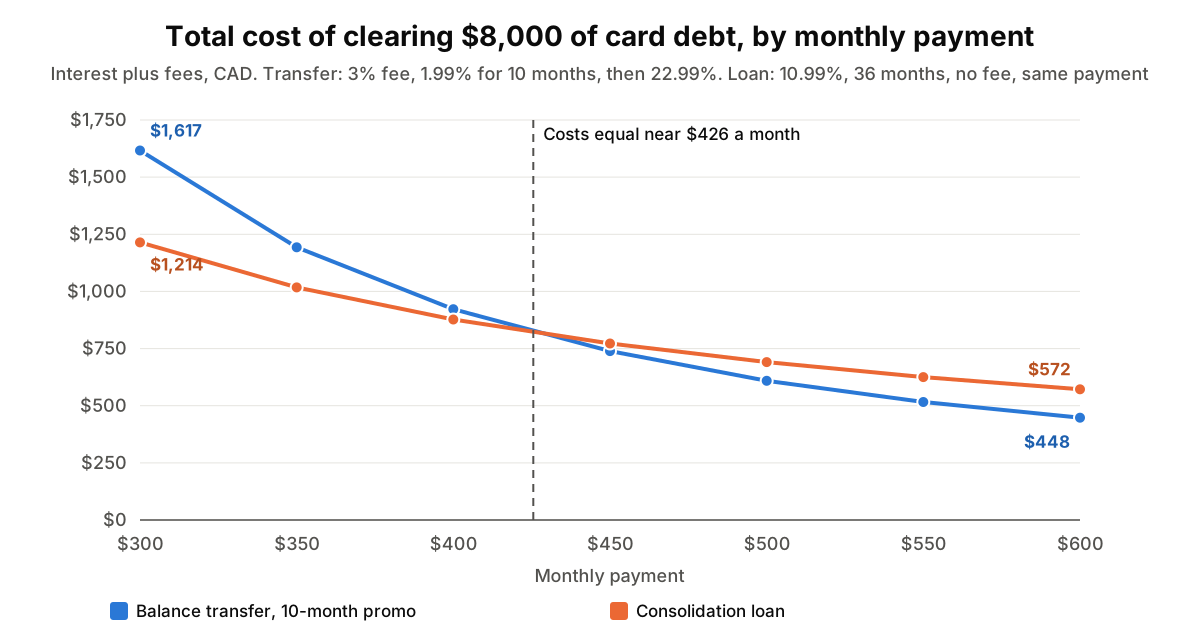
What moves the crossover
A longer promotion. Set the promotion to 18 months, the top of the FCAC's range, and at $400 only $1,187.07 is left when it ends; the transfer costs $434.12, about half the loan's cost. The payment that clears it inside the promotion drops to $465.02. On an 18-month offer the transfer wins comfortably at almost any payment that would also suit the loan.
Quebec's 5% minimum. The Office de la protection du consommateur says the minimum monthly payment on a credit card in Quebec must be at least 5% of the balance owing on your statement. On a new $8,240 balance that is $412, already above the $400 in this example. At $412 the transfer costs $872.05 against the loan's $849.53, so the two are within about $23 of each other. If you live in Quebec, your minimum payment alone puts you close to the crossover.
The regular rate. Read the rate that applies after the promotion in the cardholder agreement, not the advertisement. If it is lower than your current card, the leftover balance costs less and the crossover moves down.
Loan, line of credit or home equity?
The FCAC describes consolidating with a loan (including a home equity loan), a line of credit (including a home equity line) or a balance transfer. It adds two cautions that apply to all of them: you may only qualify for a product with a higher rate than you pay now, and a longer repayment period can cost more in interest over time.
A line of credit often has a lower rate than a card, but the FCAC points out that monthly payments may cover only the interest, and that if you keep borrowing on it, getting out of debt may be difficult. If you use one, pay it as if it were a loan: enter it in the consolidation calculator as the loan, with the term you intend to keep to.
A home equity loan or line puts card debt against your house. The rate can be lower; the risk to your home is higher, and the debt can stretch over many years.
Whatever you choose, check the cost at the source. A loan agreement starts with an information box showing the annual percentage rate and the total cost of borrowing, and the Criminal Code sets the criminal rate at an annual percentage rate above 35% on the credit advanced, so any legitimate consolidation loan should sit far below that. In Quebec, a lender must evaluate whether you can repay before granting credit or raising a credit limit, so you may be approved for less than the full balance.
How the tools count interest
Both calculators charge the annual rate divided by 12 on the opening balance each month. Your card may work out interest another way, for example daily, so statements can differ by a few dollars a month. The comparison assumes no new purchases on either card and every payment on time.
This comparison does not fit you if you are already behind on payments. The FCAC suggests credit counselling agencies and Licensed Insolvency Trustees as places to look at other options before you borrow more.
Tools for this job
- Balance Transfer Calculator: fee, promotional interest, what is left when the promotion ends and the payment that clears it.
- Debt Consolidation Calculator: cards and a line of credit against one fixed-rate loan, with the cost of keeping your current payment.
- Debt Payoff Calculator: the plan with no new credit, by avalanche or snowball.
- APR Calculator: checks the APR on a loan offer that has fees.
For working through several debts, read the Canadian edition of car loans and paying off debt.
Frequently asked questions
Is a 0% transfer always better than a 1.99% one?
Not by itself. On this example the 1.99% costs $107.69 of interest over 10 months. A 0% offer with a higher fee or a shorter promotion can cost more. Enter both offers in the calculator with the same payment and compare the totals.
Can I transfer only part of the balance?
Yes, and it is common when the new card's limit is lower than the balance. Run the transfer on the approved amount and the loan or a plain payoff plan on the rest, then add the two totals.
What happens if I miss a payment during the promotion?
According to the FCAC you may lose the promotional rate and your interest rate may go up, temporarily or permanently. The issuer must tell you before an increase takes effect. Set up an automatic payment.
Will consolidating affect my credit score?
Applying adds an inquiry and a new account to your credit report, while paying card balances down lowers how much of your available credit you use. The net effect depends on your whole file.
Sources and further reading
- How credit cards work, Financial Consumer Agency of Canada. Balance transfer fees, no grace period on transfers, payment allocation and missed payments.
- Debt consolidation, Financial Consumer Agency of Canada. Loans, lines of credit, home equity and 6 to 18 month promotional rates.
- Credit card: payment, Office de la protection du consommateur (Quebec). The 5% minimum monthly payment.
- Evaluating one's ability to pay, Office de la protection du consommateur (Quebec). Assessment before credit is granted or a limit raised.
- Criminal Code, section 347, Justice Laws Website. The criminal rate: an annual percentage rate above 35% on the credit advanced.
- Financial Consumer Protection Framework Regulations, Justice Laws Website. How banks disclose the APR and cost of borrowing.
Open the Balance Transfer Calculator
More Loans & Mortgages
Every tool in the Loans & Mortgages section, free and in your browser.