
Balance Transfer vs Debt Consolidation Loan: Running the Numbers
A 0% card with a 4% fee against a 12.99% loan with a 5% origination fee on the same $12,000 of card debt, and the monthly payment at which each one wins.
By Redbison Dev · · Updated · 10 min read
You owe $12,000 on a credit card at 24.99%, you can put about $350 a month toward it, and two offers have arrived: a card with 0% on transfers for 12 months and a 4% fee, and a personal loan at 12.99% over five years with a 5% origination fee. The balance transfer wins if you can pay off most of the balance before the 0% period ends; the loan wins if you cannot, because whatever is left on the card moves to a high go-to rate while the loan's rate stays fixed. With these two offers the line falls at about $366 a month: below it the loan is cheaper, above it the transfer is.
Below, the Balance Transfer Calculator and the Debt Consolidation Calculator work the example through, so you can repeat it with your own offers. The rules cited are US federal rules from Regulation Z (Truth in Lending) and the Consumer Financial Protection Bureau (CFPB).
What each offer costs before you pay a cent of interest
Both offers charge a fee up front, and they charge it differently.
A balance transfer fee is added to the new card's balance. The CFPB describes it as usually a percentage of the amount transferred or a fixed amount, whichever is more, and confirms an issuer may charge it on a 0% offer. A 4% fee on $12,000 is $480, so on day one you owe $12,480 on the new card, all of it at 0% for the promotional period.
A loan origination fee is usually taken out of the money the lender sends you. If the fee is 5% and you need $12,000 to reach your card, you have to borrow $12,000 ÷ 0.95 = $12,631.58; the lender keeps $631.58. Regulation Z treats loan fees like this as finance charges (12 CFR 1026.4), which is why the loan's APR is higher than its 12.99% note rate.
The other number that matters is what happens after the promotion. Under 12 CFR 1026.55(b)(1), a card issuer can raise a promotional rate when it expires only if the promotion lasted at least six months and the issuer told you in advance how long it lasts and what rate follows. That go-to rate is in the offer's terms. In this example it is 27.99%, higher than the card you are leaving.
Worked example 1: the balance transfer
Open the Balance Transfer Calculator. Its default inputs are this example, so you can check each number:
- Balance to transfer 12,000 and Current APR 24.99
- Transfer fee 4 and Minimum fee 5
- Promotional APR 0, Promotional period 12 months, APR after the promotion 27.99
- Monthly payment 350
The calculator shows a $480 fee and $8,280 still owed when the promotion ends: twelve payments of $350 take $4,200 off the $12,480. To clear the balance inside the 12 months you would need $1,040 a month ($12,480 ÷ 12).
From month 13 the $8,280 is charged 27.99%. At $350 a month the card is paid off after 47 months (the Paid off column shows 3 years 11 months) in total, and the transfer costs $4,382.66: the $480 fee plus $3,902.66 of interest, every cent of it after the promotion. Staying on the current card with the same $350 payment takes 61 months (5 years 1 month) and costs $9,257.05 in interest, so even a promotion you cannot finish saves $4,874.39 here.
The break-even fee, shown under the results, is 19.4%. The fee is not what makes this offer risky; the balance left at month 12 is.
Worked example 2: the consolidation loan
Open the Debt Consolidation Calculator. It starts with three sample cards; remove two with the bin icon and set the remaining row to a balance of 12,000, an APR of 24.99 and a monthly payment of 350. Then set:
- Loan interest rate 12.99
- Loan term 60 months
- Origination fee 5, with How the fee is paid on "Taken from the loan"
The loan amount is $12,631.58, the scheduled payment $287.34, and the APR with the fee 15.295%. Paid as scheduled over 60 months, the loan costs $5,240.55: $4,608.98 of interest plus the $631.58 fee. That is $857.89 more than the balance transfer, even though the payment is $62.66 lower, because the debt is spread over five years.
The third row is the fair comparison. Keep paying the $350 you pay now and the loan is gone in 47 months (3 years 11 months) for $4,104.32 ($3,472.74 of interest plus the fee). Against the transfer's $4,382.66 over the same 47 months, the loan comes out $278.34 ahead. Check first that the loan has no prepayment penalty.
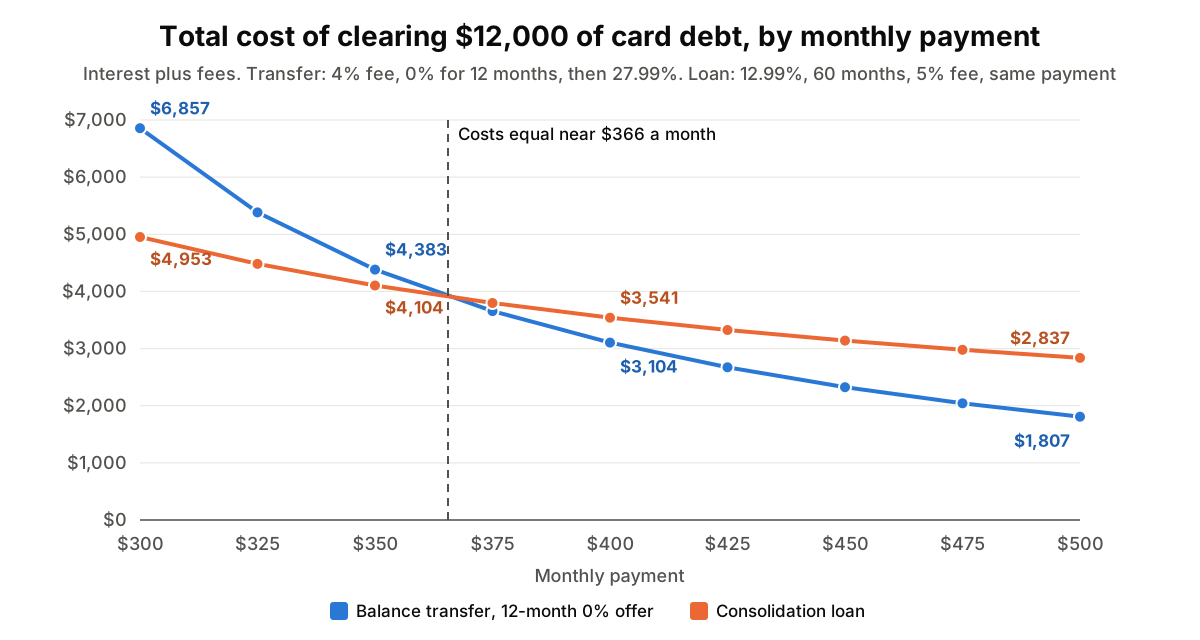
Where the line falls, and what moves it
The chart repeats both calculations for payments from $300 to $500 a month. Below about $366 the loan is cheaper, because too much of the transferred balance survives the 0% year and meets the 27.99% go-to rate. Above it the transfer is cheaper, and the gap widens fast: at $400 the transfer costs $3,104.25 against the loan's $3,540.98, and at $500 it is $1,807.08 against $2,836.93.
Three inputs move the crossover more than any other:
- The promotional period. Change the period to 18 months in the Balance Transfer Calculator and, at $350, only $6,180 is left when it ends; the transfer costs $2,357.13 and beats the loan by a wide margin. The payment needed to clear it in time drops to $693.33.
- The go-to rate. A go-to rate at or below your current card's rate makes the leftover balance less costly. Read it in the offer, not the advertisement.
- The loan term. A shorter term raises the scheduled payment and lowers the total. On the same debt, a 36-month loan at 12.99% with the same fee has a $425.55 payment and costs $3,319.69. If you can afford that payment, compare it with the transfer at $425 too: the transfer costs $2,672.24.
The loan also has a downside the chart cannot show: at a long term and a low payment it can cost more than the cards it replaces. The Debt Consolidation Calculator warns when the loan's rate is lower than your average APR yet its total is higher. The CFPB makes the same point: a consolidation loan's lower payment may only reflect a longer repayment period.
The rules that change the result
The figures above assume a few conditions. Each one, broken, raises the real cost.
- Pay on time. Being more than 60 days late on a payment can end the promotional rate early, according to the CFPB. Set up an automatic payment.
- Do not spend on the new card. While a transferred balance is carried, new purchases are charged interest from the day you buy, because you lose the grace period unless you pay the whole balance by the due date. Payments above the minimum go to the highest-rate balance first (12 CFR 1026.53), so purchases are paid down before the 0% balance, but purchases still accrue interest.
- Check it is not deferred interest. A balance transfer promotion is normally a reduced APR: if a balance remains when it ends, interest applies from then on. Retail "no interest if paid in full" plans work differently and charge interest back to the purchase date if anything is left, as the CFPB explained in its 2017 statement on deferred-interest promotions.
- Watch for teaser loan rates. The CFPB notes that some consolidation loans advertise a low rate that lasts only for a while. Enter the rate that applies for the whole term.
Both calculators charge APR ÷ 12 on the month's opening balance. Most card issuers compute interest with a daily periodic rate on the average daily balance (the method is named in the card's account-opening disclosures), so real statements can differ by a few dollars a month on a balance this size.
This comparison does not fit everyone. If you are already behind on payments or cannot cover the minimums, a nonprofit credit counselor can look at options such as a debt management plan, and the CFPB's page on credit counseling explains how to check one before you sign up.
Tools for this job
- Balance Transfer Calculator: the fee, the balance left when the promotion ends, the payment that clears it in time and the total cost against staying on your card.
- Debt Consolidation Calculator: one loan against all your current debts, with the origination fee, the APR, the payoff date and the cost of keeping your current payment on the loan.
- Debt Payoff Calculator: the do-nothing baseline. Remove all but one of its sample debts, set that one to a balance of 12,000, an APR of 24.99 and a minimum of 350, and enter 350 as the total paid each month; it shows the same 5 years 1 month (61 months) and $9,257.05 of interest. With several cards it orders extra payments by the avalanche or snowball method, which can be enough without new credit.
- APR Calculator: check a loan offer's APR. Enter a loan amount of 12,631.58, a rate of 12.99, a term of 5 years, fees of 631.58 and 0 points, leave "Add fees and points to the loan balance" off, and it returns 15.295%.
- EMI Calculator: a monthly schedule for the loan. Enter 12,631.58 as the total amount before down payment, a down payment of 0, 12.99% and 60 months; the Principal & Interest figure is $287.34 (set the insurance, tax and maintenance boxes to 0 if you want the total to match).
For the arithmetic behind avalanche and snowball payoff, read Car Loans, Leases and Paying Off Debt: The Numbers That Matter. For why an APR and an effective annual rate differ, see APY, Bond Yields and SIP Returns: Reading the Rate Correctly, and for fitting a payment into a monthly budget, The 50/30/20 Budget: Needs, Wants and Savings in Practice.
Frequently asked questions
Can I do both: transfer part of the debt and consolidate the rest?
Yes, and it is common when the new card's transfer limit is lower than the balance. Run the Balance Transfer Calculator on the amount the issuer approves and the Debt Consolidation Calculator on the rest, then add the two totals. Keep the payment you planned for each, or the comparison will not hold.
Does a consolidation loan or a new card hurt my credit score?
Either one is a new credit application and a new account, which can lower a score for a while, while paying down card balances lowers your utilization. The size of each effect depends on your credit file, so no calculator can put a number on it.
What if I can only afford the minimum payment on the new card?
Then most of the transferred balance will still be there when the promotion ends, and the transfer mainly delays the interest. Enter the minimum as the monthly payment in the Balance Transfer Calculator to see the leftover balance and the total, and compare it with a loan whose scheduled payment you can make.
Is the loan's APR or its interest rate the one to compare with my card?
The APR. It includes the origination fee, as Regulation Z requires, so it is comparable with your card's APR and with other loan offers. A 12.99% loan with a 5% fee over 60 months has an APR of 15.295%.
Sources and further reading
- 12 CFR 1026.55: Limitations on increasing annual percentage rates, fees, and charges, Consumer Financial Protection Bureau. Promotional rates must last at least six months, with the length and the go-to rate disclosed in advance.
- 12 CFR 1026.53: Allocation of payments, Consumer Financial Protection Bureau. Payments above the minimum go to the highest-rate balance first.
- Appendix J to Part 1026: Annual Percentage Rate Computations for Closed-End Credit Transactions, Consumer Financial Protection Bureau. The actuarial method behind the loan APRs in this post.
- What do I need to know about consolidating my credit card debt?, Consumer Financial Protection Bureau. How transfer fees are set, the grace-period catch, teaser loan rates and longer terms.
- What is a balance transfer fee? Can a balance transfer fee be charged on a zero percent interest rate offer?, Consumer Financial Protection Bureau. Confirms a fee can apply to a 0% offer.
- How long can I keep a low rate on a balance transfer or other introductory rate?, Consumer Financial Protection Bureau. The six-month minimum and the 60-days-late exception.
- Consumer Financial Protection Bureau Encourages Retail Credit Card Companies to Consider More Transparent Promotions, Consumer Financial Protection Bureau. The 2017 statement on how deferred interest differs from a 0% promotion.
- What is credit counseling?, Consumer Financial Protection Bureau. Nonprofit counseling and debt management plans, and how to check an agency.
Open the Balance Transfer Calculator
More Loans & Mortgages
Every tool in the Loans & Mortgages section, free and in your browser.