
Balance Transfer or Consolidation Loan in Ireland?
€6,000 on a card at 22.9%: a 0% balance transfer against a 7% bank or credit union loan in Ireland, with the €30 stamp duty and Central Credit Register checks.
By Redbison Dev · · 10 min read
Ireland edition. Written for Irish borrowers: euro amounts, card rates in the CCPC's 13% to 22.9% range, credit union and bank consolidation rates, the €30 annual stamp duty per card account and the Letter of Closure, the Central Credit Register and MABS. US edition
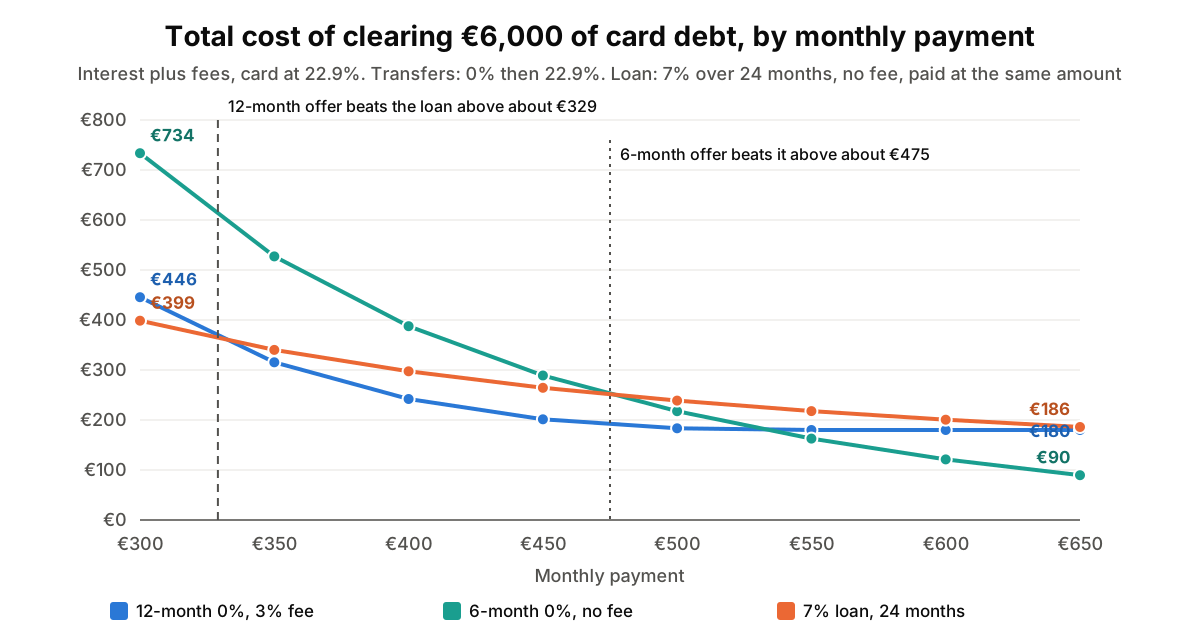
You owe €6,000 on a credit card at 22.9% and can put about €300 a month towards it. In Ireland the choice is usually between a 0% balance transfer card from a bank and a consolidation loan from a bank, fintech, An Post or your credit union. At €300 a month, a 12-month 0% card with a 3% fee costs about €446 in total and a 7% bank loan paid at the same €300 about €399, so the loan edges it. Pay about €330 or more and the card wins. A short 6-month offer only catches the loan above roughly €475 a month. The figures come from the Irish versions of the Balance Transfer Calculator and the Debt Consolidation Calculator, so you can run your own offers the same way.
Irish card debt is expensive: the CCPC puts credit card rates at 13% to 22.9%. What makes Ireland different from the UK or US comparisons you will find online is that consolidation loans here are cheap. The CCPC's consolidation page quotes bank, fintech and An Post rates of about 6.5% to 7.1% APR and credit union rates of about 7.75% to 12.74%, and says most lenders charge no application fee. A loan at 7% is a serious competitor to a 0% card.
Staying put: the cost you are comparing against
Leave the €6,000 on the card at 22.9% and pay €300 a month, and the calculator shows it cleared in 26 months with €1,629.87 of interest. The CCPC notes that the minimum payment is usually around 2% to 5% of the balance; paying only that on €6,000 would take years. Every option below is measured against that €1,629.87.
Option 1: a 0% balance transfer card
Enter in the Balance Transfer Calculator (Ireland):
- Balance 6,000 at 22.9%
- Transfer fee 3%, rate during the offer 0, 0% period 12 months, rate after the offer ends 22.9%
- Monthly payment 300
The €180 fee is added on day one, so the new card starts at €6,180. Twelve payments of €300 leave €2,580 when the offer ends, and that remainder goes back to 22.9%. The card is cleared in month 22 and the transfer costs €445.67: the €180 fee plus €265.67 of interest after the offer. Against staying put that saves €1,184.19. To clear it inside the 0% period you would need €515 a month.
A short offer with no fee behaves differently. On a 6-month 0% offer at €300 a month, €4,200 is still owed when the offer ends and the plan costs €733.70, all of it interest after the offer. Clearing it in time would take €1,000 a month.
The CCPC's checklist for any transfer: how long the low rate lasts, whether it covers new purchases or only the moved balance, and what the rate becomes afterwards. If purchases are charged at the full rate, use the new card only to repay.
Option 2: a consolidation loan
In the Debt Consolidation Calculator (Ireland), clear the sample debts and enter one credit card of 6,000 at 22.9% with a payment of 300. Set the loan to 7%, 24 months, fee 0.
The scheduled repayment is €268.64 and the loan costs €447.25 in interest if you stick to it. Keep paying the €300 you were already paying and it is gone in 22 months for €398.63. At a credit union rate of 11% the same plan costs €658.61; at the top of the CCPC's credit union range, 12.74%, it costs €780.62. Ask about early repayment fees before you plan to overpay. The CCPC notes that some credit unions charge neither arrangement fees nor early repayment penalties.
Which wins, by monthly payment
| Monthly payment | 12-month 0%, 3% fee | 6-month 0%, no fee | 7% loan, 24 months |
|---|---|---|---|
| €300 | €445.67 | €733.70 | €398.63 |
| €400 | €242.01 | €387.52 | €297.41 |
| €500 | €183.44 | €217.57 | €238.83 |
| €600 | €180.00 | €121.20 | €200.52 |
The rule of thumb still holds: divide the balance plus the fee by the number of 0% months. If you can pay that, take the transfer. If you will be well short, a fixed-rate loan at Irish bank rates is often cheaper and certainly more predictable, because whatever stays on the card meets the full rate again.
Irish costs the headline rate leaves out
Stamp duty. Government stamp duty of €30 a year is charged per credit card account, not per card. Move the balance and leave the old account open and you pay it on both. The CCPC's advice is to pay the old account's stamp duty and ask the old provider for a Letter of Closure for the new one. The loan route has a quieter advantage here: if you clear the card with a loan and close the account, there is no card stamp duty at all for the years the loan runs.
The Central Credit Register. Loans of €500 or more, credit cards included, are reported to the Central Credit Register, and a new lender will look at your report before approving a card or loan. You can request your own report free of charge. Check it before applying, so a forgotten account or an error does not cost you the rate.
Approval is not certain. The CCPC notes that card providers check your credit history, income and existing debt before accepting a transfer, and that consolidation lenders assess affordability, credit history and the purpose of the loan. The rate you are offered may be above the advertised one.
Borrowing again. The biggest risk with either route is that the cleared card fills up again. Close it, or ask for a lower limit.
Before you apply
- Write down the payment you can keep up every month, not the one you hope for. That number decides the answer.
- Get the transfer's 0% period, fee and after-offer rate from the card's terms, and the loan's APR and any fees from a written quote.
- Run both calculators with those figures and the same monthly payment.
- If you are already missing repayments, talk to the Money Advice and Budgeting Service before taking on new credit; its help is free and independent.
This guide shows how the costs compare; it is not advice on a particular product. If your debts are large or you are in arrears, MABS or a regulated adviser can look at your whole situation.
Tools for this job
- Balance Transfer Calculator (Ireland): the cost of a 0% offer, the balance left when it ends and the payment that clears it in time.
- Debt Consolidation Calculator (Ireland): your card, overdraft and loans against one credit union or bank loan.
- Debt Payoff Calculator (Ireland): how long each card or loan takes to clear at the payment you can afford.
- APR Calculator (Ireland): the true annual rate of a loan quote once fees are included.
The US edition of this guide covers US card offers and the effect on your credit score.
Frequently asked questions
Is a balance transfer or a credit union loan better in Ireland?
It depends on what you can repay each month. For €6,000 at 22.9%, a 12-month 0% offer with a 3% fee beats a 7% loan only if you pay more than about €329 a month; credit union rates of 11% to 12.74% make the card more attractive.
Do I pay credit card stamp duty twice after a balance transfer?
Only if you leave the old account open. Stamp duty of €30 a year is charged per account. Pay the old account's stamp duty, close it and give the Letter of Closure to the new provider.
Will a consolidation loan show on my Central Credit Register report?
Yes. Loans of €500 or more, including credit cards, are reported, and lenders check your report when you apply. You can get your own report free.
What happens when the 0% period ends?
Whatever is still owed is charged at the card's standard rate. On a 12-month offer at €300 a month, €2,580 of the €6,180 starting balance is left and costs €265.67 more in interest.
Sources and further reading
- Credit cards, Competition and Consumer Protection Commission. Card rates of 13% to 22.9%, balance transfers, minimum repayments and the €30 stamp duty with the Letter of Closure.
- Consolidating debt, Competition and Consumer Protection Commission. Credit union, bank, fintech and An Post rate ranges, fees and MABS.
- Credit card debt, Competition and Consumer Protection Commission. Moving to a 0% card and the checks a new provider makes.
- Central Credit Register FAQ, Central Bank of Ireland. Which loans are reported and free credit reports.
- Money Advice and Budgeting Service, MABS. Free, independent help with debt.
Open the Balance Transfer Calculator
More Loans & Mortgages
Every tool in the Loans & Mortgages section, free and in your browser.