
Blood Pressure Readings in Canada: The 130/80 Line Explained
What Hypertension Canada's 2025 threshold of 130/80 means for a pharmacy, office or home reading, when 140/90 matters, and how to average a week of readings.
By Redbison Dev · · 10 min read
Canada edition. Written for readers in Canada: readings are judged by the Hypertension Canada 2025 primary care guideline (130/80 to define hypertension, 140/90 or high risk for medication, a systolic target below 130), with its home-monitoring routine, pharmacy kiosks and 9-1-1 advice from Heart & Stroke; US and European labels appear only for comparison. US edition
In Canada, a confirmed blood pressure of 130/80 or higher is now called hypertension. That is the definition in Hypertension Canada's 2025 primary care guideline, published in the CMAJ, and it is lower than the threshold the organization used before. The guideline then draws a second line at 140/90, where it recommends medication for everyone with confirmed hypertension, and sets a treatment target of a systolic below 130. This edition explains those lines, how to take readings that count, and how to check yours with the Canadian version of the Blood Pressure Checker.
One definition for office, pharmacy and home
Some guidelines use one threshold in the clinic and a lower one at home. Hypertension Canada uses a single number. Its diagnosis recommendations define hypertension in adults as 130/80 mmHg or higher when measured with a validated device under optimal conditions, and note that standardized automated office readings closely approximate daytime ambulatory and home averages. If either number reaches its line, the reading counts: 128/82 is over the line because of the 82.
| Band in the checker | Reading | What the 2025 guideline does with it |
|---|---|---|
| Below the threshold | below 130 and below 80 | not hypertension |
| Hypertension | 130 to 139, or 80 to 89 | lifestyle changes for all; medication if systolic is 130 to 139 and cardiovascular risk is high |
| Medication threshold | 140 or higher, or 90 or higher | medication plus lifestyle changes, once confirmed |
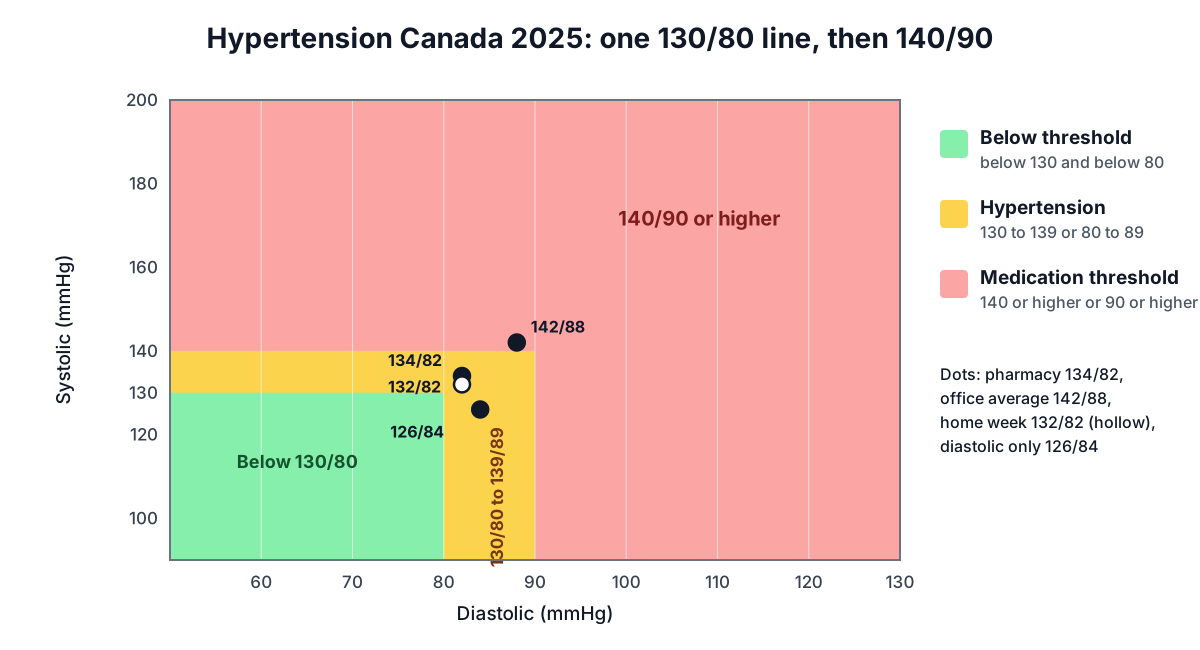
The committee says plainly that the lower threshold "will increase the number of people labelled as having hypertension". It justifies the change with data showing risk at 130 to 139 systolic or 85 to 89 diastolic is 1.5 to 2 times that below 120/80. Because the labels moved, a printout or app from a few years ago may describe the same numbers more gently.
How it lines up with US and European labels
Monitors sold in Canada often come with US-designed apps. The table shows what the Canadian checker reports for the same readings under each scheme:
| Reading | Hypertension Canada 2025 | US ACC/AHA | ESH 2023 |
|---|---|---|---|
| 126/84 | hypertension (diastolic) | stage 1 | normal |
| 134/82 | hypertension | stage 1 | high normal |
| 142/88 | medication threshold | stage 2 | grade 1 (isolated systolic) |
| 162/98 | medication threshold | stage 2 | grade 2 |
| 182/118 | medication threshold | severe range | grade 3 |
Canada and the US now agree on 130/80 as the starting line; Europe still waits until 140/90 to call it hypertension. The bigger difference from the US is what follows: Hypertension Canada sets one systolic target for everyone being treated and a short list of high-risk conditions for the 130 to 139 range.
Taking a reading that counts
The guideline is strict about measurement because errors move readings across these lines:
- Use a validated device. Hypertension Canada keeps a list of recommended devices. Its guideline notes that 90% of the blood pressure devices sold at Canadian pharmacies are validated, against 45% of those sold by online retailers.
- Standardize the routine. Unstandardized office readings come out 5 to 10 mmHg higher on average. Most recent trials used a 5-minute seated rest followed by three readings a minute apart, all averaged.
- At home, Hypertension Canada's monitoring advice is: measure morning and evening for 7 days; no smoking, caffeine or need for the washroom in the 30 minutes before; cuff on a bare arm; sit quietly for 5 minutes, back supported and feet flat; no talking; two readings a minute apart.
Heart & Stroke adds practical points: wrap the cuff so two fingers fit underneath with its lower edge about 3 cm above the elbow crease, use the same arm each time, and take your home monitor to your health-care provider once or twice a year to confirm it still reads accurately.
Worked example 1: a pharmacy kiosk reading
A 47-year-old uses the self-serve machine at a pharmacy and gets 134/82. Typed into the Blood Pressure Checker, it falls in the hypertension band (130/80 or higher), with a mean arterial pressure of 99 mmHg. One reading is not a diagnosis. Heart & Stroke suggests having a single high reading checked at least two more times on separate days, and the guideline recommends out-of-office monitoring to confirm it.
Worked example 2: a standardized office check
At the clinic, after five minutes of rest, an automated device takes 146/90, 141/88 and 139/86. Paste all three under "Several readings" and the checker averages them to 142/88: the medication threshold band. Reading only the first value (146/90) would overstate it; dropping the first and averaging the last two, as some European protocols do, gives 140/87, still in the same band. Before treatment starts, the guideline wants the diagnosis confirmed out of the office where that is possible.
Worked example 3: a week of home readings
Hypertension Canada's standard home protocol is duplicate readings twice a day for a week, averaged. Here is a log of 28 readings:
| Day | Morning | Evening |
|---|---|---|
| 1 | 138/86, 135/84 | 133/83, 131/82 |
| 2 | 136/85, 133/83 | 131/81, 130/80 |
| 3 | 134/84, 132/82 | 130/81, 129/80 |
| 4 | 137/85, 134/83 | 132/82, 130/81 |
| 5 | 133/83, 131/82 | 129/80, 128/80 |
| 6 | 135/84, 132/82 | 131/81, 129/80 |
| 7 | 134/83, 131/82 | 130/80, 128/79 |
Pasted in full, the readings average 132.0/82.1, classed as 132/82: hypertension (below the 140/90 medication threshold). The 14 morning readings alone average 133.9/83.4 and the 14 evening ones 130.1/80.7, so a log of evenings only would have sat right on the line. Leaving out the first day, as the UK's NICE method does, still gives 132/82. Notice too that several single readings are under 130/80; the guideline works from the mean, not the best or worst value.
What happens at 130 to 139 versus 140/90
The guideline's treatment recommendations split confirmed hypertension in two:
- 140/90 or higher: start medication along with healthy lifestyle changes.
- Systolic 130 to 139: start medication only for people at high cardiovascular risk. The guideline's list is established cardiovascular disease, diabetes (type 1 or 2), chronic kidney disease (eGFR below 60 mL/min/1.73 m² or albuminuria of 3 mg/mmol or more), a 10-year Framingham risk score of 20% or more, or age 75 or older. Without one of those, lifestyle changes come first, with a recheck in 3 to 6 months and then every 6 to 12 months if the systolic stays in that range.
So the person in example 3, averaging 132/82, has hypertension by definition, but whether medication is discussed depends on that risk list. Which treatment, if any, is a decision for you and your doctor or nurse practitioner.
The reading of 126/84 is a quieter case. It crosses the definition on the diastolic alone, the US labels it stage 1, and the European scheme calls it normal. The Canadian medication rules key on 140/90 and on systolic 130 to 139, so this pattern points to lifestyle changes and rechecks rather than a prescription.
Targets once treated
For adults being treated, the target is a systolic below 130 mmHg, provided treatment is well tolerated. There is no separate diastolic target; the committee cites evidence that people with a systolic below 130 are at relatively low risk even with a diastolic of 70 to 90. A treated home average of 128/84 therefore meets the Canadian target, even though the checker still places 128/84 in the hypertension band, because the bands describe diagnosis, not treatment. The guideline allows a higher target where frailty, falls, orthostatic hypotension or goals of care make it safer.
Lifestyle numbers from Canadian sources
The guideline recommends healthy lifestyle changes for everyone with hypertension and cites WHO advice of less than 2 g of sodium a day, more than 3.5 g of potassium from food, and 150 to 300 minutes of moderate aerobic activity a week. Heart & Stroke's own figure is less than 2,300 mg of sodium a day in total. People with kidney disease, or who take medicines that raise potassium, should ask before adding potassium.
When a reading is an emergency
A single high reading does not mean you have high blood pressure: Heart & Stroke says to have it checked at least two more times on separate days, and if your readings are high, to follow up with your healthcare provider. Heart & Stroke says to call 9-1-1 for signs of a heart attack (chest discomfort, sweating, upper body discomfort, nausea, shortness of breath, light-headedness) or of a stroke, and not to drive yourself to hospital for a stroke.
The guideline is for adults in primary care. It is not intended for pregnant people or children, and an irregular heart rhythm can make automated devices inaccurate; in those cases, follow your clinician's advice.
Tools for this job
- Blood Pressure Checker: classify one reading or a pasted week by Hypertension Canada 2025, with the US and ESH labels alongside.
- Waist-to-Hip Ratio Calculator: another quick measure of cardiovascular risk to bring to an appointment.
- Target Heart Rate Calculator: set an intensity for the aerobic activity the guideline recommends.
Frequently asked questions
Is 130/80 high blood pressure in Canada?
Yes, once confirmed. Hypertension Canada's 2025 guideline defines hypertension as 130/80 or higher on a validated device under proper conditions, ideally confirmed with home or ambulatory readings. Either number on its own can put you over the line.
Do Canadian doctors start medication at 130/80?
Not for everyone. The guideline recommends medication at 140/90 or higher, and for a systolic of 130 to 139 only when cardiovascular risk is high, for example with diabetes, chronic kidney disease, existing heart or blood vessel disease, or age 75 or older.
Are pharmacy machine readings reliable?
They are a good prompt, not a diagnosis. Hypertension Canada notes that most devices sold in Canadian pharmacies are validated, but any single reading can be off; Heart & Stroke suggests getting a high one checked at least twice more on separate days.
How many home readings should I take?
Hypertension Canada's routine is two readings a minute apart, morning and evening, for seven days, then the average of all of them. Paste them into the checker in any order.
What blood pressure should I aim for on treatment?
A systolic below 130 mmHg if the treatment is well tolerated. The guideline sets no separate diastolic target, and your clinician may set a higher target if you are frail or at risk of falls.
Sources and further reading
- Hypertension Canada guideline for the diagnosis and treatment of hypertension in adults in primary care, CMAJ, 2025. The full guideline.
- Diagnosis (2025 primary care guideline), Hypertension Canada. Validated devices, standardized measurement, out-of-office confirmation and the 130/80 definition.
- Treatment (2025 primary care guideline), Hypertension Canada. Lifestyle, the 140/90 and high-risk medication thresholds, and the systolic target below 130.
- How do I monitor my blood pressure?, Hypertension Canada. The seven-day home routine.
- High blood pressure, Heart & Stroke. Rechecking a high reading on separate days, following up with your healthcare provider, cuff placement and sodium.
- Signs of a heart attack and signs of stroke, Heart & Stroke. When to call 9-1-1.
- 2023 ESH Guidelines for the management of arterial hypertension, Journal of Hypertension. The European grades shown for comparison.
Open the Blood Pressure Category Checker
More Wellness Tools
Every tool in the Wellness Tools section, free and in your browser.