
Blood Pressure Readings UK: NICE Stages, Clinic and Home
What 140/90 at the GP or pharmacy and 135/85 at home mean under NICE NG136, how the NHS wants a week of home readings averaged, and when a reading is urgent.
By Redbison Dev · · 10 min read
United Kingdom edition. Written for UK readers: readings are judged by NICE guideline NG136 as the NHS uses it, with separate clinic and home thresholds, the NHS home-monitoring routine, free pharmacy checks in England, NHS 111 and 999, and the US and European labels shown only for comparison. US edition
In the UK a blood pressure of 140/90 or more taken by a nurse, GP or pharmacist, or an average of 135/85 or more from home readings, is the level the NHS treats as high. Those two thresholds come from NICE guideline NG136, and they are higher than the 130/80 used by American apps and monitors, so the same numbers can earn a warning on a US-built app and a "fine" from your surgery. This edition explains the NICE stages, how to run the week of home readings your GP may ask for, and how to read the result with the UK version of the Blood Pressure Checker.
Two thresholds, depending on where you measured
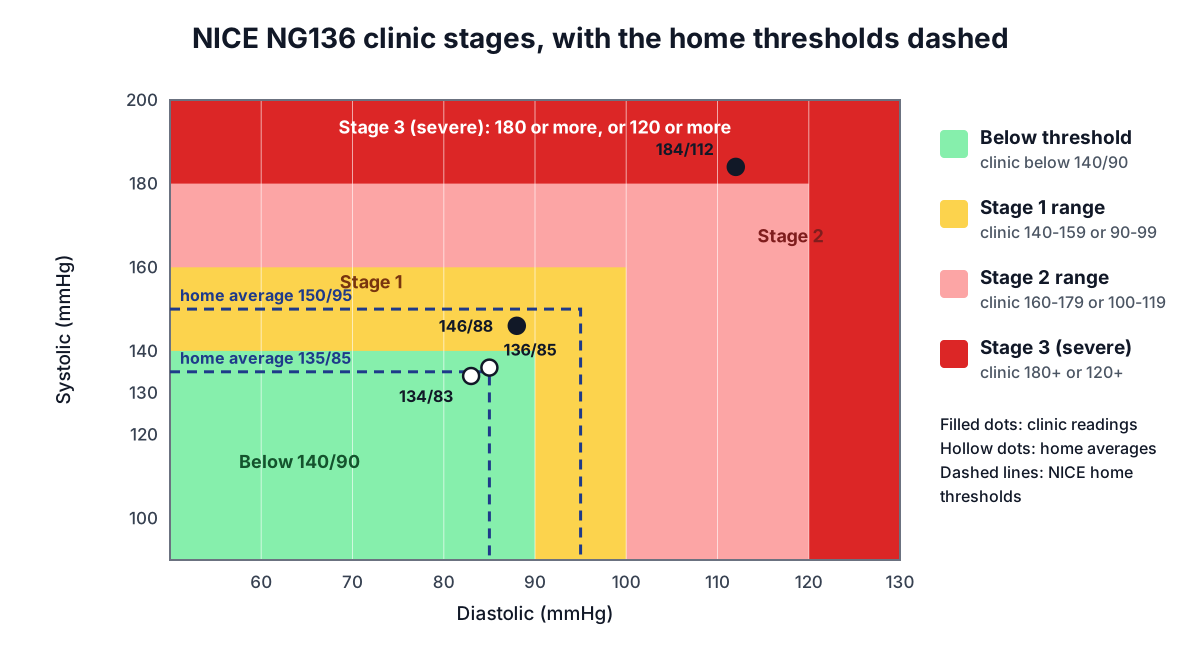
NICE treats a home or daytime ambulatory average as running 5 mmHg lower than the matching clinic figure (recommendation 1.4.18), so each setting has its own numbers. Hypertension is confirmed when the clinic reading is 140/90 or higher and the average from ambulatory or home monitoring is 135/85 or higher (NG136, recommendation 1.2.8). The NHS pages on high blood pressure and the blood pressure test use the same pair of figures.
The full stages, from the "Terms used in this guideline" section of NG136, are:
| NICE stage | Clinic reading | Home or daytime ambulatory average |
|---|---|---|
| Stage 1 hypertension | 140/90 to 159/99 | 135/85 to 149/94 |
| Stage 2 hypertension | 160/100 or higher, below 180/120 | 150/95 or higher |
| Stage 3 or severe hypertension | systolic 180 or more, or diastolic 120 or more | (not defined by a home figure) |
As with every scheme, if the top and bottom numbers fall in different rows, the higher row applies. A clinic reading of 136/92 is in the stage 1 range because of the 92.
Why a US app may disagree with your surgery
Most home monitors and phone apps sold worldwide use the American ACC/AHA categories, which call anything from 130/80 "stage 1 hypertension" and anything from 140/90 "stage 2". European societies use a third set of words. Here is how the UK checker labels six readings when each is typed in as one clinic reading:
| Reading | NICE (clinic) | US ACC/AHA | ESH 2023 |
|---|---|---|---|
| 128/82 | below the NICE threshold | stage 1 | normal |
| 138/86 | below the NICE threshold | stage 1 | high normal |
| 146/88 | stage 1 range | stage 2 | grade 1 (isolated systolic) |
| 152/94 | stage 1 range | stage 2 | grade 1 |
| 162/98 | stage 2 range | stage 2 | grade 2 |
| 184/112 | stage 3 or severe | severe range | grade 3 |
None of these schemes is wrong; they draw lines on the same continuous risk in different places. If your monitor flashes "stage 2" at 146/88, the NHS reading of it is "high enough to check properly with home or ambulatory monitoring", not a diagnosis. The British Heart Foundation's readings table puts the same NICE bands in plain words, calling 130/85 to 139/89 "slightly raised".
Worked example: a pharmacy reading that needs a home week
A 52-year-old has a free check at a community pharmacy and is told 146/88. Typed into the Blood Pressure Checker as one clinic reading, it gives the stage 1 range, a mean arterial pressure of 107 mmHg and a pulse pressure of 58 mmHg. Under NG136 the next step is ambulatory monitoring, a cuff worn through the day that takes at least two readings an hour while awake, or, if that is unsuitable, home monitoring (recommendations 1.2.3 and 1.2.4).
NICE's home routine (recommendation 1.2.7) is specific:
- At each sitting take two readings at least a minute apart, seated.
- Record twice a day, ideally morning and evening.
- Keep going for at least four days, ideally seven.
- Discard the first day and average every remaining reading.
Here is a seven-day log, two readings in the morning and two in the evening:
| Day | Morning | Evening |
|---|---|---|
| 1 | 156/96, 150/93 | 148/92, 145/90 |
| 2 | 138/86, 135/84 | 134/84, 132/82 |
| 3 | 137/85, 134/83 | 133/82, 131/82 |
| 4 | 136/85, 134/84 | 132/83, 131/81 |
| 5 | 138/86, 135/84 | 133/83, 132/82 |
| 6 | 135/84, 133/83 | 132/82, 130/81 |
| 7 | 137/85, 134/84 | 133/82, 131/81 |
Paste days 2 to 7 (24 readings) with "Home average" selected and the checker gives 133.75/83.25, classed as 134/83: below the NICE home threshold. Paste all 28, including the first nervous day, and the average becomes 136.0/84.6, classed as 136/85, which is in the stage 1 home range. Dropping day 1 is not a way to shop for a better answer; it is part of the NICE method, so the day 2 to 7 average is the number to bring to your practice.
With a clinic reading of 146/88 and a home average under 135/85, NICE would not diagnose hypertension. It recommends checking the clinic reading at least every five years, and more often when it is below 140/90 but still raised (recommendation 1.2.10), plus healthy-living advice for people whose pressure is raised without a diagnosis (1.2.11).
White-coat and masked readings
NG136 defines a white-coat effect as a gap of more than 20/10 mmHg between the clinic reading and the home or ambulatory average at diagnosis. Take a clinic reading of 152/94 and 12 home readings over six days averaging 129.9/81.8, which the checker classes as 130/82: the gap is 22/12, so this is a white-coat effect, and the home average is below 135/85. The reverse pattern, masked hypertension, is a normal clinic reading (under 140/90) with a raised home or ambulatory average. NICE suggests home or ambulatory monitoring alongside clinic checks for people with either pattern (recommendation 1.4.18), noting that home and ambulatory figures run 5 mmHg lower than clinic ones.
Getting a reading in the UK
- Pharmacies. The NHS says many pharmacies offer a free check to people aged 40 or over, and its reading checker page specifies the free pharmacy check is for those living in England. Some pharmacies charge others.
- NHS Health Check. In England, people aged 40 to 74 without existing heart disease, diabetes, kidney disease or diagnosed hypertension should be invited every five years; it includes a blood pressure test and a 10-year cardiovascular risk score (NHS Health Check).
- GP surgery and workplaces. The NHS suggests a check if you are 40 or over and have not had one for more than five years.
- Your own monitor. NICE points clinicians to the British and Irish Hypertension Society's list of validated devices (recommendation 1.1.3). Blood Pressure UK advises an automatic, clinically validated monitor with an upper-arm cuff in the right size, rather than a wrist or finger device. If you use one regularly, the NHS asks you to tell your GP practice.
In the clinic, NICE asks for a second reading if the first is 140/90 or more, a third if the two differ substantially, and records the lower of the last two (recommendation 1.2.2). It also measures both arms when hypertension is being considered and uses the higher arm if they differ by more than 15 mmHg on repeat (1.2.1). Neither step is something the checker can do for you, but both explain why a surgery figure may differ from the first number on a pharmacy printout.
Targets once treated
NICE sets one target for people with and without cardiovascular disease (recommendation 1.4.23):
| Age | Clinic target | Home or ambulatory target |
|---|---|---|
| Under 80 | below 140/90 | below 135/85 |
| 80 and over | below 150/90 | below 145/85 |
So an 82-year-old whose home average is 142/80 is within the home target for that age, even though the checker places 142/80 in the stage 1 range: the stages are for diagnosis, the targets for treatment. People with type 1 diabetes or severe chronic kidney disease have their own targets in NG136, which their care team sets. Whether to start medicines at stage 1 depends on age, organ damage, existing disease, diabetes and a 10-year risk of 10% or more (recommendation 1.4.10); at persistent stage 2 NICE says to offer treatment at any age (1.4.9). That decision belongs with your GP.
Low readings and dizziness on standing
The NHS describes low blood pressure as a reading below 90/60, and the checker flags averages under it. Low readings without symptoms are often simply normal for a fit person. NICE defines postural hypotension as a fall of 20 mmHg or more systolic, or 10 mmHg or more diastolic, after standing for at least a minute (recommendation 1.1.6); dizziness, falls or fainting on standing are worth raising with a GP.
When a reading is urgent
NICE calls a clinic reading of 180/120 or higher severe hypertension. A single high home reading is not a diagnosis: Blood Pressure UK says one-off high readings are not a cause for worry, because numbers vary, and advises phoning your GP or practice nurse if you notice a consistent rise. The NHS says to get help from NHS 111 if you often have headaches or blurred vision, or chest pain that comes and goes. NICE asks clinicians to check for organ damage as soon as possible and to refer for same-day specialist assessment when a reading this high comes with signs such as new confusion, chest pain or heart failure (recommendations 1.5.1 and 1.5.2). The NHS says to call 999 for sudden chest pain that does not go away, pain spreading to the arm, neck, jaw, stomach or back, or chest pain with sweating, sickness, light-headedness or breathlessness.
This edition explains how readings are classified; it is not a diagnosis, and it does not cover pregnancy or children, whose readings are judged differently. If you are pregnant, have a long-term condition or take medicines that affect blood pressure, follow the advice of your midwife, GP or specialist.
Tools for this job
- Blood Pressure Checker: classify a clinic reading or a pasted home week by NICE, with the US and ESH labels alongside.
- Waist-to-Hip Ratio Calculator and BMI Calculator: two of the measures an NHS Health Check records next to blood pressure. The UK BMI guide covers the lower thresholds NICE uses for some ethnic groups.
Frequently asked questions
Is 140/90 high blood pressure in the UK?
Taken by a healthcare professional, 140/90 is the point at which NICE starts looking for hypertension. It is not a diagnosis on its own: NICE confirms it with ambulatory or home monitoring, and hypertension is diagnosed only if that average is 135/85 or more.
Why is the home threshold lower than the clinic one?
Readings taken at home, after sitting quietly and averaged over several days, run lower than readings in a surgery. NICE treats a home or daytime ambulatory average as about 5 mmHg lower than the equivalent clinic figure, so 135/85 at home matches 140/90 in the clinic.
Do I really leave out the first day of home readings?
Yes. NG136 asks for two seated readings a minute apart, morning and evening, for four to seven days, then discards the first day and averages the rest. In the example above, including day 1 moved the average from 134/83 to 136/85 and across the threshold.
My monitor says stage 2 but my GP says I am fine. Who is right?
Most monitors use the US categories, where 140/90 is stage 2. NICE labels a clinic reading of 140/90 to 159/99 as the stage 1 range and wants an out-of-surgery average before any diagnosis. Both are describing the same numbers; in the UK your care follows NICE.
Where can I get a free blood pressure check?
In England, many pharmacies check adults aged 40 or over free, and people aged 40 to 74 without certain conditions are invited to an NHS Health Check every five years. The NHS describes both services for England; elsewhere in the UK, ask your GP practice or local pharmacy what is offered.
Sources and further reading
- Hypertension in adults: diagnosis and management (NG136), recommendations, NICE. Stage definitions, home monitoring method (1.2.7), diagnosis (1.2.8), targets (1.4.20 to 1.4.23) and severe hypertension (1.5); last updated 26 February 2026.
- High blood pressure (hypertension), NHS. 140/90 in clinic and 135/85 at home, free pharmacy checks, when to call 111 or 999.
- Check your blood pressure reading, NHS. Free pharmacy checks in England for people aged 40 or over, and telling your GP practice if you use a home monitor regularly.
- Blood pressure test, NHS. Where to get tested and how home readings are taken.
- NHS Health Check, NHS. Who is invited in England and what it measures.
- Low blood pressure (hypotension), NHS. Below 90/60 and postural symptoms.
- High blood pressure, British Heart Foundation. Plain-language readings table based on the NICE stages.
- Monitoring your blood pressure at home, Blood Pressure UK. Choosing a validated upper-arm monitor and cuff; not worrying about one-off high readings and phoning your GP or practice nurse about a consistent rise.
- 2023 ESH Guidelines for the management of arterial hypertension, Journal of Hypertension. The European grades shown for comparison.
Open the Blood Pressure Category Checker
More Wellness Tools
Every tool in the Wellness Tools section, free and in your browser.