
Board Feet in Canada: FBM, Mfbm and Metric Lumber Sizes
Calculate board feet (FBM) for framing, decks and hardwood, convert yard prices to CA$ per board foot and per Mfbm, and see what 38 x 140 mm means for volume.
By Redbison Dev · · 9 min read
Canada edition. Canadian edition in board feet as Canadian yards, mills and hardwood dealers quote them (FBM and Mfbm), with dressed sizes in millimetres, NLGA grading, an Ontario-style deck package and prices compared in CA$. US edition
A board foot, written FBM (foot board measure) on many Canadian quotes, is 1 inch by 12 inches by 1 foot of nominal size, 144 cubic inches. A 2x6 that is 12 feet long is 2 x 6 x 12 / 12 = 12 board feet, even though it measures 38 x 140 mm. Mills and wholesalers trade softwood in thousands of board feet (Mfbm or MBF), hardwood dealers price rough boards per board foot, and the yard sells framing by the piece. The Board Foot Calculator converts between all three.
This edition works through the Canadian side: the sizes in millimetres you see on the stamp, a deck package, comparing per-piece and per-Mfbm prices in Canadian dollars, and what the metric volume really means.
The formula
board feet = thickness (in) x width (in) x length (ft) / 12
For softwood dimension lumber, use the nominal size: 2x4, 2x6, 2x10. For rough hardwood, use the thickness in quarters (4/4 = 1 in, 8/4 = 2 in) and the measured width. That one difference causes much of the confusion about board feet.
Nominal and dressed sizes, in inches and millimetres
Canadian dimension lumber is graded under the NLGA grading rules, which the National Lumber Grades Authority writes for Canada and which are accepted for structural use under both Canadian and US codes. The dressed sizes of dry dimension lumber, in inches and millimetres:
| Nominal | Dressed (in) | Dressed (mm) | Board feet per foot of length |
|---|---|---|---|
| 2x4 | 1-1/2 x 3-1/2 | 38 x 89 | 0.667 |
| 2x6 | 1-1/2 x 5-1/2 | 38 x 140 | 1.000 |
| 2x8 | 1-1/2 x 7-1/4 | 38 x 184 | 1.333 |
| 2x10 | 1-1/2 x 9-1/4 | 38 x 235 | 1.667 |
| 2x12 | 1-1/2 x 11-1/4 | 38 x 286 | 2.000 |
Plans and building codes in Canada often write sizes as 38 x 140 mm rather than 2x6; they mean the same piece. Board feet stay on the nominal 2 x 6, so when you list dimension lumber in the calculator, enter 2 x 6 rather than 38 x 140 to match the yard's tally.
Worked example: a backyard deck package
A ground-level backyard deck in pressure-treated lumber:
| Piece | Qty | Board feet each | Board feet |
|---|---|---|---|
| 2x8 x 12 ft joists | 16 | 16.00 | 256.0 |
| 2x10 x 16 ft beam plies | 6 | 26.67 | 160.0 |
| 6x6 x 8 ft posts | 6 | 24.00 | 144.0 |
| 5/4 x 6 x 16 ft decking | 40 | 10.00 | 400.0 |
| Total | 960.0 | ||
| With 10% waste | 1,056.0 |
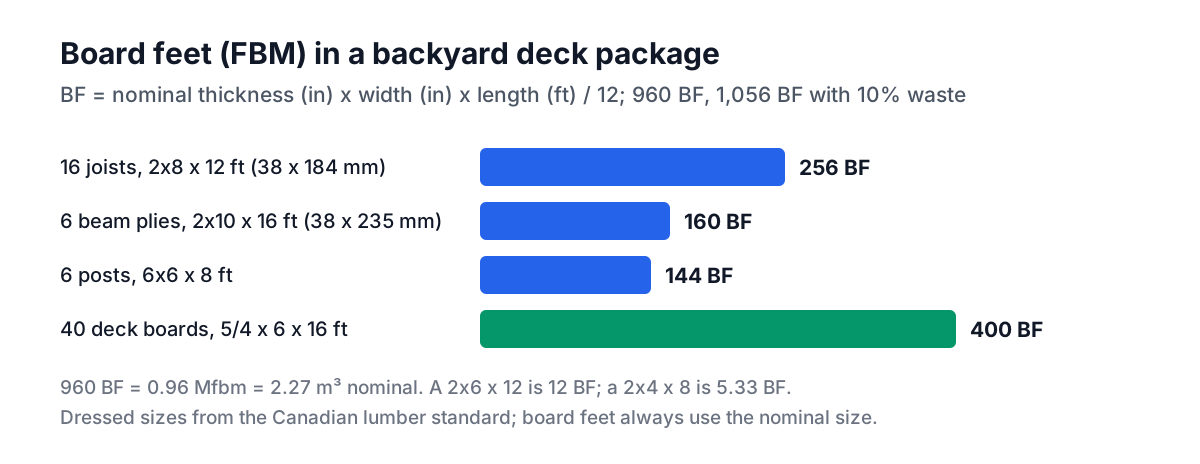
The decking is the largest single item, 400 board feet, because it covers the whole surface. It is counted here at its nominal 1-1/4 in thickness; counted at 1 in it would be 320 board feet, so check how a quote counts it before comparing. The framing alone (joists, beams and posts) is 560 board feet, or 616 with waste.
The same package is 2.27 m³ of nominal volume (960 x 0.002360). That is the figure you get if a supplier or a statistic converts board feet to cubic metres without accounting for dressing.
Comparing prices in Canadian dollars
The yard prices a 2x4 x 8 per piece; the wholesaler quotes per Mfbm; a hardwood dealer per board foot. To compare, convert everything to dollars per board foot:
price per BF   = piece price / board feet in the piece
price per Mfbm = price per BF x 1,000
| Item, example price | Board feet | CA$ per BF | CA$ per Mfbm |
|---|---|---|---|
| 2x4 x 8 stud at CA$4.50 | 5.333 | 0.84 | 844 |
| 2x6 x 12 at CA$11.00 | 12.000 | 0.92 | 917 |
The prices are examples; use your own quote. The per-Mfbm figure is what you compare with lumber market reports, which are quoted per thousand board feet. In this example the 2x6 costs more per board foot than the stud, so buying by the piece hides a real difference.
Hardwood: quarters, random widths and CA$ per board foot
Hardwood from Ontario, Quebec and the Maritimes, such as hard maple, red oak, yellow birch and cherry, is sold rough sawn by the board foot under the NHLA rules used across North America. Thickness is the rough quarter size; widths are random.
A workbench top in hard maple: six boards of 8/4 x 7 in x 8 ft are 6 x 9.33 = 56 board feet. Rough hardwood loses wood to defects, planing and jointing, so allow 20 to 30%: with 25% you buy 70 board feet. At an example price of CA$9.50 per board foot that is CA$665, against CA$532 for the 56 board feet the top needs on paper.
A random-width tally in cherry: boards of 4/4 x 5.5 in x 8 ft, 4/4 x 7.25 in x 8 ft, 4/4 x 4 in x 10 ft and 4/4 x 9 in x 7 ft add up to 17.08 board feet: 3.67, 4.83, 3.33 and 5.25. Measure each board's width rather than averaging, and ask whether the dealer rounds widths to the nearest inch, which changes the tally.
Metric volume: nominal versus actual
One board foot is 144 cubic inches, or 0.002359737 m³, so 1,000 board feet is 2.36 m³ of nominal volume. Dressed lumber holds much less wood. A thousand board feet of 2x6 is 1,000 linear feet of 38 x 140 mm stock:
1,000 ft x 0.3048 m x 0.038 m x 0.140 m = 1.62 m³ of wood
So the actual volume is about 69% of the nominal one for a 2x6. When you compare a Canadian figure in Mfbm with a European figure in cubic metres, check whether the cubic metres are nominal, actual, or the solid wood content of the logs, which is different again.
Logs are a separate problem
Board feet measure sawn lumber. Logs are measured by scaling, and Canadian provinces have their own rules. British Columbia, for example, publishes a Timber Scaling Manual that governs how harvested timber is measured for volume and quality. Check the provincial rules for logs rather than applying US log rules such as Doyle and Scribner, which the US edition of this guide covers.
Common mistakes
- Using the dressed size. A 2x6 is figured at 2 x 6, not 1.5 x 5.5. Using the tape measure undercounts by about 31%.
- Treating hardwood like softwood. Hardwood uses the rough quarter thickness and the actual width.
- Comparing per-piece and per-Mfbm prices directly. Convert both to dollars per board foot first.
- Forgetting waste. Allow about 10% for framing and decks, 20% or more for rough hardwood.
Tools for this job
- Board Foot Calculator: board feet, Mfbm, cubic metres and CA$ cost from a list of pieces.
- Deck Calculator: joists, beams, posts and decking for a deck plan.
- Framing Calculator: studs and plates for a wall.
- The US board feet guide covers the NHLA tally in more depth and the Doyle and Scribner log rules.
Frequently asked questions
What does FBM mean on a lumber quote?
Foot board measure, the board foot: 1 in x 12 in x 1 ft of nominal size, or 144 cubic inches. Mfbm or MBF is a thousand board feet, the unit Canadian softwood lumber is traded in.
How many board feet are in a 2x6 x 12?
Twelve: 2 x 6 x 12 / 12. A 2x4 x 8 is 5.33 board feet, a 2x8 x 12 is 16 and a 2x10 x 16 is 26.67.
Is a 38 x 140 mm board a 2x6?
Yes. 38 x 140 mm is the dressed size of a dry 2x6 under the Canadian lumber standard. Board feet are still figured on the nominal 2 x 6.
How do I convert board feet to cubic metres?
Multiply by 0.00236 for nominal volume: 1,000 board feet is 2.36 m³. The wood actually in 1,000 board feet of dressed 2x6 is about 1.62 m³.
How do I compare a per-piece price with a per-Mfbm price?
Divide the piece price by its board feet, then multiply by 1,000. A 2x4 x 8 at CA$4.50 is CA$0.84 per board foot, or CA$844 per Mfbm.
Sources and further reading
- National Lumber Grades Authority, NLGA. The grading rules for Canadian lumber, accepted under Canadian and US codes.
- Timber scaling, Government of British Columbia. The Timber Scaling Manual for harvested timber.
- Lumber production, shipments and stocks by species, monthly, Statistics Canada, Table 16-10-0017-01. National lumber statistics by province and species.
- Rules for the measurement and inspection of hardwood and cypress, National Hardwood Lumber Association. The hardwood tally used across North America.
- NIST Special Publication 811, Appendix B.8, US National Institute of Standards and Technology. The cubic inch as 1.638706 x 10^-5 m³ (Appendix B.8); a board foot is 144 in³ = 0.002359737 m³.
Open the Board Foot Calculator
More Carpentry & Woodworking
Every tool in the Carpentry & Woodworking section, free and in your browser.