
Engineering Manager, ML and UX Interviews in Canada
How Canadian panels test engineering managers, ML engineers and UX designers: ESA notice and cause, the federal Algorithmic Impact Assessment, AODA and French UI.
By Redbison Dev · · 7 min read
Canada edition. Written for Canadian candidates: people answers built on provincial employment standards (Ontario's ESA as the worked case), ML design with the federal Directive on Automated Decision-Making, and design rounds on AODA accessibility, Canada.ca colours and French text expansion. US edition
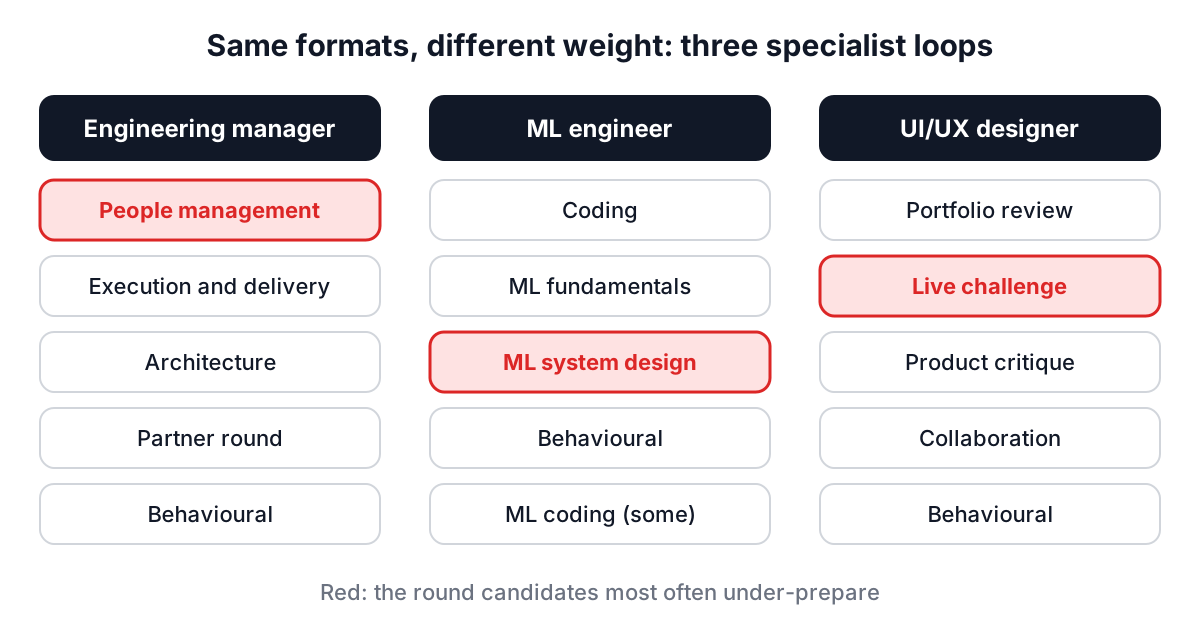
Specialist interview loops in Canada use the familiar rounds: people, delivery, technical design, portfolio and behavioural questions. What changes is the backdrop. Canadian employment is not at-will, so a manager's answer about underperformance has to sound like it was given in Toronto or Vancouver, not California. Government and regulated-sector ML teams work under a federal framework for automated decisions. And design work in Canada has to meet accessibility law in Ontario and, for federal services, work in English and French. This edition covers the three roles with the practice pages: Engineering Manager Interview Prep (Canada), ML Engineer Interview Prep and UX/UI Designer Interview Prep (Canada).
| Role | Rounds you are likely to meet | The Canadian angle |
|---|---|---|
| Engineering manager | People, delivery, technical judgement, partners, behavioural | Notice and cause under provincial employment standards |
| ML engineer | Coding, ML fundamentals, ML system design, behavioural | Impact assessment and human involvement in automated decisions |
| UX/UI designer | Portfolio, design challenge, critique, collaboration | AODA accessibility and English and French interfaces |
Engineering managers: performance without "for cause"
What the panel listens for
In Ontario, the Employment Standards Act (ESA) gives employees with at least three months of service notice of termination or termination pay, from 1 week for under a year of service up to 8 weeks for 8 years or more:
| Service | ESA notice |
|---|---|
| 3 months to under 1 year | 1 week |
| 1 to under 3 years | 2 weeks |
| 3 to under 4 years | 3 weeks |
| 4 to under 5 years | 4 weeks |
| 5 to under 6 years | 5 weeks |
| 6 to under 7 years | 6 weeks |
| 7 to under 8 years | 7 weeks |
| 8 years or more | 8 weeks |
The exception is wilful misconduct, disobedience or wilful neglect of duty that is not trivial and has not been condoned. Ontario's guide is explicit that poor work conduct that is accidental or unintentional is generally not considered wilful. Employees may also have common-law rights above the ESA minimums, though they cannot both sue for wrongful dismissal and file an ESA claim for termination pay on the same termination.
The practical consequence for an interview answer: poor performance is almost never "cause". A manager who says "I documented everything and we let them go for cause" raises a flag. A strong Canadian answer spends its time on improvement:
- A private conversation to find the cause.
- Written, specific expectations with a timeline.
- Real support: training, a change of scope, pairing, time off.
- Regular check-ins with notes, and HR involved early.
- If it ends in an exit, say it was handled by HR with notice or pay in lieu under the province's standards.
- The real outcome, and what you would do differently.
Provincial or federal?
Most software and product companies fall under provincial employment standards. The Canada Labour Code applies instead to federally regulated industries, including banking, telecommunications, air transportation, interprovincial road and rail transport, broadcasting, and postal and courier services. An engineering manager in a bank's technology group works under the federal code. Knowing which regime applies to the employer you are interviewing with is a small detail that panels notice.
Technical judgement
EM loops usually keep a system design or architecture round, at the level of trade-offs: why your team chose an approach, what it cost, what you would change. The System Design Interview guide covers the structure.
ML engineers: impact levels and human involvement
The technical core is the same everywhere: baselines first, no leakage, no training-serving skew, and metrics that survive class imbalance. With numbers, for 1,500,000 transactions of which 750 are fraudulent (0.05%):
"Never fraud" model:  accuracy = 1,499,250 / 1,500,000 = 99.95%,  recall = 0 / 750 = 0%
Model flagging 3,000 transactions and catching 600 frauds:
  recall    = 600 / 750   = 80%
  precision = 600 / 3,000 = 20%
The Canadian addition comes from the federal government. Its Directive on Automated Decision-Making is supported by the Algorithmic Impact Assessment (AIA), a mandatory questionnaire of 65 risk questions and 41 mitigation questions that sets an impact level for an automated decision system:
| Level | Impact | Score |
|---|---|---|
| I | little to no impact | 0% to 25% |
| II | moderate | 26% to 50% |
| III | high | 51% to 75% |
| IV | very high | 76% to 100% |
Higher levels raise requirements such as the type of peer review and the extent of human involvement in decisions. Some apply at every level: consulting legal services before development, testing and monitoring outcomes, and giving people a route to recourse.
The directive binds federal institutions, but the habit of thought is what a Canadian panel at a bank, insurer or government contractor is listening for. In an ML system design answer:
- Say how you would assess the impact of a wrong decision on the person, and let that set how much human review the design needs.
- Separate low-impact automated actions from decisions with serious consequences, which go to a person who can overturn the model.
- Plan monitoring by outcome, and a recourse path the customer can use.
The Coding Interview Prep guide covers the algorithms round most ML loops still include.
UX/UI designers: AODA, French and Canada.ca
Accessibility law
Under the Accessibility for Ontarians with Disabilities Act (AODA), designated public sector organizations and businesses or non-profits with 50 or more employees must make their public websites meet WCAG 2.0 Level AA, as of January 1, 2021, for content posted after January 1, 2012. Two criteria are excepted: live captions (1.2.4) and pre-recorded audio descriptions (1.2.5). The current W3C Recommendation is WCAG 2.2, which keeps the 2.0 AA contrast rule of 4.5:1 for normal text and 3:1 for large text and adds criteria such as minimum target size. Saying you design to 2.2 AA so you also meet the AODA is a clean answer.
Contrast with the Canada.ca palette
Using the Canada.ca colours in the Contrast Checker:
| Foreground on background | Ratio | Normal text |
|---|---|---|
| Text #333 on white | 12.63:1 | passes |
| Default link #284162 on white | 10.38:1 | passes |
| Visited link #7834bc on white | 6.96:1 | passes |
| Form error #d3080c on white | 5.51:1 | passes |
| White on main accent #26374a | 12.15:1 | passes |
| Default link #284162 on #26374a | 1.17:1 | fails |
| Form error #d3080c on #26374a | 2.20:1 | fails |
The palette is built for white backgrounds. Put the link or error colour on the dark accent band and it disappears, which is the kind of catch a design challenge is built to test.
English and French
The Canada.ca design system makes the language toggle mandatory on all pages, in the top-right corner of the global header, linking to the same page in the other official language, and for English and French only. For a bilingual role, expect to be asked how you handled the second language.
The hardest part is space. A W3C internationalization article reproduces IBM guidance on how much text grows when translated from English into European languages:
| English length | Average expansion |
|---|---|
| Up to 10 characters | 200 to 300% |
| 11 to 20 | 180 to 200% |
| 21 to 30 | 160 to 180% |
| Over 70 | 130% |
So an 8-character English button label needs room for up to 24 characters, and a 15-character tab title up to 30. Buttons, tabs and table headers are where English-first layouts break; design them with the long version in place.
The design challenge
The practice page's plan fits a 40 to 60 minute session: clarify the brief, define the problem, explore options, design the core flow, then validate. In a bilingual brief, use the clarifying minutes to ask which language users arrive in and whether the French version is translated or written in parallel.
Three weeks of preparation
- Week 1. Ask the recruiter for the stages. Work through the checklist on the practice page and note the gaps.
- Week 2. Practise the Canadian angle for your role: an improvement story with no "for cause" in it; an ML design with an impact assessment and a recourse path; a design challenge with a contrast check and a French label budget.
- Week 3. Behavioural stories and mocks. Draft six to eight stories in the STAR answer builder and do two full mock interviews with someone in the role.
Frequently asked questions
Is poor performance just cause in Ontario?
Rarely. Ontario's ESA guide says employees guilty of wilful misconduct, disobedience or wilful neglect of duty that is not trivial and not condoned lose notice and termination pay, and that poor work conduct that is accidental or unintentional is generally not considered wilful. In most performance cases the employer gives notice or pay in lieu.
What is an Algorithmic Impact Assessment?
A mandatory questionnaire supporting the federal Directive on Automated Decision-Making. Its 65 risk and 41 mitigation questions place a system at impact level I to IV, and higher levels bring stronger peer review and more human involvement in decisions.
Which WCAG level does the AODA require?
WCAG 2.0 Level AA for public websites of designated public sector organizations and of businesses and non-profits with 50 or more employees, excluding live captions and pre-recorded audio descriptions, since January 1, 2021.
How much space should I leave for French text?
IBM guidance reproduced by the W3C gives 200 to 300% for English strings up to 10 characters, 180 to 200% for 11 to 20 characters, and about 130% for strings over 70 characters. Short labels need the most room.
Sources and further reading
- Your guide to the Employment Standards Act: Termination of employment, Government of Ontario. Notice by length of service, wilful misconduct, ESA claim or civil suit.
- Federally regulated industries and workplaces, Government of Canada. Industries under the Canada Labour Code.
- Algorithmic Impact Assessment tool, Government of Canada. Questions, impact levels and scaled requirements.
- How to make websites accessible, Government of Ontario. AODA scope, WCAG 2.0 AA, dates and exceptions.
- Language toggle and Colours, Canada.ca design system.
- Text size in translation, W3C Internationalization. IBM expansion rates.
- Web Content Accessibility Guidelines (WCAG) 2.2, W3C.
Open the Engineering Manager Interview Prep
More Interview Prep
Every tool in the Interview Prep section, free and in your browser.