
Engineering Manager, ML and UX Interviews in the UK
How UK interview panels test engineering managers, ML engineers and UX designers: Acas capability answers, UK GDPR automated decisions and GOV.UK accessibility.
By Redbison Dev · · 7 min read
United Kingdom edition. Written for UK candidates: people answers built on the Acas Code and day-one flexible working requests, ML system design with the UK GDPR rules on solely automated decisions, and design rounds framed by the GOV.UK Service Standard and WCAG 2.2 AA. US edition
A UK interview loop for a specialist role looks much like an American one on paper: a people round, a technical round, a design or portfolio round, a behavioural round. What the panel listens for differs, because British employment law, data protection law and public sector accessibility rules sit behind the questions. An engineering manager who answers the underperformance question with "PIP them and manage them out" sounds American; an ML engineer who designs a fraud system with no route to a human misses a legal requirement; a designer who says "accessible" without naming WCAG 2.2 AA sounds vague to a government panel. This edition goes through the three roles with the practice pages: Engineering Manager Interview Prep (UK), ML Engineer Interview Prep and UX and Interaction Designer Interview Prep (UK).
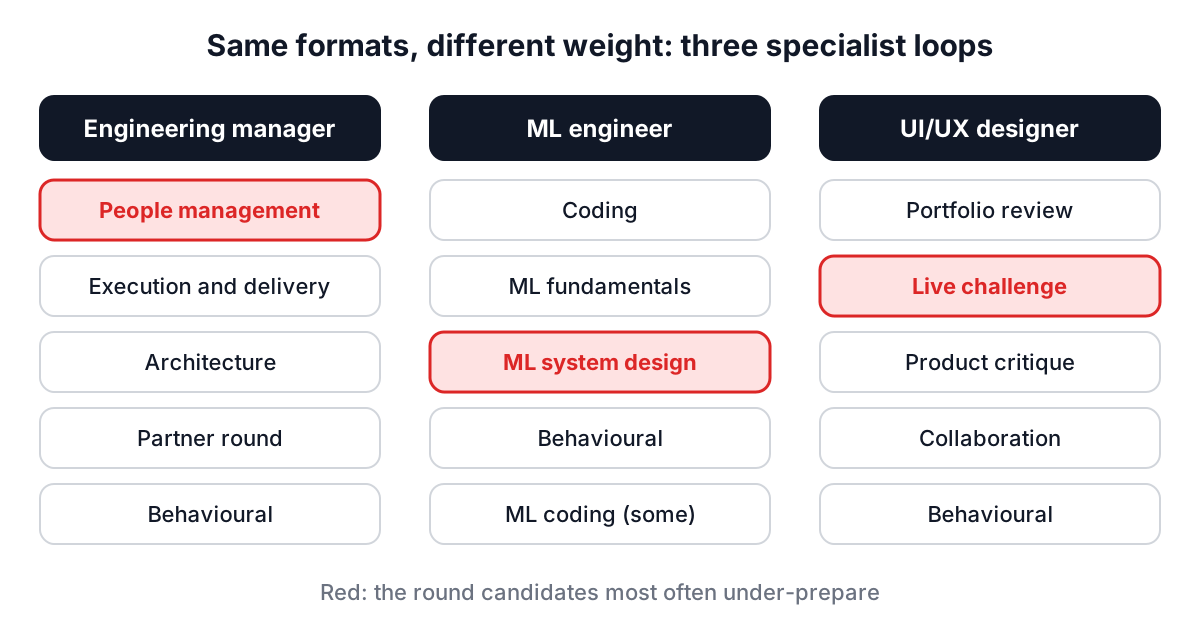
| Role | Rounds you are likely to meet | The UK angle the panel listens for |
|---|---|---|
| Engineering manager | People, delivery, technical judgement, stakeholders, behavioural | A fair capability process and flexible working handled reasonably |
| ML engineer | Coding, ML fundamentals, ML system design, behavioural | Human involvement in significant automated decisions |
| UX or interaction designer | Portfolio, design task, critique, collaboration | The Service Standard and WCAG 2.2 AA |
Ask the recruiter for the stages and what each one assesses. It is a normal question in the UK and saves guesswork.
Engineering managers: the people round, UK version
Underperformance under the Acas Code
There is no at-will employment in Britain, and UK panels expect a manager to know it. The Acas Code of Practice on disciplinary and grievance procedures states that "disciplinary situations include misconduct and/or poor performance", and employment tribunals can adjust awards by up to 25% where an employer unreasonably fails to follow it. Many employers run poor performance through a separate capability procedure, but it follows the same shape.
A strong answer to "tell me about someone who was underperforming" therefore has two halves:
- The informal stage, where most of the answer belongs. A private conversation about causes (workload, unclear expectations, health, personal circumstances, a poor fit with the work), written expectations with a review date, real support such as training, pairing or a change of project, and regular check-ins with notes.
- The formal stage, briefly, and only if it came to that. Following the Code's steps: establish the facts, tell the employee the problem in writing, hold a meeting, let them be accompanied, decide and confirm it in writing, and offer an appeal. At a formal meeting the employee may bring a fellow worker, a trade union representative or an official employed by a trade union.
Say "capability procedure" rather than "PIP and manage out", say when you brought HR in, and end with what actually happened. Panels respect a story where support fixed the problem without any formal step.
Flexible working requests
Employees can request flexible working from their first day in a job. Employers must deal with requests in a reasonable manner, for example by weighing the pros and cons, discussing alternatives and offering an appeal, and can refuse only for a good business reason. Northern Ireland has different rules.
A realistic UK question: "A senior engineer asks for a four-day compressed week, starting during a critical launch. What do you do?" An outline that works: acknowledge the right to ask; meet to discuss the request and alternatives; look honestly at the delivery impact; propose a trial or a start date after launch if the timing is the real problem; and put the decision, with any business reason, in writing. "No, we have a deadline" on its own is the answer that fails.
Technical judgement
UK EM loops usually keep a system design or architecture round, pitched at trade-offs rather than code: why your team chose an approach, what it cost, and how you would know it was wrong. The System Design Interview guide covers the structure.
ML engineers: design with a human route
The fundamentals and system design rounds test the same ideas as anywhere: baselines, leakage, training-serving skew, metrics that survive class imbalance. Imbalance is worth saying out loud with numbers. Take 2,000,000 card payments of which 400 are fraudulent (0.02%):
"Never fraud" model:  accuracy = 1,999,600 / 2,000,000 = 99.98%,  recall = 0 / 400 = 0%
Model that flags 2,000 payments and catches 300 frauds:
  recall    = 300 / 400   = 75%
  precision = 300 / 2,000 = 15%
The headline accuracy hides everything; precision and recall at a threshold show what the model costs customers in false declines and what it saves in fraud.
The UK-specific part is legal. The Data (Use and Access) Act 2025 replaced Article 22 of the UK GDPR with Articles 22A to 22D, now in force. A decision is "based solely on automated processing" where there is no meaningful human involvement, and it is "significant" if it produces a legal effect or a similarly significant effect for the person. Where a significant decision is made solely by automated processing, Article 22C requires safeguards that give the person information about the decision, let them make representations, let them obtain human intervention from the controller, and let them contest the decision.
In a system design answer, that becomes a design choice rather than a footnote:
- Separate low-impact automated actions (a step-up check, a short hold) from decisions with significant effects for the customer.
- For the significant ones, design meaningful human involvement or the Article 22C safeguards: a reason the customer can be told, a review queue staffed by people who can overturn the model, and a way to challenge the outcome.
- Log the features and model version behind each decision so a reviewer can explain it.
Whether a particular decision is "significant" is a question for the company's data protection officer; showing you would ask it is what the panel wants. The Coding Interview Prep guide covers the algorithms round most ML loops still include.
UX and interaction designers: the Service Standard and WCAG 2.2 AA
Government design panels, and the agencies and consultancies that build public services, ask about the GOV.UK Service Standard's 14 points, especially:
- 1, understand users and their needs;
- 3, provide a joined up experience across all channels;
- 4, make the service simple to use;
- 5, make sure everyone can use the service.
The accessibility questions have a legal basis. GOV.UK guidance says public sector websites and mobile apps should meet WCAG 2.2 AA and publish an accessibility statement explaining how accessible they are. The Equality and Human Rights Commission enforces this in England, Scotland and Wales, and the Equality Commission for Northern Ireland in Northern Ireland. The Government Digital Service examines a sample of public sector sites and apps every year. A body can claim that a fix would be a disproportionate burden only after a formal assessment, and cannot count lack of time or knowledge in it. Being able to explain an accessibility statement you worked on marks you out.
Contrast checks with the GOV.UK palette
Design tasks often include a quick contrast question. WCAG 2.2 AA needs 4.5:1 for normal text and 3:1 for large text. Using the current GOV.UK Design System colours in the Contrast Checker:
| Foreground on background | Ratio | Normal text |
|---|---|---|
| Secondary text #484949 on white | 9.03:1 | passes |
| Link #1a65a6 on white | 6.07:1 | passes |
| Link #1a65a6 on template background #f4f8fb | 5.69:1 | passes |
| White on brand blue #1d70b8 | 5.16:1 | passes |
| Error red #ca3535 on white | 5.15:1 | passes |
| Link #1a65a6 on border grey #cecece | 3.86:1 | fails (large text only) |
| White on focus yellow #ffdd00 | 1.34:1 | fails |
| Text #0b0c0c on focus yellow #ffdd00 | 14.54:1 | passes |
The pattern to say out loud: a colour that passes on white can fail on a tinted panel, and the GOV.UK focus state uses black text on yellow because white on yellow is unreadable.
The design task
The practice page's plan fits a 40 to 60 minute session: clarify the brief (5 to 8 minutes), define the problem (5 to 7), explore options (8 to 10), design the core flow (17 to 25) and validate (5 to 10). For a government-style brief, spend the clarifying phase on who cannot use the online route and what happens for them (point 3), then design one question per page with its error messages before any visual polish.
Three weeks of preparation
- Week 1. Get the list of stages. Work through the checklist on the relevant practice page and note the gaps.
- Week 2. Practise the round that carries the UK angle for your role: a capability story and a flexible working answer for managers; an ML design with a human review route; a design task with a WCAG check for designers.
- Week 3. Behavioural stories and mocks. Draft six to eight stories in the STAR answer builder, using "I" for your own decisions, and run two full mocks with someone who does the job.
Frequently asked questions
How should I answer an underperformance question in a UK engineering manager interview?
Spend most of the answer on the informal stage: a private conversation about causes, written expectations, support and regular reviews. Then say that if it did not improve you would follow the company's capability procedure with HR, consistent with the Acas Code: establish the facts, set out the problem in writing, hold a meeting where the employee can be accompanied, decide, and offer an appeal.
Does UK law affect ML system design interviews?
It can. Under Articles 22A to 22D of the UK GDPR, a significant decision made solely by automated processing needs safeguards: information about the decision, a way to make representations, human intervention on request and a way to contest it. A design that includes a human review route for significant decisions answers that.
Which accessibility standard should I quote in a UK design interview?
WCAG 2.2 AA. GOV.UK guidance says public sector websites and apps should meet it and publish an accessibility statement. For a private sector role, say which level your last team aimed for and how it was tested.
Can an employee ask for flexible working in their first week?
Yes. GOV.UK says employees can request flexible working from their first day in a job; the employer must deal with the request reasonably and can refuse only for a good business reason. Northern Ireland has different rules.
Sources and further reading
- Code of Practice 1: Disciplinary and grievance procedures, Acas. Poor performance in scope, the 25% adjustment, the right to be accompanied and the steps.
- Flexible working, GOV.UK. Requests from day one, reasonable manner, good business reason.
- UK GDPR Article 22A and Article 22C, legislation.gov.uk. Definitions and safeguards for solely automated significant decisions.
- The Service Standard, GOV.UK Service Manual. The 14 points.
- Understanding accessibility requirements for public sector bodies, GOV.UK. WCAG 2.2 AA, accessibility statements, enforcement and monitoring.
- Colour, GOV.UK Design System. The palette used in the contrast table.
- Web Content Accessibility Guidelines (WCAG) 2.2, W3C.
Open the Engineering Manager Interview Prep
More Interview Prep
Every tool in the Interview Prep section, free and in your browser.