
Engineering Manager, ML and UX Interviews in Singapore
How Singapore panels test engineering managers, ML engineers and UX designers: flexible work requests, MOM notice rules, PDPA training data and AI oversight.
By Redbison Dev · · 7 min read
Singapore edition. Written for Singapore candidates: people answers built on the Tripartite Guidelines on Flexible Work Arrangement Requests, MOM notice rules and the coming Workplace Fairness Act, and ML design answers using PDPC's AI guidelines and the Model AI Governance Framework. US edition
Interview loops for engineering managers, ML engineers and designers in Singapore follow the familiar pattern of people, technical, design and behavioural rounds. The difference is the local reference points the panel expects you to know. A manager is asked how they would handle a formal flexible work request and a resignation during reservist training. An ML engineer can expect to be asked whether personal data can be used to train the model at all, and how much human oversight the decision needs. This edition covers the three roles with the practice pages: Engineering Manager Interview Prep (Singapore), Machine Learning Engineer Interview Prep (Singapore) and UI/UX Designer Interview Prep.
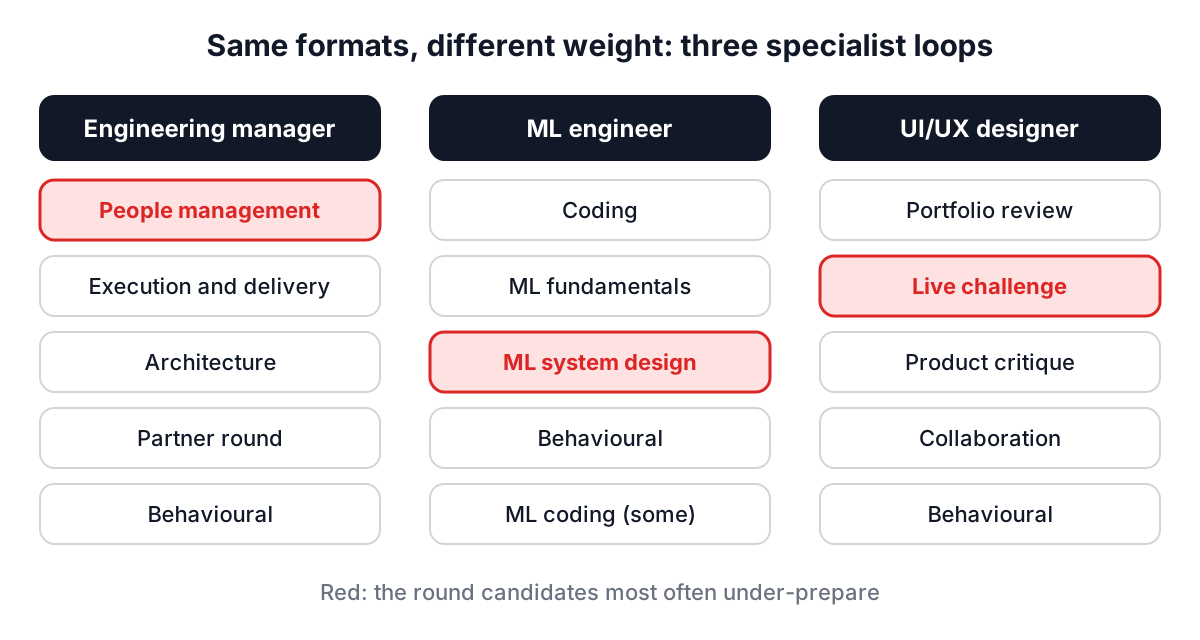
| Role | Rounds you are likely to meet | The Singapore angle |
|---|---|---|
| Engineering manager | People, delivery, technical judgement, stakeholders, behavioural | Formal flexible work requests, notice rules, fair employment |
| ML engineer | Coding, ML fundamentals, ML system design, behavioural | PDPA basis for training data; human oversight by risk |
| UI/UX designer | Portfolio, design challenge, critique, collaboration | Accessibility checks and evidence of your own role |
Engineering managers: the people round in Singapore
Formal flexible work requests
The Tripartite Guidelines on Flexible Work Arrangement Requests (TG-FWAR) set out how employers should handle formal requests. Employees who have completed probation can make one, and employers may choose to consider requests from staff still on probation. The employer should give a written decision within two months of receiving the request, including the reason if it is rejected, and is encouraged to discuss alternatives.
Rejection should rest on business grounds. The guidelines give three examples of reasonable ones: a significant increase in cost, a significant drop in the quantity or quality of individual, team or organisational productivity or output, and requests that are not feasible or practical because of the nature of the job. They also list unreasonable ones: management not believing in flexible work, a supervisor wanting to see the employee in the office even though their performance is consistently satisfactory, and "it is our tradition not to allow it".
A realistic question: "A senior engineer formally asks to work from home three days a week, starting in the middle of a launch. What do you do?" An answer that works:
- Treat it as a formal request and discuss it with the engineer promptly.
- Assess the real impact on delivery, not the preference for seeing people at their desks.
- Offer an alternative if the timing is the problem: a trial, or a start after launch.
- Give the decision in writing within two months, with the reason if any part is refused.
Resignations and notice
Notice must be in writing and, where the contract says nothing, MOM's defaults apply: 1 day for under 26 weeks of service, 1 week from 26 weeks to under 2 years, 2 weeks from 2 years to under 5 years, and 4 weeks from 5 years. Notice counts calendar days, including rest days and public holidays, and both sides can agree in writing to waive it. Reservist training does not count towards notice, so a week of in-camp training extends the notice by a week.
That last rule makes a good scenario: a key engineer resigns with one month's notice and has a week of reservist training inside it. The strong answer plans the handover around the actual working days and does not assume the engineer is available for the whole month.
Fair practice and performance
The Workplace Fairness Act, passed in January 2025 and slated to take effect at the end of 2027, prohibits employment decisions based on protected characteristics (such as age, nationality, sex, marital status, pregnancy, caregiving responsibilities, race, religion, language ability, disability and mental health conditions) that lead to an adverse outcome. It covers hiring, performance reviews, training, promotions and dismissals. For an engineering manager, the interview answer to "how do you run performance reviews?" should already show consistent written criteria and notes that show decisions rest on the work, which the Act will require once it takes effect.
The System Design Interview guide covers the architecture round most EM loops keep.
ML engineers: data basis and human oversight
The technical core
Baselines, leakage, training-serving skew and imbalance-aware metrics come up everywhere. Say the imbalance arithmetic out loud. For 800,000 transfers of which 160 are fraudulent (0.02%):
"Never fraud" model:  accuracy = 799,840 / 800,000 = 99.98%,  recall = 0 / 160 = 0%
Model flagging 1,000 transfers and catching 120 frauds:
  recall    = 120 / 160   = 75%
  precision = 120 / 1,000 = 12%
Can you train on this personal data?
PDPC's Advisory Guidelines on Use of Personal Data in AI Recommendation and Decision Systems, issued on 1 March 2024, answer this in PDPA terms. The Business Improvement Exception lets organisations use, without consent, personal data they collected in accordance with the PDPA for purposes such as improving existing goods and services or developing new ones. The guidelines' examples include recommendation engines that offer users content more aligned to their browsing history, job assignment systems for platform workers, and internal HR systems that recommend potential candidates by giving a first cut in matching them to vacancies. A separate Research Exception covers commercial research to develop AI systems with a public benefit, such as precision medicine. The exceptions are not a blank cheque: a good answer adds data minimisation and training on pseudonymised data where possible.
How much human involvement?
The Model AI Governance Framework (second edition) from IMDA and PDPC describes three approaches:
- Human-in-the-loop: the human keeps full control and the AI only recommends; nothing happens without the human's affirmative action.
- Human-over-the-loop: the human monitors and can take over when the model meets unexpected events, adjusting parameters while it runs.
- Human-out-of-the-loop: the system decides with no human override.
The framework chooses among them with a matrix of the probability and severity of harm, and adds other factors, including whether human involvement is operationally feasible: it notes that a human in the loop would be unfeasible in high-speed financial trading. For a fraud system, that points to a split design. Automated scoring at payment speed runs with people over the loop, monitoring and adjusting thresholds; decisions with serious consequences for a customer, such as closing an account, go to a human-in-the-loop review queue.
Most ML loops still include a normal algorithms round; the Coding Interview Prep guide covers it.
UI/UX designers: show the work and check the contrast
Design loops in Singapore, as elsewhere, centre on a portfolio presentation, a timed design challenge, critique and collaboration. Two habits make answers stronger:
- Name your own role. The panel is scoring your decisions, not the team's. Say what you designed and what the researcher, product manager and engineers did.
- Check contrast in the task. WCAG 2.2 AA asks for 4.5:1 for normal text and 3:1 for large text. In the Contrast Checker, grey #767676 on white is 4.54:1 and passes, but the same grey on a light panel of #f2f2f2 drops to 4.05:1 and fails for normal text. White on a strong red #d0021b is 5.66:1 and passes. A colour that passes on white can fail on a tinted card.
The practice page's plan fits a 40 to 60 minute challenge: clarify the brief (5 to 8 minutes), define the problem (5 to 7), explore options (8 to 10), design the core flow (17 to 25) and validate (5 to 10).
Three weeks of preparation
- Week 1. Ask the recruiter for the stages and work through the checklist on the practice page.
- Week 2. Practise the local angle: a flexible work request and a reservist-notice handover for managers; a PDPA data-basis answer and a human-oversight split for ML engineers; a timed challenge with a contrast check for designers.
- Week 3. Draft six to eight behavioural stories in the STAR answer builder and run two full mock interviews.
Frequently asked questions
How should a manager answer a flexible work arrangement question in Singapore?
Treat it as a formal request under the Tripartite Guidelines: discuss it, assess it on business grounds such as cost, productivity or output and feasibility, give a written decision within two months, and state the reason if you reject it. Offer alternatives such as a trial.
Does reservist training count towards notice in Singapore?
No. MOM says reservist training does not count towards the notice period, so it extends notice by the length of the training.
Can personal data be used to train an AI model under the PDPA?
Sometimes without consent. PDPC's 2024 advisory guidelines say the Business Improvement Exception lets organisations use personal data collected in accordance with the PDPA to improve existing products or develop new ones, with examples including recommendation engines and internal HR systems that shortlist candidates. Data minimisation still applies.
What does human-over-the-loop mean?
In the Model AI Governance Framework, a human monitors the AI system and can take over control when it meets unexpected or undesirable events, adjusting parameters while it runs. It sits between human-in-the-loop, where the human makes every decision, and human-out-of-the-loop, where there is no human override.
Sources and further reading
- Tripartite Guidelines on Flexible Work Arrangement Requests, TAFEP and Ministry of Manpower. Eligibility, the two-month written decision and reasonable and unreasonable grounds.
- Termination with notice, Ministry of Manpower. Default notice periods, counting, waiver and reservist training.
- Workplace Fairness, TAFEP. Status of the Act, protected characteristics and covered decisions.
- Advisory Guidelines on Use of Personal Data in AI Recommendation and Decision Systems, PDPC, issued 1 March 2024. Business Improvement Exception, and the Research Exception for commercial research with a public benefit.
- Model Artificial Intelligence Governance Framework, second edition, IMDA and PDPC. Human-in, over and out of the loop; probability-severity matrix.
- Web Content Accessibility Guidelines (WCAG) 2.2, W3C.
Open the Engineering Manager Interview Prep
More Interview Prep
Every tool in the Interview Prep section, free and in your browser.