
STAR Method for Behavioural Interviews in Canada
How to write STAR answers for Canadian behavioural interviews and GC Jobs screening questions: essential qualifications, "and" questions, leadership competencies.
By Redbison Dev · · 7 min read
Canada edition. Written for Canadian candidates: GC Jobs screening questions and essential qualifications, the federal key leadership competencies, and private-sector behavioural interviews, in Canadian spelling. US edition
Canadian employers ask the same "tell me about a time" questions as anyone else, and the STAR structure (Situation, Task, Action, Result) answers them the same way. What is different in Canada is the federal public service, where the first behavioural answers you write are not spoken at all. They are typed into GC Jobs screening questions, one per essential qualification, and a reviewer decides from them whether you are screened in. This edition covers both: written screening answers that prove a qualification, and spoken interview answers that hold up to follow-up questions. Draft each one in the behavioural interview STAR builder as you go.
What Canadian interviewers score
A behavioural interviewer collects evidence against a list. In a private-sector loop the list is usually a set of competencies in the job posting: collaboration, ownership, handling conflict, delivering results. In the federal public service the list is written on the job poster as essential and asset qualifications, and the PSC says screening questions relate to the qualifications on that poster.
For managers and executives there is a further federal list. The Treasury Board's Key Leadership Competencies are the fundamental basis for selecting executives and can also be used to select managers, supervisors and employees:
| Key leadership competency | A behavioural question you might hear |
|---|---|
| Creating Vision and Strategy | Tell me about a time you set direction for a team in uncertainty |
| Mobilize People | Describe how you got a team to commit to a difficult goal |
| Uphold Integrity and Respect | Tell me about a time you raised a concern that was unwelcome |
| Collaborate with Partners and Stakeholders | Describe working with a partner whose priorities conflicted with yours |
| Achieve Results | Tell me about delivering under a fixed deadline |
| Promote Innovation and Guide Change | Give an example of a change you introduced |
GC Jobs screening questions: STAR in writing
The Public Service Commission's advice on applying is specific, and it maps directly onto STAR:
- Give details, not just "yes". If you answer yes, write a full answer with specific examples in the box below. Do not just point to your résumé.
- Read "and" and "or" carefully. If the question uses "and", show you have every skill or experience listed; if it uses "or", one is enough. "Participating in and leading a team" needs both.
- Use the question's keywords, not synonyms, and avoid acronyms the reader may not know.
- Write in the first person, using "I" rather than "we".
- Structure the answer with the Situation, the Task, the Action you took and the Result.
Shared Services Canada's hiring tips put the same point in one line: "Simply saying you did something does not prove you meet the qualification!" They ask for concrete examples of how you did it, and, for experience requirements such as supervision, how many years, where and on what dates.
Apply only if you meet every essential qualification, the PSC says. Asset qualifications are helpful but not required; answer the ones you do meet.
A worked example: an "and" qualification
The poster lists "Experience in planning and delivering information technology projects." Both parts need evidence. Here is the screening answer written in the four STAR boxes:
Situation: From April 2023 to March 2024 I worked as a project lead in a provincial health ministry's IT branch, where our appointment scheduling system had to move to a new platform before the vendor ended support.
Task: I was responsible for planning the move and delivering it without losing any booked appointments for the 40 clinics that used the system.
Action: I wrote the project plan, with a schedule, a budget and a risk log, and had it approved by the steering committee. I ran weekly status meetings with the three branches involved and reported to the director every two weeks. When testing showed a data mapping problem in month seven, I re-sequenced the work, moved the cut-over by two weeks and told the steering committee the same day with a recovery plan. I led the cut-over weekend and the go or no-go call.
Result: The new system went live in month 11, two weeks later than first planned, with every booked appointment carried over. The risk log and cut-over checklist were reused for the next two platform moves in the branch.
The answer names dates and setting, uses the qualification's own words ("planning", "delivering"), proves both halves of the "and", and keeps every Action sentence in the first person. It also reports a delay honestly, which is more convincing than a perfect story and survives a reference check.
From screening answer to interview
If you are screened in, the PSC's guide to what to expect says you may be asked to write a test or series of tests, interviews may follow depending on the job, and each step can take from 4 weeks to a few months. It notes that in 2021 the median time to hire a new candidate was 227 days. If you need accommodation for a test or interview, let the person inviting you know as soon as possible.
An interview story needs more depth than the written one, because the board will probe it. The same project can supply several stories, each led by different actions:
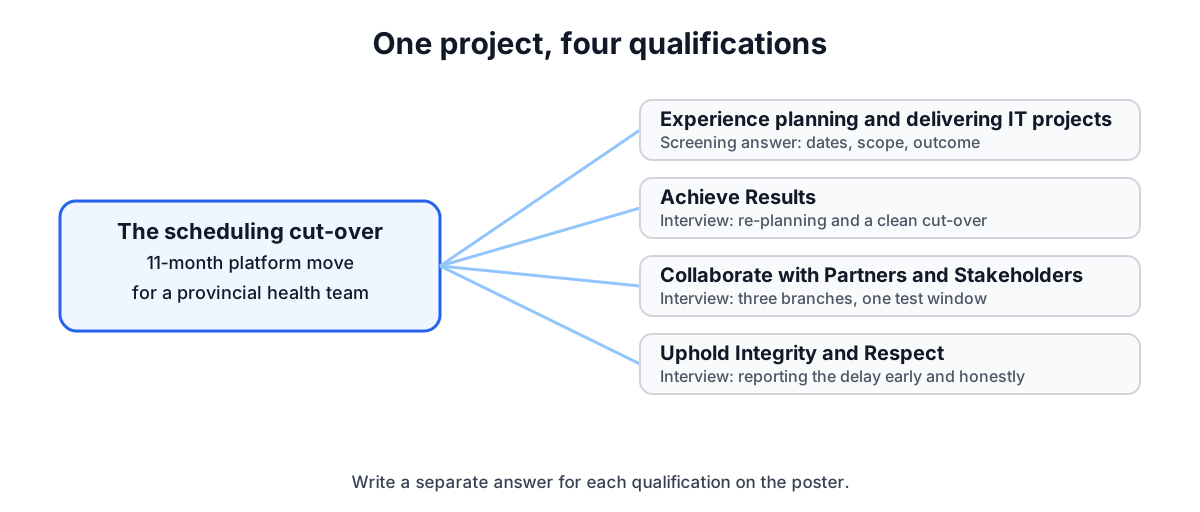
- For Achieve Results, lead with how you re-planned after the data mapping problem and still carried over every booked appointment.
- For Collaborate with Partners and Stakeholders, lead with how you got three branches to agree a single testing window.
- For Uphold Integrity and Respect, lead with reporting the delay early, the same day the problem was found.
Write each version separately in the builder. An answer built for one qualification rarely shows the evidence another one asks for.
Private-sector interviews in Canada
Private-sector behavioural rounds in Canada look much like US ones: a hiring manager or panel, a list of competencies, and follow-up questions such as "What would you do differently?" or "How did you know it worked?". A few habits help in a Canadian loop:
- Use Canadian experience where you have it, including co-op terms: they are real work and give you recent, specific stories early in a career.
- Be ready for questions about distance. If you have worked with colleagues in other provinces or time zones, a story about keeping that team aligned is worth preparing.
- Keep the language plain. Panels outside the federal system do not need qualification keywords, but they still need specific actions and a result.
Mistakes that screen people out
- "Yes, see my résumé." The PSC shows exactly this as its "incomplete answer".
- Half an "and" qualification. Planning without delivering, or leading without participating, does not meet the criterion.
- "We" in the Action. Reviewers cannot credit you with the team's work.
- No dates or scale. "I managed projects" says nothing; "from April 2023 to March 2024, for 40 clinics" is evidence.
- A formatted résumé. The PSC recommends an unformatted résumé, without bullets, underlines or bold, because GC Jobs removes most formatting when you paste it.
For management roles, the Canadian engineering manager interview guide covers people scenarios under provincial employment standards. The US edition of this guide has more general examples and a one-week preparation routine.
Frequently asked questions
How do I answer GC Jobs screening questions?
Treat each one as a short written STAR answer for one qualification. Use the question's own keywords, write in the first person, and give the dates, setting, actions and result of a real example. The PSC says not to just answer "yes" or refer to your résumé.
What does "and" mean in an essential qualification?
That you need evidence of every part. The PSC's example is "participating in and leading a team", which needs both a participant and a leader example. If the qualification uses "or", one part is enough.
What are the key leadership competencies?
Six competencies set by the Treasury Board: Creating Vision and Strategy, Mobilize People, Uphold Integrity and Respect, Collaborate with Partners and Stakeholders, Achieve Results, and Promote Innovation and Guide Change. They are the basis for selecting executives and can be used for managers, supervisors and employees.
How long does federal hiring take?
The PSC says each step can take from 4 weeks to a few months, and that in 2021 the median time to hire a new candidate was 227 days. Keep your stories ready; an interview invitation can arrive long after you applied.
Can I ask for accommodation in a federal interview?
Yes. The PSC advises letting the person who invites you to the test or interview know as soon as possible if you need accommodation measures.
Sources and further reading
- Applying for Government of Canada jobs: how to apply, Public Service Commission of Canada. Screening questions, "and" and "or", STAR, essential and asset qualifications.
- Applying for Government of Canada jobs: what to expect, Public Service Commission of Canada. Tests, interviews, accommodation and time to hire.
- Tips and tricks to apply for a job at Shared Services Canada, Shared Services Canada.
- Key Leadership Competency profile, Treasury Board of Canada Secretariat.
- Janz (1982) on patterned behaviour description interviews, Journal of Applied Psychology. Early comparison of past-behaviour and unstructured interviews.
Open the Behavioral Interview STAR Answer Builder
More Interview Prep
Every tool in the Interview Prep section, free and in your browser.