
STAR Method for Competency-Based Interviews (UK)
How to answer UK competency-based interview questions with STAR: Civil Service Success Profiles behaviours and strengths, NHS values-based questions, with examples.
By Redbison Dev · · 7 min read
United Kingdom edition. Written for UK candidates: competency-based interviews, the Civil Service Success Profiles behaviours and strengths questions, and NHS values-based recruitment. US edition
In the UK a "tell me about a time" interview is usually called competency-based. The job advert and person specification list what will be assessed, the panel asks one question per competency, and each answer is scored against the evidence you give. STAR (Situation, Task, Action, Result) is the structure GOV.UK itself suggests for Civil Service examples, and it works the same way for private employers. Where UK candidates trip up is less the structure than the format around it: knowing which questions want a STAR story and which do not, pitching the example at the right grade, and writing a shorter version for the application form. Draft each story in the competency-based interview answer builder as you work through this.
What a UK panel is scoring
A competency-based panel works from a list. In the Civil Service the list comes from Success Profiles, which has five elements: behaviours, strengths, ability, experience and technical. GOV.UK's candidate overview notes that not all of them are relevant to every role, so read the advert to see which are assessed.
The nine Civil Service behaviours are:
| Behaviour | A question you might hear |
|---|---|
| Seeing the Big Picture | Tell me about a time you linked your work to wider priorities |
| Changing and Improving | Give an example of a time you improved a process |
| Making Effective Decisions | Describe a decision you made with incomplete information |
| Leadership | Tell me about a time you set direction for others |
| Communicating and Influencing | Give an example of persuading someone who disagreed |
| Working Together | Tell me about a disagreement with a colleague |
| Developing Self and Others | Describe a time you helped a colleague develop |
| Managing a Quality Service | Tell me about improving the service for a user |
| Delivering at Pace | Describe a time you had to work under pressure |
GOV.UK is clear that you will not be asked to demonstrate all the behaviours for one role: recruiting managers choose the ones that fit the job. The behaviour descriptions are written for grade groups (AA and AO, EO, HEO and SEO, Grade 7 and Grade 6, Deputy Director, Director and Director General), so pitch your example at the level of the advert.
The builder's eight questions map onto these behaviours: the process question to Changing and Improving, the pressure question to Delivering at Pace, the disagreement question to Working Together, the mentoring question to Developing Self and Others.
STAR, sized for a competency answer
GOV.UK's advice is to use STAR to "set the scene, show what and how you did and the overall outcome", and to read the job description carefully to see which behaviours are required. The proportions that work in practice:
- Situation and Task, about a fifth. Where you were, what was at stake, what you were responsible for. Two or three sentences.
- Action, most of the answer. What you did, in the first person, with your reasoning. This is where the panel finds its evidence.
- Result, about a fifth. What happened, with a figure if you have one, and what you would repeat or change.
Examples can come from work, work experience, volunteering or a hobby, according to the behaviours guidance. That matters for career changers and recent graduates: a well-run community project at the right level is valid evidence.
A worked example: Delivering at Pace at HEO
The advert lists Delivering at Pace at HEO. The question is "Describe a time when you had to work under pressure", the builder's stress-management question. Here is a story written in the four boxes:
Situation: A rule change meant 1,900 open benefit cases had to be decided before a fixed date six weeks away, and our team of eight was clearing about 200 a week.
Task: I was the senior caseworker asked to plan how we would clear the backlog without lowering decision quality.
Action: I split the cases by complexity and sent the simplest third to a fast track with a checklist I wrote. I asked my manager for two caseworkers from a neighbouring team for four weeks and showed her the numbers that made the case. I set a weekly target for each person, checked progress every Friday and moved work between people when someone fell behind. When the error rate in the fast track rose in week two, I paused it for a day, added two checks to the checklist and briefed the team.
Result: We cleared all 1,900 cases three days before the deadline, and the quality check pass rate stayed above our usual level. The fast-track checklist is now used for every rule change.
Count the words in each box and the shape is right: the Action carries most of it. Every Action sentence is something the candidate did ("I split", "I asked", "I set", "I paused"), and together they show planning, checking progress, adjusting and protecting quality, which is what a Delivering at Pace answer needs to make visible. Check the wording of the behaviour at your grade and use its words in your notes. The figures in the Result are the candidate's own, and a panel may ask how they were measured, so only use numbers you can explain.
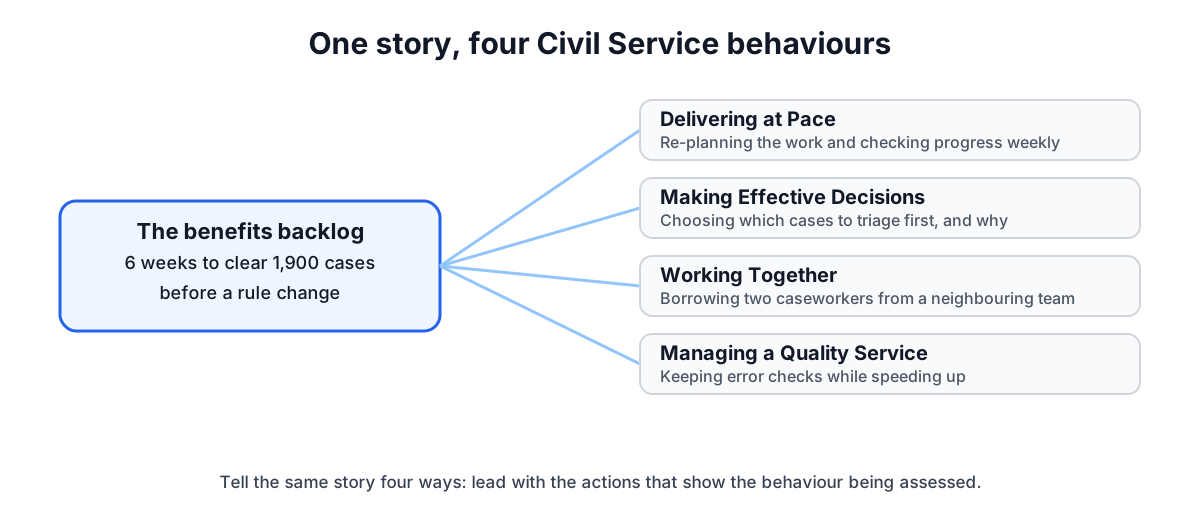
The same story can answer a Making Effective Decisions or Working Together question if you lead with different actions. Write each version separately in the builder so you do not repeat the same opening twice in front of one panel.
Strengths questions are not STAR questions
Success Profiles also assesses strengths, defined by GOV.UK as "the things we do regularly, do well and that motivate us". The candidate overview says you may be asked about your interests to assess your strengths and preferred style of working. These questions sound like "What do you enjoy doing?", "How do you feel when plans change at short notice?" or "What gives you energy at work?".
A rehearsed STAR story is the wrong answer to a strengths question. The panel wants a natural, honest reply about what you enjoy and why, ideally with a brief, real illustration. GOV.UK suggests reflecting beforehand on your personal strengths and preferred ways of working, and says you will never be expected to demonstrate them all for one job. Preparation means knowing yourself, not scripting.
The application form: the same story, shorter
Civil Service assessment can include application forms with written examples as well as interviews, tests and exercises, according to the behaviours guidance. If the advert asks for a written behaviour statement, check it for a word limit. Keep the full story from the builder for the interview, and cut a version to the limit for the form:
- keep one sentence each for Situation and Task;
- keep the two or three actions that best match the behaviour;
- keep the Result figure.
If the panel has your written example in front of them, a different story at interview gives them more evidence, as long as both are strong.
NHS roles: values as well as competencies
NHS employers often add values-based questions. NHS Employers describes values-based recruitment as finding people whose personal values match the organisation's, delivered through pre-screening, values-based interviewing techniques and assessment centres. The values come from the NHS Constitution for England: working together for patients; respect and dignity; commitment to quality of care; compassion; improving lives; everyone counts.
A STAR story still works here, but the Result should show the effect on patients or service users, and the Action should show how you treated people, not only what you delivered. The backlog story, retold for an NHS administrative role, would stress the checks that protected the people waiting for decisions (commitment to quality of care) and how cases from vulnerable claimants were flagged first (everyone counts).
Mistakes UK panels see often
- Answering a strengths question with a STAR story. It reads as rehearsed and misses what is being assessed.
- Pitching at the wrong grade. An EO example for a Grade 7 role, or the reverse, scores poorly even when it is well told.
- "We" all the way through. The panel can only score your actions.
- One example for every behaviour. A panel may ask for another example when the first is thin; have two for the behaviours the role leans on most.
- Ignoring the person specification. Each essential criterion is a likely question; read it line by line.
For managers, the UK engineering manager interview guide covers people scenarios under UK employment practice. The US edition of this guide has more general examples and a one-week preparation plan.
Frequently asked questions
Do Civil Service interviews use the STAR method?
Yes, for behaviour questions. GOV.UK suggests the STAR method so you can set the scene, show what you did and how, and give the outcome. Strengths questions are different and do not need a STAR story.
How many behaviours are assessed in a Civil Service interview?
It depends on the role. GOV.UK says you will not be asked to demonstrate all nine behaviours for one role; the recruiting manager chooses the ones that fit, and the advert names them.
Can I use an example from volunteering?
Yes. The Success Profiles behaviours guidance says examples can come from work, work experience, volunteering or a hobby. Pick the example that shows the behaviour at the level of the role.
What is a strengths-based question?
A question about what you enjoy and how you prefer to work, such as "What do you enjoy most about your current job?". Success Profiles defines strengths as the things you do regularly, do well and that motivate you. Answer naturally and honestly rather than with a prepared story.
What are the NHS values for interview?
The six values in the NHS Constitution for England: working together for patients; respect and dignity; commitment to quality of care; compassion; improving lives; everyone counts. Values-based questions look for evidence of these in how you have treated people.
Sources and further reading
- Success Profiles, Cabinet Office, GOV.UK. The five elements.
- Success Profiles: Civil Service behaviours, Cabinet Office, GOV.UK. The nine behaviours, grade groups, STAR and sources of examples.
- Success Profiles: candidate overview, Cabinet Office, GOV.UK. Strengths questions and preparing for them.
- Values-based recruitment, NHS Employers.
- The NHS Constitution for England, Department of Health and Social Care. The six NHS values.
- Janz (1982) on patterned behaviour description interviews, Journal of Applied Psychology. Early comparison of past-behaviour and unstructured interviews.
Open the Behavioral Interview STAR Answer Builder
More Interview Prep
Every tool in the Interview Prep section, free and in your browser.