
What Revs Should My Car Do at 70 mph? Gearing Explained
Work out engine revs at 70 mph in every gear from the gearbox ratios, final drive and tyre size, and see why worn or bigger tyres change the speedometer.
By Redbison Dev · · 10 min read
United Kingdom edition. UK edition in mph around the 70 mph motorway limit, with a five-speed manual on 195/65 R15 tyres, the mph and km/h speedometer rule, the 1.6 mm tread limit and what a tyre size change does to the reading. US edition
A small petrol hatchback with a five-speed manual geared 3.55, 1.90, 1.28, 0.97 and 0.76, a 4.06 final drive and 195/65 R15 tyres turns 2,906 rpm at 70 mph in fifth. Drop to fourth and the same speed needs 3,709 rpm; in third it is 4,895 rpm. Those three numbers come from one formula that links the engine to the road through the gearbox, the differential and the tyre, and the Gear Speed Calculator works them out for any car once you type in its ratios.
This edition is written around the questions UK drivers ask: revs at the 70 mph limit, why the speedometer shows more than the satnav, and what happens to both when the tyres wear down or you fit a different size.
The chain from crankshaft to tarmac
Three reductions sit between the engine and the road:
- The gear you are in. In fifth above, the gearbox output turns 1 / 0.76 times for every engine revolution, so it spins faster than the crankshaft. Any ratio below 1.00 is an overdrive.
- The final drive. The differential slows it again by 4.06. Multiply the two and fifth has an overall ratio of 3.09: the engine turns 3.09 times for each turn of the wheel.
- The tyre. Each wheel turn rolls the car forward one circumference.
So the speed in kilometres per hour is
km/h = rpm x tyre diameter (mm) x π x 60 / (gear x final drive x 1,000,000)
and dividing by 1.609344 turns that into mph, the unit every UK car must be able to show. Regulation 35 of the Road Vehicles (Construction and Use) Regulations 1986 requires a speedometer that can indicate both miles per hour and kilometres per hour, or one that meets ECE Regulation 39. The calculator works in either; set the speed unit to mph.
Tyre size to diameter, in UK notation
UK tyre sidewalls and the door-pillar placard write the size as 195/65 R15 91H. Only the first three numbers set the diameter:
sidewall  = 195 x 0.65            = 126.75 mm
diameter  = 15 x 25.4 + 2 x 126.75 = 634.5 mm
per mile  = 1,609,344 / (π x 634.5) = 807 revolutions
The 91 is the load index and the H the speed rating (up to 130 mph). Neither changes the size, but both matter when you buy: a replacement should meet the load and speed ratings the car was approved with.
Revs in every gear at the speeds you drive
With the five-speed above and a 6,200 rpm redline, the calculator gives:
| Gear | Ratio | Overall | Top of gear at 6,200 rpm | 30 mph | 50 mph | 60 mph | 70 mph |
|---|---|---|---|---|---|---|---|
| 3rd | 1.28 | 5.20 | 88.7 mph | 2,098 | 3,496 | 4,196 | 4,895 |
| 4th | 0.97 | 3.94 | 117.0 mph | 1,590 | 2,650 | 3,180 | 3,709 |
| 5th | 0.76 | 3.09 | 149.3 mph | 1,246 | 2,076 | 2,491 | 2,906 |
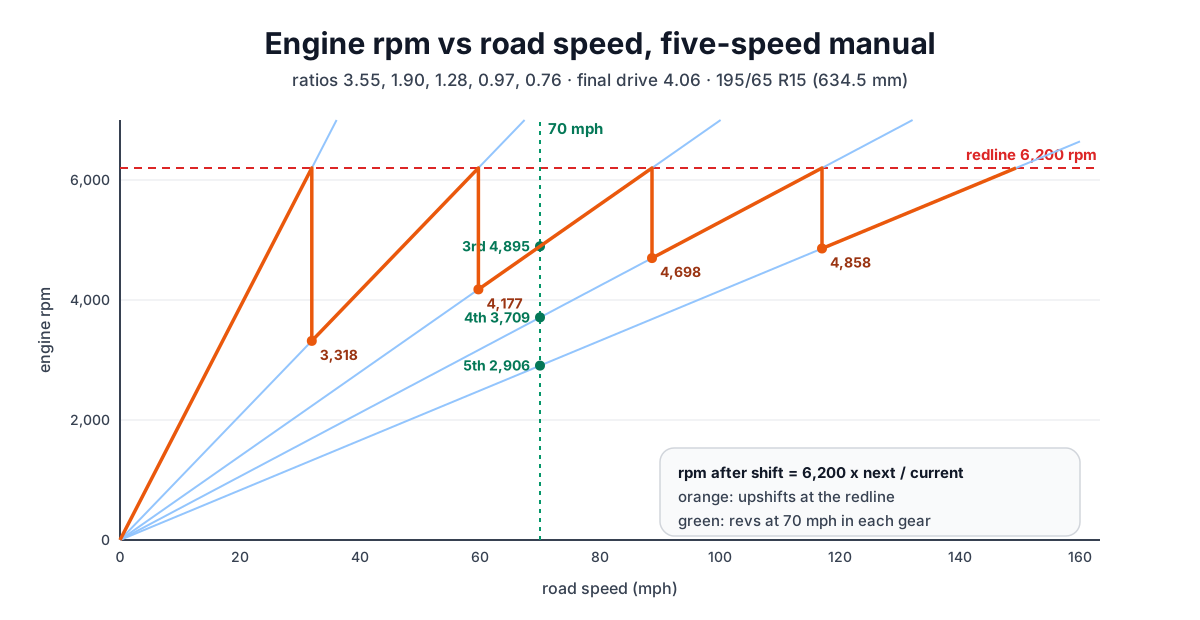
First tops out at 32.0 mph and second at 59.7 mph, so a 60 mph single-carriageway limit is just beyond second gear on this car. The 70 mph figure applies to cars on motorways and dual carriageways; GOV.UK's national speed limit table gives 60 mph on single carriageways, 60 mph on motorways for cars towing caravans or trailers, and 20 mph in built-up areas in Wales.
The 149.3 mph at the redline in fifth is a gearing figure only. A small hatchback runs out of power against air resistance long before that, which is why fifth on this kind of car is mostly a quiet cruising gear.
Where the revs land after each change
At the moment of an upshift the car's speed has not changed, so the new rpm is the old rpm times the ratio of the two gears. Changing up from first at 6,200 rpm:
6,200 x 1.90 / 3.55 = 3,318 rpm
On this gearbox the drops are 3,318, 4,177, 4,698 and 4,858 rpm, so the gaps narrow as you go up. The first-to-second change is the big one, which is why a car that pulls hard in first can feel flat for a moment in second. For everyday driving the same arithmetic tells you something more practical: changing from fourth to fifth at 50 mph takes the engine from 2,650 to 2,076 rpm, and a petrol engine that makes its torque higher up may need fourth again for an overtake.
Why your speedometer reads more than the satnav
Most drivers notice the dial showing a few mph more than a GPS app. That is by design. Cars approved to ECE Regulation 39 must never show less than the true speed, and as summarised by Wikipedia's speedometer article, the UK rules for individually approved vehicles allow an indicated speed of up to 110% of the true speed plus 6.25 mph between 25 and 70 mph. At a true 70 mph that is a reading anywhere from 70 to 83.25 mph.
The geometry behind it:
- Wear makes the dial read higher. The Highway Code's vehicle maintenance annex sets a legal minimum of 1.6 mm across the central three-quarters of the tread, all the way round. A new tyre has around 8 mm. Taking 6.4 mm off each side shrinks the 195/65 R15 from 634.5 to 621.7 mm, 2.0% smaller. The wheel turns faster at the same road speed, so the dial reads high by another 2%: at an indicated 70 mph you would be doing about 68.6 mph, and fifth needs 2,966 rpm for a true 70.
- A bigger tyre makes it read lower. This is the change that eats into the margin.
- Load and pressure flatten the tyre at the contact patch, so the car travels a little less per turn than π x diameter. Tyre makers' published revolutions per mile are the better figure when you want precision.
Changing tyre size: what moves
Swap the 195/65 R15 for one of the alternatives you see on placards and wheel upgrade lists:
| Size | Diameter | Change | True speed at an indicated 70 mph | Revs at a true 70 mph in fifth |
|---|---|---|---|---|
| 195/65 R15 (original) | 634.5 mm | 0 | 70.0 mph | 2,906 |
| 205/55 R16 | 631.9 mm | -0.41% | 69.7 mph | 2,918 |
| 215/45 R17 | 625.3 mm | -1.45% | 69.0 mph | 2,949 |
| 185/65 R15 | 621.5 mm | -2.05% | 68.6 mph | 2,967 |
| 205/60 R16 | 652.4 mm | +2.82% | 72.0 mph | 2,827 |
The "true speed" column assumes the speedometer read exactly right on the original size, so it shows the shift, not the absolute error. Smaller sizes push the dial further on the safe side. The 205/60 R16 is the one to watch: it is 2.8% taller, so the car is doing 72 mph when the dial says 70. On a car calibrated close to true speed that can leave it reading under the real speed, which ECE Regulation 39 does not allow. The tyre size comparison in the UK Tyre Size Calculator shows the same change for any pair of sizes.
Two practical points: if you fit a wheel and tyre size the car was not supplied with, check with your insurer whether it counts as a modification, and the safest choices are the alternative sizes listed for your model in the handbook.
Checking your figures on the road
To test the calculator against your own car, hold a steady speed on a flat stretch with the satnav or a GPS app open and read the rev counter. Use the GPS speed, not the dial, in the calculator. If the two disagree by more than a few per cent, the usual causes are a different final drive (some models use one for the petrol and another for the diesel), an automatic whose torque converter has not yet locked up, or tyres that are not the size on the placard.
The formula fits manual gearboxes, dual-clutch gearboxes and automatics once the torque converter has locked. It does not apply to a CVT, which has no fixed ratios. Most electric cars have one fixed reduction, so it works with motor rpm in place of engine rpm.
Tools for this job
- Gear Speed Calculator: speed in every gear at the redline, revs at 70 mph and the drop after each change, in mph.
- Tyre Size Calculator: compares two tyre sizes and the speedometer change.
- Fuel Cost Calculator: what a journey costs once you know how the car is geared for the motorway.
- The US gear ratio, road speed and rpm guide explains the 336 constant behind the inch-based formula.
Frequently asked questions
What revs should a car do at 70 mph?
It depends on the gearing. The five-speed hatchback in this guide does 2,906 rpm in fifth. Enter your ratios, final drive and tyre size to get your car's figure.
Why does my speedometer say 70 when the satnav says 66?
Speedometers on cars approved to ECE Regulation 39 must never read below true speed, so they are set to read slightly high, and a worn tyre adds to it. A 2% smaller worn tyre alone turns an indicated 70 mph into about 68.6 mph. GPS speed is usually the closer figure on a straight, level road.
Will bigger wheels make my speedometer read wrong?
Only if the overall diameter changes. A 205/55 R16 on a car that came on 195/65 R15 is 0.4% smaller, which hardly shows. A 205/60 R16 is 2.8% taller, so the car does 72 mph at an indicated 70.
How many revs per mile does my tyre do?
Divide 1,609,344 mm by π times the tyre diameter in millimetres. A 195/65 R15 is 634.5 mm across, so about 807 revolutions per mile unloaded. The figure a tyre maker publishes is usually a little higher, because a loaded tyre rolls slightly smaller.
Is it better to cruise in fourth or fifth on the motorway?
Fifth, unless you need to accelerate. In this example fourth adds about 800 rpm at 70 mph, which means more noise and more fuel for no extra speed. Change down when you need to pull out and overtake.
Sources and further reading
- Speed limits, GOV.UK. National speed limits by road type and vehicle.
- The Road Vehicles (Construction and Use) Regulations 1986, regulation 35, legislation.gov.uk. Speedometers must show mph and km/h, or meet ECE Regulation 39.
- The Highway Code, annex 6: vehicle maintenance, safety and security, GOV.UK. Minimum tread depth of 1.6 mm.
- Speedometer, Wikipedia. Summary of the UNECE Regulation 39 and UK approval accuracy limits.
- Tire code, Wikipedia. How metric tyre sizes, load indices and speed ratings are written.
- NIST Guide to the SI, Appendix B.9, US National Institute of Standards and Technology. The exact mile of 1,609.344 m.
Open the Gear Speed Calculator
More Automotive
Every tool in the Automotive section, free and in your browser.