
How Many Rolls of Wallpaper Do I Need? UK Drops Method
Counting drops from a 10.05 m roll, chimney breasts and tall Victorian walls, what a 53/26 half-drop label means, lining paper, Artex and batch numbers.
By Redbison Dev · · 9 min read

United Kingdom edition. Written around the UK 10.05 m roll in 52 and 53 cm widths, metric room sizes, chimney breasts and tall period ceilings, cross-lining, and HSE guidance on textured coatings in homes built before 2000. US edition
For a UK bedroom of 3.8 by 3.2 metres with 2.4 metre walls and one door, a plain or free-match paper takes 7 standard rolls, and you should buy 8 so a spare comes from the same batch. A patterned paper in a tall Victorian front room is a different story: the same 53 cm repeat costs 10 rolls with a straight match and 15 with a half-drop. Decorators get these numbers by counting drops (full-height strips) rather than dividing square metres, and the Wallpaper Calculator (UK) does the same count from the figures on the roll label.
The UK roll and what is printed on its label
Most rolls sold in the UK are 10.05 metres long. The width is either 52 cm, the standard UK roll that Practical DIY gives as 0.52 x 10.05 m, or 53 cm, the European "Euro-roll" that Bricoflor describes as 0.53 m by 10.05 m, covering about 5.3 m². Wide rolls of 70 cm and designer papers in other formats exist too, so copy the size from the label rather than assuming.
The label also gives three things that decide the count:
- Pattern repeat, in centimetres: how far down the roll the design takes to start again.
- Match type: free (random), straight, or offset (half-drop). Bricoflor's example of an offset label is "53/26": the pattern repeats every 53 cm and each neighbouring drop is shifted 26 cm.
- Batch number: the print run. Graham and Brown warn that paper from a different batch may not match the paper already on your walls.
The 1 cm difference in width matters more than it looks. In the 3.8 by 3.2 m bedroom, 13.2 metres of wall (the 14 m perimeter less a 0.8 m door) takes 25 drops of 53 cm paper but 26 drops of 52 cm paper. Here both still need 7 rolls, because each roll gives four 2.5 m drops, but on a longer wall the extra drop can tip you into another roll.
Count drops, not square metres
The four steps, with the bedroom's numbers:
- Drops. Wall width to paper, less doors and full-height openings, divided by the roll width and rounded up: 13.2 / 0.53 = 24.9, so 25 drops.
- Cut length. Height from skirting to ceiling plus about 10 cm for trimming top and bottom: 2.4 + 0.1 = 2.5 m. With a pattern, round this up to whole repeats.
- Drops per roll. Roll length divided by cut length, rounded down: 10.05 / 2.5 = 4.02, so 4.
- Rolls. Drops divided by drops per roll, rounded up: 25 / 4 = 6.25, so 7. Add one for the spare.
Dividing area instead gives 13.2 x 2.4 = 31.7 m², or 6 rolls of 5.33 m². That is one short, because it assumes the 5 cm left on each roll and the short ends from every drop can be joined into wall cover. They cannot.
Not every retailer explains it this way. Graham and Brown's FAQ and Bricoflor both start from wall area less doors and windows, though Graham and Brown's own roll calculator then allows for the repeat. Practical DIY's chart works from the room perimeter and adds a couple of rolls for a large repeat. Counting drops is the method that shows you where the extra rolls come from, which is what you need when the paper costs £30 or more a roll.
Tall period rooms and half-drop patterns
Ceiling height and the repeat work together, in steps. A 10.05 m roll holds four drops up to 2.51 m long, three up to 3.35 m and two up to 5.02 m. A modern 2.4 m wall sits just inside the four-drop step. Many Victorian and Edwardian houses have taller rooms, and once a cut passes 2.51 m you lose a drop from every roll.
Take a front room of 4.2 by 3.8 metres with a chimney breast that adds two 35 cm returns, 2.85 m from skirting to ceiling and one 0.8 m door. The wall to paper is 2 x (4.2 + 3.8) + 0.7 - 0.8 = 15.9 m, which is 30 drops of 53 cm paper. The cut is 2.95 m before any pattern.
| Front room, 15.9 m of wall, 2.85 m high | Cut length | Drops per roll | Rolls | Cost at £30 a roll, with a spare |
|---|---|---|---|---|
| Free match | 2.95 m | 3 | 10 | £330 |
| Straight match, 53 cm repeat | 3.18 m | 3 | 10 | £330 |
| Straight match, 64 cm repeat | 3.20 m | 3 | 10 | £330 |
| Half-drop, 53 cm repeat (53/26) | 3.445 m | 2 | 15 | £480 |
| Dividing area (45.3 m² / 5.33 m²) | 9 |
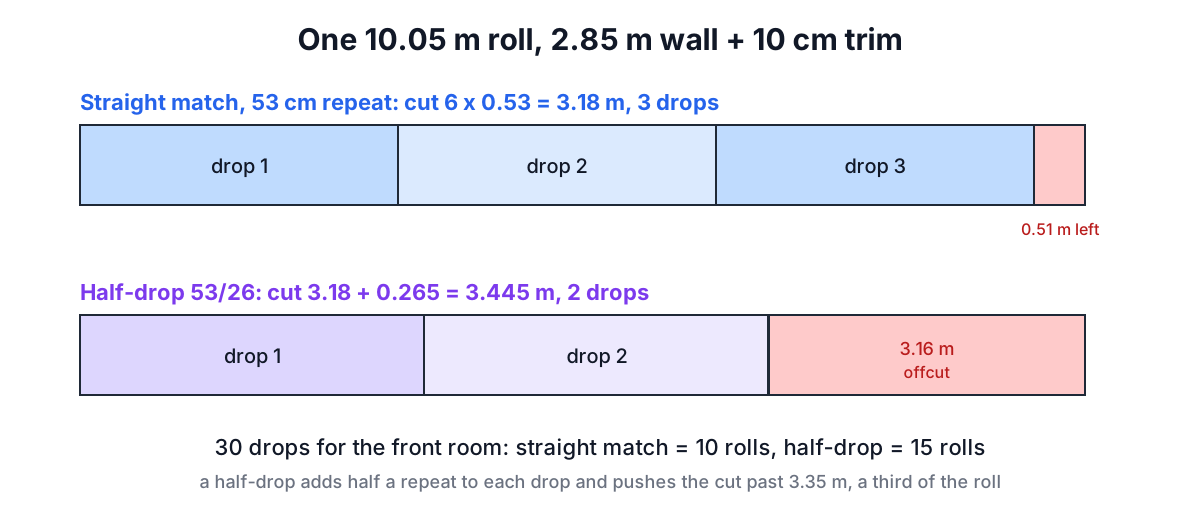
At this height the straight repeat costs nothing extra, because a 3.18 m cut still fits three times into the roll. The half-drop adds half a repeat to every drop on average, pushes the cut past 3.35 m, and turns 10 rolls into 15. If you have fallen for a half-drop design in a tall room, it is worth asking the decorator whether they cut alternate drops from two rolls at once, which can save some of that paper. Count on the full figure until they say so.
Chimney breasts, alcoves, bays and stairs
British rooms are rarely four flat walls, and the awkward parts use the most paper.
- Chimney breast. Add the front and both returns to the wall width. A 1.5 m breast front alone at 2.85 m takes three drops, one roll with a straight 53 cm repeat. Front and returns together (2.2 m) take five drops and two rolls, because the pattern has to be matched round both corners.
- Alcoves. The alcoves either side of a breast are often papered as a feature. Measure each one across the back wall and treat it as its own wall width.
- Bay windows. Do not take the window out. Paper above and below a window still needs most of a drop, cut from a full length so the pattern lines up. Only doors and openings that run to the floor come off the width.
- Picture and dado rails. If you paper only above a dado rail, measure the height from the rail up. That shorter cut can fit five or more drops on a roll.
- Stairwells. Each wall has a different height. Count drops wall by wall at its tallest point and add them up.
Lining paper and older walls
Old plaster that is patched, cracked or uneven often gets lining paper first. Graham and Brown describe cross lining: hanging the lining paper horizontally so its joints do not line up with the wallpaper seams. Because lining paper has no pattern and runs across the wall, area is a fair way to estimate it, unlike the wallpaper on top.
Before you strip, sand or scrape an older wall, check what is on it. HSE's diagrams of where asbestos is found list textured decorative coatings such as Artex in homes, and say asbestos can be found in any residential building built or refurbished before the year 2000. Paper over a sound textured surface, or have it tested, rather than sanding it. For stairwells and tall walls, HSE's ladder and stepladder guidance is written for workplaces but its checks apply at home.
Buying: batches, spares and returns
Buy every roll at once and check that the batch numbers on the labels match. Graham and Brown note that online orders are sent with matching batches but that you should check in store. Keep one spare roll from the same batch: it covers a miscut and gives you matching paper for repairs later. Some suppliers take back unopened rolls, which Practical DIY also mentions, so ask about returns before you buy.
Frequently asked questions
How many drops do I get from a roll of wallpaper in the UK?
A 10.05 m roll gives four drops for a cut of up to 2.51 m, three up to 3.35 m and two up to 5.02 m. On a 2.4 m wall with 10 cm of trim and a free match, that is four. Add a pattern repeat or a half-drop and the cut grows, so tall rooms often get three or two.
Does 52 cm or 53 cm wallpaper make a difference?
Sometimes. Narrower paper needs more drops: 13.2 m of wall takes 26 drops at 52 cm and 25 at 53 cm. In that room both need 7 rolls, but on longer walls the extra drop can mean an extra roll. Use the width on your label.
What does 53/26 mean on a wallpaper label?
It describes an offset (half-drop) match: the pattern repeats every 53 cm and neighbouring drops are shifted down by 26 cm. Enter 53 cm as the repeat and choose half-drop in the calculator.
How many rolls of wallpaper for a chimney breast?
Measure the front and both returns. A 1.5 m front with 35 cm returns is 2.2 m, which is five drops of 53 cm paper. On a 2.85 m high wall with a 53 cm straight repeat, three drops come from each roll, so you need two rolls plus a spare.
Should I take windows off when measuring for wallpaper?
Take off doors and floor-length openings, but not ordinary windows. The pieces above and below a window still use most of a drop because they are cut from a full length to keep the pattern in line.
Sources and further reading
- Wallpaper frequently asked questions, Graham and Brown. Pattern repeat, free, straight and offset matches, batch numbers and cross lining.
- Wallpaper: how to calculate how many rolls are needed, Bricoflor. The 0.53 x 10.05 m Euro-roll and offset labels such as 53/26.
- Wallpapering: estimating the number of rolls, Practical DIY. The 0.52 x 10.05 m UK roll and a perimeter chart.
- Diagrams showing where asbestos can occur in buildings, Health and Safety Executive. Textured coatings such as Artex in homes built or refurbished before 2000.
- Safe use of ladders and stepladders, Health and Safety Executive.
- How many rolls of wallpaper? (US edition), RedBison. The same method with American double rolls.
More Construction & Home
Every tool in the Construction & Home section, free and in your browser.