
AER, Gilt Yields and Fixed-Rate Bonds: UK Rates Explained
How to read UK savings and gilt rates: AER against the gross rate, fixed-rate bond penalties, gilt prices per £100 and why low-coupon gilts suit taxpayers.
By Redbison Dev · · 9 min read
United Kingdom edition. Written for UK savers and gilt buyers: AER and gross rates instead of APY, fixed-rate bonds and notice accounts, gilt prices per £100 nominal under the DMO conventions, the Personal Savings Allowance, CGT on gilts and the FSCS limit. US edition
A UK savings rate comes with two numbers, and a gilt with three. The AER on a fixed-rate bond is a promise about one year's interest; the gross rate is what the bank actually credits each time it pays; and a gilt's running yield, redemption yield and after-tax return can point in different directions. For a higher-rate taxpayer in the 2026 to 2027 tax year, a gilt yielding 4.00% can be worth 3.79% after tax while a savings account paying 4.00% AER is worth 2.40%. This edition shows where those gaps come from, with figures in pounds from the UK AER calculator and the gilt yield calculator.
It explains the arithmetic and the rules that change it. It does not recommend any account or gilt.
AER and the gross rate
UK banks quote savings in two ways. NatWest's guide describes the gross rate as the headline rate before tax deductions, and the AER as the interest your savings might earn over a year as a percentage of the balance. The difference is how often interest is added:
AER = (1 + gross ÷ n)^n − 1        n = interest payments a year
gross = n × ((1 + AER)^(1/n) − 1)
NatWest's own example, a 5.25% gross rate paid monthly, comes out at 5.38% AER, and the calculator gives 5.3782%. At a more typical 4.25% gross rate:
| Interest paid | AER from a 4.25% gross rate |
|---|---|
| Once a year | 4.2500% |
| Quarterly | 4.3182% |
| Monthly | 4.3338% |
| Daily | 4.3413% |
The gap from yearly to monthly is less than a tenth of a point, which is why the AER matters most when you compare two accounts that pay at different frequencies.
Why the monthly option shows a lower rate
Many fixed-rate bonds offer interest yearly or monthly at the same AER. The monthly option then carries a lower gross rate, because the bank sets it so that compounding brings it back to the same AER: 4.40% AER is a 4.3137% gross rate paid monthly. On £20,000 over two years both options reach £21,798.72 if the monthly interest stays in the bond. If the monthly interest is paid out to a current account instead, it stops compounding and you end up with less, unless you put it to work elsewhere.
Fixed-rate bonds: what the two years pay
A two-year bond of £20,000 at 4.40% AER with interest added yearly earns £880.00 in the first year and £918.72 in the second, £21,798.72 at maturity. Tax follows the interest, not the AER. GOV.UK sets the Personal Savings Allowance at £1,000 for basic-rate taxpayers, £500 for higher-rate taxpayers and nothing for additional-rate taxpayers, and the starting rate for savings can make up to £5,000 more tax-free if your other taxable income is below £17,570. If this bond is a higher-rate taxpayer's only savings, £380 of the first year's interest is taxable at the 2026 to 2027 savings higher rate of 40%, a bill of £152.
HM Treasury's Budget 2026 rates annex puts the savings rates for 2027 to 2028 at 24%, 44% and 49%, up from 20%, 40% and 45%, with the allowances unchanged. A bond that pays interest in the 2027 to 2028 tax year loses more of it, which narrows the gap between a taxable bond and a cash ISA at a lower AER. GOV.UK's ISA allowance for 2026 to 2027 is £20,000.
Leaving early: notice accounts and penalties
Some fixed-rate bonds lock the money away until maturity. Others let you out early for a number of days' lost interest. Take £15,000 at 4.00% AER paid monthly, with 3 months' interest (about 90 days) lost on early access, and suppose you need it at month eight:
- the balance by then is about £15,397.38 at the 3.9285% gross rate;
- 3 months' interest (about 90 days) on £15,000 at the gross rate is £147.32;
- you leave with about £15,250.06, against £15,600.00 if you had waited to the end of the year.
Put the penalty as "3 months of interest" in the calculator's bond panel to see the value for any month. The useful comparison is not the headline rate but what you would get back in the month you are worried about.
Protection
The PRA confirmed that from 1 December 2025 the FSCS protects up to £120,000 per depositor per PRA-authorised institution. The limit applies per authorised institution rather than per account, so check which firm holds the authorisation, not just the name on the website.
Gilts: priced per £100 nominal
Gilts are UK government bonds. The DMO's glossary describes the coupon as annual interest per £100 nominal, usually paid in two equal semi-annual instalments, and the DMO's price and yield formulae discount every cash flow at a semi-annually compounded yield, with days counted actual/actual. Prices are quoted per £100 nominal, so a price of 97.22 means you pay £97.22 for each £100 the Treasury repays at maturity.
Take a conventional gilt with a 4.25% coupon and 10 years to run, at a redemption yield of 4.60%:
price = Σ 2.125 ÷ 1.023^k (k = 1 to 20) + 100 ÷ 1.023^20 = £97.2196
The running yield, which the DMO calls the interest yield (coupon divided by clean price), is 4.372%. It ignores the £2.78 rise to £100 at redemption, so it understates the return on a gilt below par and overstates it on one above par. Going the other way, a quoted clean price of £95.00 implies a redemption yield of 4.8881%; there is no algebraic shortcut, so the calculator solves for it numerically.
Clean price, dirty price and the ex-dividend window
The DMO defines the clean price as the quoted price without accrued interest, and the dirty price as the clean price plus the interest earned since the last coupon. With 9.75 years left, halfway through a coupon period, the same gilt at 4.60% has a clean price of £97.2688, accrued interest of £1.0625 and a dirty price of £98.3313. On £10,000 nominal you would pay £9,833.13 before dealing costs.
Gilts have one more rule: the DMO's glossary puts the ex-dividend date 7 business days before a coupon payment date. A buyer whose trade settles after that date and before the coupon does not receive the next coupon or pay accrued interest; instead the seller, who receives the whole coupon, pays a proportion of it back to the buyer as rebate interest. The calculator assumes the gilt is trading cum-dividend, so check the date before buying just ahead of a payment.
Duration and convexity on a gilt
At 4.60% the 10-year gilt has a Macaulay duration of 8.220 years and a modified duration of 8.035, so a one-point move in yields should shift the price by about 8%. The real price moves less on the way down and more on the way up: at 5.60% the clean price falls 7.66% to £89.7695, and at 3.60% it rises 8.43% to £105.4182.
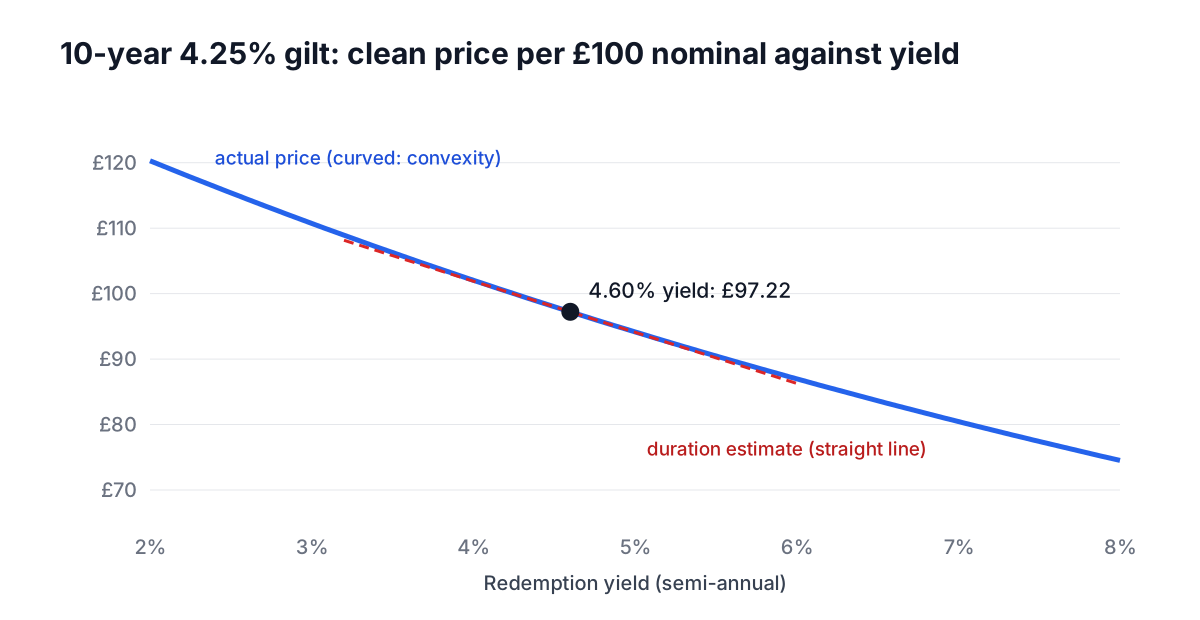
That asymmetry is convexity, and it favours the holder. It is also the reason a gilt held to redemption and a gilt sold early are different investments: held to the end, the price path does not matter; sold after yields have risen, the loss is real.
Why low-coupon gilts suit taxpayers
GOV.UK lists UK government gilts among the assets you do not pay Capital Gains Tax on, while HMRC's Savings and Investment Manual treats interest on gilts as interest for income tax. So the split of a gilt's return between coupon and pull to par changes what you keep.
Compare two gilts with 3.5 years left, both at a 4.00% redemption yield, held by a higher-rate taxpayer whose savings allowance is already used:
| Holding | Price per £100 | Taxed part | Approximate after-tax yield, 2026 to 2027 (40%) | 2027 to 2028 (44%) |
|---|---|---|---|---|
| 0.5% coupon gilt | £88.6740 | coupon of 0.5% | 3.79% | 3.76% |
| 4.5% coupon gilt | £101.6180 | coupon of 4.5% | 2.22% | 2.04% |
| Savings bond at 4.00% AER | £100 | all interest | 2.40% | 2.24% |
The after-tax yields come from solving the yield with each coupon reduced by the tax rate and the rise to £100 left untaxed; they ignore when tax is paid. The low-coupon gilt's running yield is only 0.564%, but almost all of its 4.00% comes as a tax-free gain. A basic-rate taxpayer with unused allowance gains much less from the same choice. Get advice on your own tax position before buying for this reason.
If you also invest in India
If you live in the UK and still run a monthly SIP in an Indian mutual fund, the rate conventions are a separate trap: ₹25,000 a month for seven years at an assumed 12% grows to ₹32,99,475 when the calculator divides 12% by 12, and to ₹32,20,034 when it uses the monthly rate that compounds to exactly 12% a year. The SIP calculator for UK residents shows both, and the bigger question is tax: check whether your scheme appears on HMRC's list of offshore reporting funds, updated monthly, because the UK version of the calculator explains how that status changes the way a gain is taxed here.
Reading any quoted rate
Three checks cover most UK comparisons. Is it a gross rate or an AER? Is the interest added or paid out, and when does it fall into a tax year? Is it guaranteed, like a fixed-rate bond's AER, or a yield that depends on holding to redemption, like a gilt's? The UK compound interest calculator covers the first two over longer periods, and the UK edition of the compound interest guide works through ISAs and regular savers.
Frequently asked questions
Is AER the same as the interest I will receive?
Only if the interest stays in the account for a full year at the same rate. If monthly interest is paid out to another account, you receive the gross rate without compounding, so a 4.40% AER bond paying monthly gives you about 4.31% a year in cash.
Do I pay tax on gilt interest?
HMRC's manual lists interest on gilts as interest chargeable to income tax, so coupons count towards your savings income and allowances. Gains on gilts are free of Capital Gains Tax under GOV.UK's list of exempt assets, which is why the price you pay matters as well as the coupon.
How much is a gilt's accrued interest?
It is the coupon earned since the last payment date, counted actual/actual under the DMO's rules. Halfway through a period, a 4.25% gilt carries £1.0625 per £100 nominal, which the buyer pays to the seller on top of the clean price.
Is my money in a fixed-rate bond protected?
Deposits at a PRA-authorised bank, building society or credit union are protected up to £120,000 per person per authorised firm for failures from 1 December 2025. Gilts are not deposits; the DMO describes them as sterling bonds issued by HM Treasury.
Sources and further reading
- Tax on savings interest: how much is tax free, GOV.UK. Personal Savings Allowance by band and the £5,000 starting rate for savings.
- Budget 2026: Annex A, rates and allowances, HM Treasury. Savings rates of 20%, 40%, 45% for 2026 to 2027 and 24%, 44%, 49% for 2027 to 2028.
- Capital Gains Tax: what you pay it on, GOV.UK. UK government gilts listed as exempt.
- SAIM2010: Interest, introduction, HMRC Savings and Investment Manual. Interest on gilts charged to income tax.
- Glossary, UK Debt Management Office. Coupon, clean and dirty price, interest yield, redemption yield, gilts as sterling bonds issued by HM Treasury, and the ex-dividend date 7 business days before a coupon payment date.
- Formulae for calculating gilt prices from yields, UK Debt Management Office. Semi-annual coupons, prices per £100 nominal, actual/actual discounting.
- PRA confirms FSCS deposit limit increase to £120,000, Bank of England.
- What is AER?, NatWest. Gross rate and AER, with the 5.25% monthly example.
- Offshore funds: list of reporting funds, HMRC.
- Individual Savings Accounts, GOV.UK. £20,000 allowance for 2026 to 2027.
More Calculators
Every tool in the Calculators section, free and in your browser.
- Investment Calculator
- Compound Interest Calculator
- Simple Interest Calculator
- Interest Calculator
- EMI Calculator
- Retirement Calculator
- Time-Weighted Return Calculator
- Savings Goal Calculator
- Inflation Calculator
- CAGR Calculator
- ROI Calculator
- Present and Future Value Calculator
- NPV and IRR Calculator
- 401(k) Calculator
- Roth IRA Calculator
- APY and CD Calculator
- SIP Calculator
- Annuity Calculator
- Bond Price and Yield Calculator
- Currency Converter
- Dividend Calculator
- Stock Average Calculator
- RMD Calculator