
FD Yield, G-Sec YTM and SIP Returns: Reading the Rate
What 7% on an FD, 6.4% on a G-sec and 12% on a SIP really mean: quarterly compounding, premature withdrawal, 30/360 accrued interest and step-up SIPs.
By Redbison Dev · · 9 min read
India edition. Written for Indian savers and investors: FD rates p.a. with quarterly compounding, premature withdrawal under the RBI deposit directions, G-sec prices per ₹100 on 30/360 from the RBI primer, SIP conventions and equity capital gains rates, all in rupees with lakh and crore. US edition
A bank's 7% FD, a G-sec at a 6.4% yield and a SIP "at 12%" are three different kinds of number. The FD rate is a per annum rate that compounds quarterly, so ₹6 lakh at 7% p.a. actually earns at an effective 7.1859% a year. The G-sec yield is a rate you solve for from a price, on a 30/360 calendar. And the SIP figure is an assumption that two calculators can turn into answers ₹83,000 apart. This edition works through each with rupee figures from the FD effective yield calculator, the G-sec yield calculator and the step-up SIP calculator.
It explains the arithmetic and the rules behind it. It does not recommend any bank, security or fund.
Rate p.a. and effective yield on an FD
Indian banks quote FD rates per annum. On a cumulative deposit the interest is added to the balance every quarter: SBI's reinvestment plan says interest is compounded quarterly and paid at the end of the term. Interest then earns interest, and the effective annual yield is a little above the card rate:
effective yield = (1 + rate ÷ 4)^4 − 1
maturity = principal × (1 + rate ÷ 4)^(4 × years)
| Interest added | Effective yield of a 7.00% p.a. FD |
|---|---|
| Yearly | 7.0000% |
| Quarterly (as in SBI's reinvestment plan) | 7.1859% |
| Monthly | 7.2290% |
A 6.50% p.a. FD compounded quarterly yields 6.6602%. The effective yield is the same idea the US calls APY and the UK calls AER, and it is the fair way to compare a cumulative FD with a deposit that pays at another frequency.
A non-cumulative FD that pays interest out every quarter or month does not compound for you. If the payout goes to a savings account, your yield is the card rate, so the cumulative option suits money you will not need until maturity.
What breaking an FD early really costs
The RBI's Interest Rate on Deposits Directions, 2025 set the rules every commercial bank follows:
- on premature withdrawal, interest is paid at the rate applicable to the amount and the period the deposit actually stayed with the bank, not the contracted rate;
- the bank may then charge a penalty under a Board-approved policy, but only if the components were brought to your notice when the deposit was accepted;
- the minimum tenor is seven days, and no interest is paid on a deposit withdrawn before its minimum period.
SBI's published penalty is 0.50% for deposits up to ₹5 lakh and 1% above ₹5 lakh, taken off the lower of the rate for the period run and the contracted rate.
Take ₹6,00,000 at 7.00% p.a. for three years, compounded quarterly. Held to maturity it becomes ₹7,38,863.59. Suppose the bank's card rate for a one-year deposit is 6.50% and you break it at month 12. With the 1% penalty you are paid 5.50% for the year: ₹6,33,686.89, which is ₹9,428.53 less than 7.00% would have paid to that point.
| Plan | Maturity at 3 years | Broken at month 12 | Interest lost |
|---|---|---|---|
| One FD of ₹6,00,000 (1% penalty) | ₹7,38,863.59 | ₹6,33,686.89 at 5.50% | ₹9,428.53 |
| One FD of ₹5,00,000 (0.50% penalty) | ₹6,15,719.66 | ₹5,30,681.78 at 6.00% | ₹5,247.74 |
| Three FDs of ₹2,00,000, break one | ₹2,46,287.86 each | ₹2,12,272.71 at 6.00% | ₹2,099.10 |
The rates for the shorter period are assumptions: enter your own bank's card rate for the tenure you actually completed. The last row is the practical point. If you might need ₹2 lakh, splitting the deposit means breaking only one piece, at the lower penalty slab, while the other two run to maturity.
Deposit insurance includes interest
DICGC covers up to ₹5 lakh per depositor per bank, principal and interest together, with deposits at different branches of the same bank added up. A ₹5 lakh FD is fully covered on day one but not once interest accrues, so a larger sum spread across banks is covered more fully than one held at a single bank.
FD interest is taxable, and banks deduct TDS under the income-tax rules. Under the Income-tax Act, 2025, which applies from 1 April 2026, Form 121 replaces Forms 15G and 15H for depositors who qualify to ask for no deduction. The figures above are before tax.
G-secs: a yield you solve for
The RBI's primer on the government securities market sets the conventions: dated G-secs pay coupons half-yearly on the face value, prices and yields are quoted per ₹100 of face value, and the bond market counts days on 30/360, where every month has 30 days and the year 360. T-bills and other money market instruments use actual/365.
YTM is the rate that makes the present value of the coupons and the ₹100 redemption equal the price. The RBI's own exercise is a two-year 8% bond priced at ₹102:
102 = 4 ÷ (1 + r/2) + 4 ÷ (1 + r/2)² + 4 ÷ (1 + r/2)³ + 104 ÷ (1 + r/2)⁴
The primer solves it by trial and error; the calculator does the same numerically and returns 6.9121%. Paying ₹2 over par spreads a loss across two years, so the yield sits below the coupon.
Accrued interest on 30/360
Between coupon dates the buyer pays the seller the interest earned so far. In the RBI's worked example, an 8.83% security last paid its coupon on 25 November 2013 and the trade settled on 30 January 2014, 65 days later on 30/360. Accrued interest is 8.83 × 65 ÷ 360 = ₹1.5943 per ₹100, so a clean price of ₹100.50 becomes a dirty price of ₹102.0943, and ₹5 crore face value costs ₹5,10,47,150. The calculator returns the same accrued interest and a YTM of 8.7497% at that price.
Duration and convexity
Take a retail holding of ₹10,000 face value (the primer's minimum bid) of a 6.79% G-sec with 7.5 years left, at a 6.40% yield. The clean price is ₹10,229.46, the current yield is 6.638% and the modified duration is 5.832, so a one-point change in yields should move the price by roughly 5.8%. In fact the price falls to ₹9,653.66 at 7.40% (5.63% down) and rises to ₹10,847.98 at 5.40% (6.05% up).
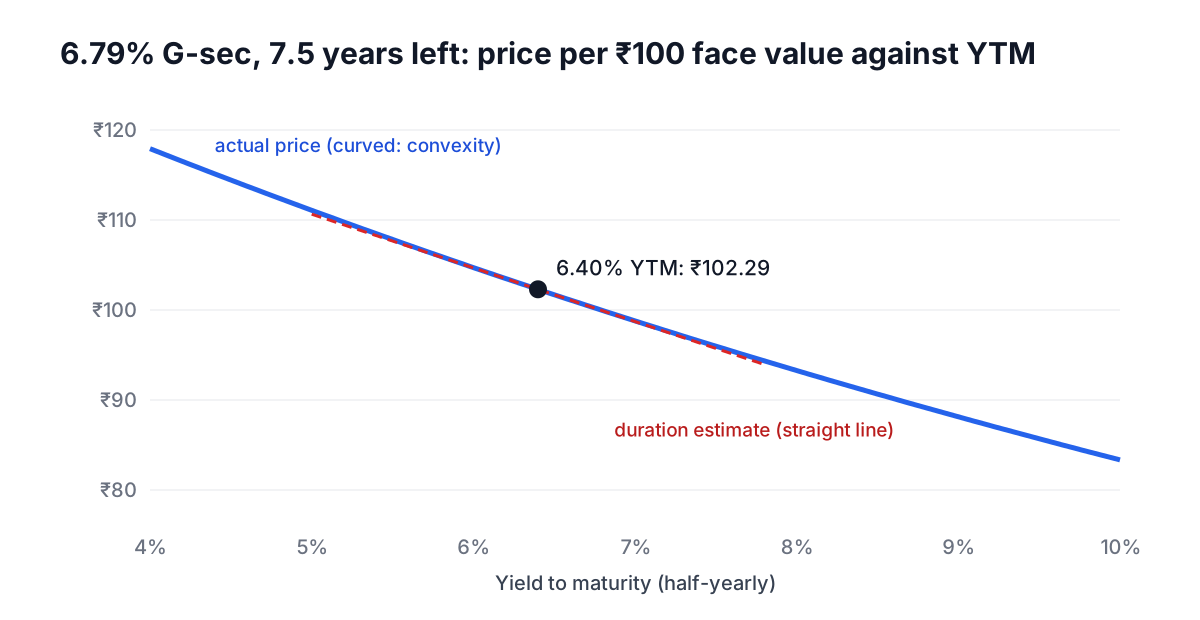
The curve bending above the straight duration line is convexity: the holder gains more from a fall in yields than they lose from an equal rise. Held to maturity, none of this matters; the price returns to ₹100. Sold early after yields rise, the loss is real.
SIPs: why calculators disagree
A SIP buys units at the start of each month, so the textbook future value is an annuity due:
FV = P × [((1 + i)^n − 1) ÷ i] × (1 + i)
The disagreement is all in i. Many calculators divide the annual rate by 12, so 12% becomes 1% a month, which compounds to 12.68% a year. Others use (1 + 12%)^(1/12) − 1, about 0.949% a month, so that 12% means exactly 12% a year. For ₹10,000 a month over 10 years:
| Convention | Value after 10 years |
|---|---|
| 12% ÷ 12, instalment at the start of the month | ₹23,23,391 |
| 12% ÷ 12, instalment at the end of the month | ₹23,00,387 |
| Monthly rate that compounds to 12% a year | ₹22,40,359 |
All three invest ₹12 lakh. The ₹83,032 gap is a modelling choice, not a better fund, so when a fund house's calculator and yours differ, switch the convention before you suspect an error.
The step-up matters more than the convention
Raising the instalment every year changes the answer far more. ₹15,000 a month for 15 years at an assumed 12% grows to ₹75,68,640 kept flat. Raised by 10% each year, it reaches ₹1,30,25,774 on ₹57,19,047 invested. Market-linked returns are not promised, so run a lower rate too: at 8% the flat SIP ends at ₹52,25,177. To reach ₹50 lakh in 12 years you need about ₹15,516 a month at 12%, or ₹17,938 at 10%.
Tax when you redeem
The Union Budget speech of 23 July 2024 set the rates for listed equity and equity-oriented fund units: listed financial assets held for more than a year are long term, long-term gains are taxed at 12.5% with an exemption of ₹1.25 lakh a year, and short-term gains on these assets at 20%. The same speech said debt mutual funds are taxed at the applicable rates whatever the holding period. Check the rates in force for the year you redeem.
Each SIP instalment has its own purchase date. Redeem all of the ₹10,000 SIP above after 10 years and the gain of ₹11,23,391 splits into about ₹11,15,297 long-term and ₹8,093 short-term (the last 12 instalments, worth ₹1,28,093). If nothing else uses the exemption that year, long-term tax is 12.5% of ₹9,90,297, about ₹1,23,787, and short-term tax about ₹1,619, before surcharge and cess. Spreading the redemption across two financial years uses the ₹1.25 lakh exemption twice. Check your own position with a tax adviser before a large redemption.
Reading any quoted rate
Ask three questions. Is it a rate p.a. or an effective yield? How often does it compound or pay out? And is it a promise, like an FD's card rate, or an assumption, like a SIP's 12%? A 7% FD covered by DICGC and a 12% equity SIP are not on the same scale, because only one is contracted. The compound interest calculator for India handles the first two over longer periods, and the India edition of SIP vs lump sum compares investing gradually with investing at once.
Frequently asked questions
How much interest do I lose if I break an FD after one year?
You get the bank's rate for a one-year deposit minus its penalty, not the contracted rate. On ₹6 lakh at 7% for three years, broken at month 12 with a 6.50% one-year rate and SBI's 1% penalty, you get ₹6,33,686.89, about ₹9,429 less than 7% would have paid by then.
Is the effective yield on an FD the same as its interest rate?
No. The card rate is per annum; with quarterly compounding the effective yield is higher. A 7.00% p.a. cumulative FD yields 7.1859% a year, and a 6.50% FD yields 6.6602%.
How is accrued interest on a G-sec calculated?
Coupon × days since the last coupon ÷ 360, per ₹100 face value, counting days on 30/360. An 8.83% security 65 days after its coupon carries ₹1.5943 of accrued interest, which the buyer pays on top of the clean price.
Why does my SIP calculator not match the fund house's figure?
The two probably convert the annual rate to a monthly one differently, or place the instalment at a different point in the month. For ₹10,000 a month over 10 years at 12%, the answers range from ₹22,40,359 to ₹23,23,391 on the same ₹12 lakh invested.
Sources and further reading
- Reserve Bank of India (Commercial Banks: Interest Rate on Deposits) Directions, 2025, Reserve Bank of India. Interest on premature withdrawal, Board-approved penalty policy, disclosure, seven-day minimum tenor.
- Government Securities Market in India: A Primer, Reserve Bank of India. Half-yearly coupons, ₹100 face value, 30/360 day count, accrued interest and YTM examples, ₹10,000 minimum bid.
- Reinvestment Plan, State Bank of India. Quarterly compounding, 0.50% and 1% premature withdrawal penalties; TDS applies as per the Income Tax Rules.
- A Guide to Deposit Insurance, DICGC. ₹5 lakh per depositor per bank, principal and interest together.
- Form Mapping Guide: Income-tax Act, 1961 to Income-tax Act, 2025, Income Tax Department. Form 121 (formerly 15G and 15H), the declaration under section 393(6) for receiving certain incomes without deduction of tax, from 1 April 2026.
- Budget speech 2024-25, Ministry of Finance. 12.5% long-term and 20% short-term rates, the ₹1.25 lakh exemption and the one-year holding period for listed financial assets.
- What is Systematic Investment Plan (SIP)?, Association of Mutual Funds in India.
More Calculators
Every tool in the Calculators section, free and in your browser.
- Investment Calculator
- Compound Interest Calculator
- Simple Interest Calculator
- Interest Calculator
- EMI Calculator
- Retirement Calculator
- Time-Weighted Return Calculator
- Savings Goal Calculator
- Inflation Calculator
- CAGR Calculator
- ROI Calculator
- Present and Future Value Calculator
- NPV and IRR Calculator
- 401(k) Calculator
- Roth IRA Calculator
- APY and CD Calculator
- SIP Calculator
- Annuity Calculator
- Bond Price and Yield Calculator
- Currency Converter
- Dividend Calculator
- Stock Average Calculator
- RMD Calculator