
Readability Scores and Reading Age: A UK Plain English Guide
What Flesch, Fog and SMOG scores mean as UK school years and reading ages, what GOV.UK and the NHS ask for, and worked rewrites of a bill and a GP notice.
By Redbison Dev · · 12 min read
United Kingdom edition. Written for UK writers: US grade scores translated into year groups in England, the GOV.UK plain English rules, the NHS view of readability tools, adult literacy figures for each UK nation, and examples from a utility bill and a GP surgery. US edition
Readability formulas were built in the United States, so most of them answer in US school grades. A UK writer needs two translations: from a grade to a year group or reading age, and from a score to what GOV.UK and the NHS actually ask of public writing. The short version is that a US grade is about one year behind the matching year group in England (grade 8 is roughly Year 9, ages 13 to 14), and that no UK public body sets a score as a target. They set rules about sentences, words and voice, and treat the score as a way to find the sentences that need work. This edition covers both, with rewrites scored by the Readability Checker (UK).
From US grades to UK year groups
Flesch-Kincaid, Gunning Fog, SMOG, Coleman-Liau and the Automated Readability Index all express difficulty as the US grade a reader would need. A US eighth grader is 13 to 14 years old. The GOV.UK national curriculum table puts ages 13 to 14 in Year 9, so the year group in England is the grade plus one:
| US grade | Year group in England | Age |
|---|---|---|
| 3 | Year 4 | 8 to 9 |
| 6 | Year 7 | 11 to 12 |
| 8 | Year 9 | 13 to 14 |
| 10 | Year 11 | 15 to 16 |
| 12 | (sixth form) | 17 to 18 |
Scotland, Wales and Northern Ireland number their school years differently, so the age column is the safer way to talk about a reading level across the UK. "Reading age" in this sense is a rough label, not a measurement of any particular reader.
Flesch Reading Ease is the exception: it runs from 0 (very difficult) to 100 (very easy), with 60 to 70 described by Flesch as "standard".
What the formulas count
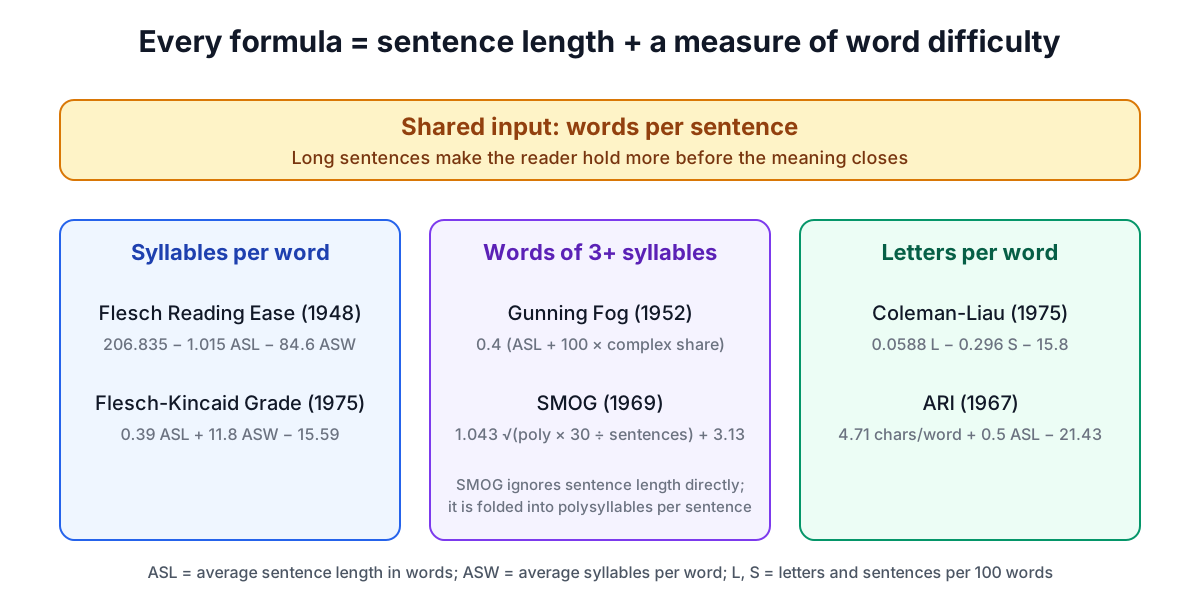
All six formulas combine the same two signals: how long the sentences are, and how long the words are.
| Formula | Sentence measure | Word measure | Output |
|---|---|---|---|
| Flesch Reading Ease (1948) | words per sentence | syllables per word | 0 to 100, higher is easier |
| Flesch-Kincaid (1975) | words per sentence | syllables per word | US grade |
| Gunning Fog (1952) | words per sentence | share of words with 3+ syllables | US grade |
| SMOG (1969) | sentences sampled | words with 3+ syllables | US grade, aimed at full understanding |
| Coleman-Liau (1975) | sentences per 100 words | letters per 100 words | US grade |
| ARI (1967) | words per sentence | letters per word | US grade |
The formulas cannot see whether your points come in the right order or whether the reader knows what a term means. They are good at one job: finding the sentences that will tire a reader, and showing that a new draft is easier than the old one.
British spelling moves the score slightly
Syllables are estimated from spelling, and British spellings change both letters and syllable guesses. The checker scores "The colour of the centre was analysed by the organisation." at Flesch-Kincaid grade 8.4 and the US-spelled version at 9.6, mainly because its rules count "centre" as one syllable and center as two. Compare drafts written in the same spelling, and do not read much into a fraction of a grade.
What UK public bodies ask for
GOV.UK. Plain English is mandatory for all of GOV.UK. The guidance asks writers to try to split sentences over 25 words, keep paragraphs to no more than 5 sentences, use the active voice, and choose "buy" over "purchase", "help" over "assist" and "about" over "approximately". It mentions the Hemingway app as a way to check for passive writing but sets no score.
The reason it gives is literacy. GOV.UK cites figures that 1 in 6 adults in England and 1 in 5 in Northern Ireland have very poor literacy skills, 1 in 8 adults in Wales lack basic literacy skills, and 1 in 4 in Scotland experience challenges because of their literacy skills, noting that each nation defines literacy differently. It also notes that people with higher literacy prefer plain English too: in one study of legal language, 80% preferred sentences in clear English.
NHS. The NHS digital service manual says more than 4 in 10 adults struggle with health content for the public, and more than 6 in 10 with health content that includes numbers and statistics. Its position on scores is direct: "We do not recommend readability tools, except to help you prioritise your content." Tools, it says, cannot tell you how usable content is.
So in the UK, a readability score is an editing aid. Sentence length, plain words and the active voice are the rules; testing with real readers is the proof.
Worked example: an energy supplier's letter
A Direct Debit review letter in typical house style:
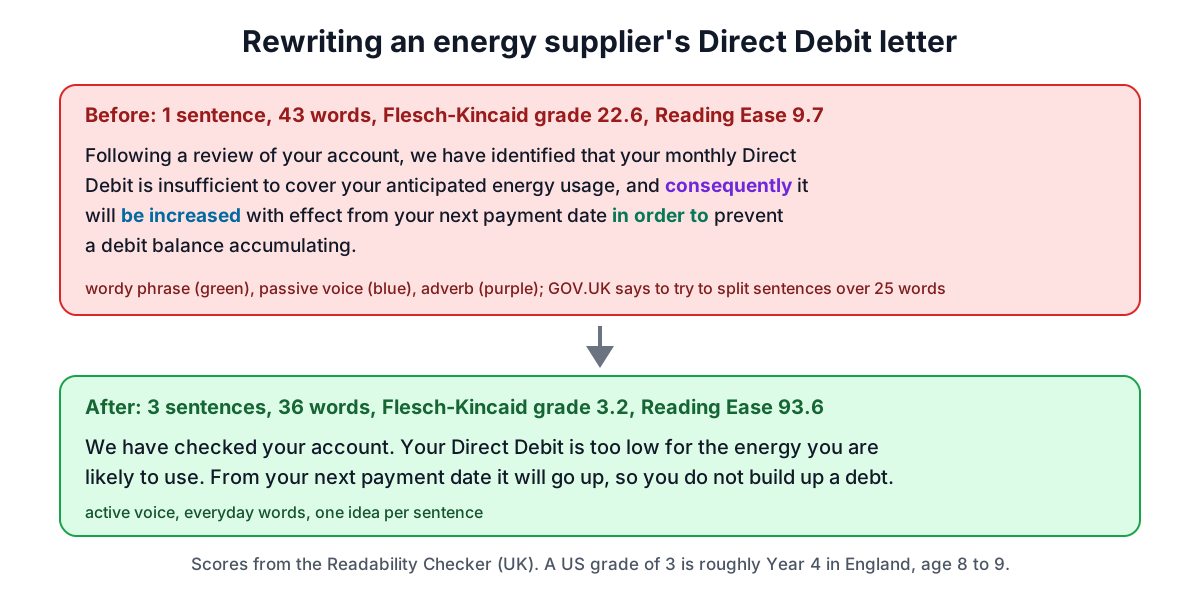
Following a review of your account, we have identified that your monthly Direct Debit is insufficient to cover your anticipated energy usage, and consequently it will be increased with effect from your next payment date in order to prevent a debit balance accumulating.
One sentence of 43 words. The checker gives Flesch Reading Ease 9.7 and Flesch-Kincaid grade 22.6, marks the sentence very hard, flags "be increased" as passive, "consequently" as an adverb and "in order to" as a wordy phrase. It is also 18 words over GOV.UK's 25-word line.
Rewritten:
We have checked your account. Your Direct Debit is too low for the energy you are likely to use. From your next payment date it will go up, so you do not build up a debt.
Three sentences, 36 words: Reading Ease 93.6, Flesch-Kincaid grade 3.2 (roughly Year 4, age 8 to 9). Nothing is lost. The reader now knows what happened, what will change and why, in that order.
Worked example: a GP surgery notice
Patients are requested to ensure that repeat prescription requests are submitted a minimum of two working days prior to the date on which medication is required.
26 words, grade 14.5, Reading Ease 37.3, with three passive verbs ("are requested", "are submitted", "is required") and "prior to" flagged. Rewritten:
Please order your repeat prescription at least 2 working days before you need it.
14 words, grade 6.7 (about Year 7 to 8), Reading Ease 71.8. The numeral "2" also makes the deadline easier to spot than "two".
Which number to track
Different formulas give the same text different grades; the rewrite above scores 6.7 on Flesch-Kincaid but 10.2 on Coleman-Liau, because "prescription" is a long word that the letter-based formula weights heavily. Pick one formula for a project, usually Flesch-Kincaid or the checker's average grade, and watch it move between drafts. A five-point drop is real; a half-point difference between two tools is noise from the way each counts syllables and sentences.
For public-facing UK copy, a practical check is: every sentence under 25 words, no sentence marked very hard, and a Flesch-Kincaid grade that puts the page within reach of a 13 or 14 year old. Specialist content can score higher, provided terms are explained.
Tools for this job
- Readability Checker (UK): paste a draft, set a target as a UK year group and work through the highlighted sentences, passives and wordy phrases.
- Word Counter: length and reading time for the same draft.
- Online Diff Tool: shows exactly what changed between the before and after versions.
- Related: word count and reading time and comparing two versions of a text.
Frequently asked questions
What reading age is a Flesch-Kincaid score?
Add five to the grade for a rough age, and one for the year group in England. A grade of 8 is about Year 9, ages 13 to 14; a grade of 6 is about Year 7, ages 11 to 12, based on the national curriculum table on GOV.UK.
Does GOV.UK set a readability score?
No. GOV.UK makes plain English mandatory and asks writers to split sentences over 25 words, keep paragraphs to 5 sentences or fewer, use the active voice and choose everyday words. It mentions the Hemingway app for spotting passive writing but sets no target score.
Does the NHS recommend readability tools?
Only to help prioritise. The NHS digital service manual says it does not recommend readability tools except to help you prioritise your content, because tools cannot tell you how usable your content is.
Why does my British spelling score differently from a US checker?
The formulas estimate syllables and count letters from spelling, so "centre", "colour" and "organisation" change the counts. In the checker, the same sentence scores grade 8.4 in British spelling and 9.6 in US spelling.
Sources and further reading
- Use clear language, GOV.UK publishing guidance. Plain English mandatory, sentences over 25 words, 5-sentence paragraphs, active voice, literacy figures by nation.
- The national curriculum, GOV.UK. Key stages, year groups and ages in England.
- Health literacy, NHS digital service manual. More than 4 in 10 adults struggle with health content; position on readability tools.
- A new readability yardstick, Rudolf Flesch, Journal of Applied Psychology, 1948. Flesch Reading Ease.
- Derivation of New Readability Formulas for Navy Enlisted Personnel, Kincaid and colleagues, 1975. Flesch-Kincaid grade level.
- A computer readability formula designed for machine scoring, Coleman and Liau, Journal of Applied Psychology, 1975.
More Writing Tools
Every tool in the Writing Tools section, free and in your browser.