
Readability Scores and Plain Language in Canada
What Flesch-Kincaid, Fog and SMOG scores mean, what the Canada.ca Content Style Guide asks for instead, and worked plain language rewrites of public notices.
By Redbison Dev · · 12 min read
Canada edition. Written for Canadian writers: the Canada.ca Content Style Guide's plain language duty and sentence lengths, its warning about readability tools, Statistics Canada's adult literacy results, and rewrites of a benefit reminder and a city water notice. US edition
Readability formulas give a quick number for how hard a passage is to read: a Flesch Reading Ease score from 0 to 100, or a school grade. In Canada, federal government writers are told two things at once: they must use plain language, and they should not rely on readability tools to judge it. This edition explains what the formulas measure, why the Canada.ca Content Style Guide treats them as a first pass only, and how to use the scores well, with rewrites scored by the Readability Checker (Canada).
The plain language duty
The Canada.ca Content Style Guide says you must use plain language because it is a requirement of the Directive on the Management of Communications. It adds that plain language does not oversimplify or strip meaning from content. The guide's rules for text are concrete:
- break up long sentences, with the optimum under 15 to 20 words;
- keep each paragraph to one main idea and no more than three sentences;
- consider your audience's reading level and literacy needs;
- write out numbers zero to nine in narrative text, and use digits for 10 and over and for data, steps, times and dates.
It sets no grade or score target. Its reason for the plain language rule is literacy: citing Statistics Canada (2012) and Canadian literacy organizations, it says almost 50% of Canadians have literacy challenges.
The newer data are better but still sobering. In Statistics Canada's release of the 2022 Programme for the International Assessment of Adult Competencies (PIAAC), Canada's average literacy score was 271 against an OECD average of 259, and 19% of adults aged 16 to 65 scored at the two lowest literacy levels, compared with 27% across participating OECD countries. One adult in five is still a lot of readers for a benefit notice or a safety instruction.
What the formulas measure
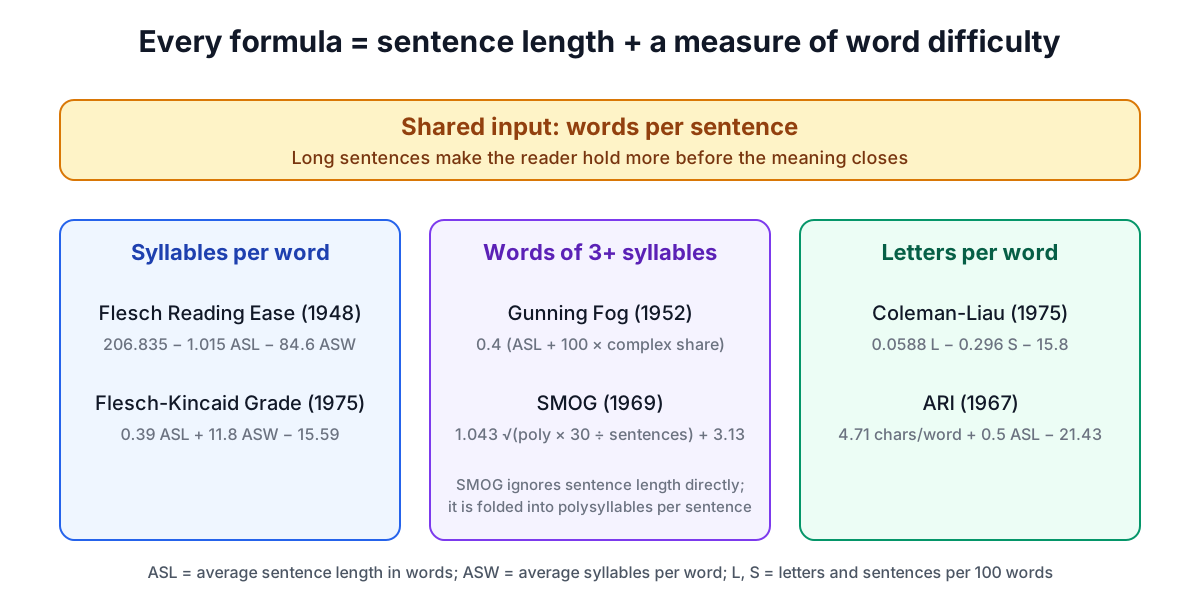
Each formula is a regression from the mid-20th century that predicts reading difficulty from two text features: sentence length and word length.
| Formula | Year | Word measure | Result |
|---|---|---|---|
| Flesch Reading Ease | 1948 | syllables per word | 0 to 100, higher is easier |
| Flesch-Kincaid Grade Level | 1975 | syllables per word | school grade |
| Gunning Fog | 1952 | share of words with 3 or more syllables | years of schooling |
| SMOG | 1969 | words with 3 or more syllables over 30 sentences | grade for full understanding |
| Coleman-Liau | 1975 | letters per 100 words | school grade |
| Automated Readability Index | 1967 | letters per word | school grade |
The grades are US school grades. Outside Quebec, where high school runs from Secondary I to V, Canadian provinces also count school years as grades, so a Flesch-Kincaid grade of 8 reads naturally as "a Grade 8 reader".
Why the style guide says not to rely on them
Section 2.1 of the guide is headed "Don't rely on readability tools". The tools, it says, can help you spot problem areas and show why text should be simplified, but they cannot tell you whether your audience will find your content easy to understand and use. That matches what the formulas are: counts of sentence and word length. They cannot see whether a notice puts the action first, whether a term is defined, or whether the reader can find the deadline.
The practical reading is: use a score to find the sentences that need work, fix them by the guide's rules, and test anything important with real readers.
Worked example: a benefit reminder
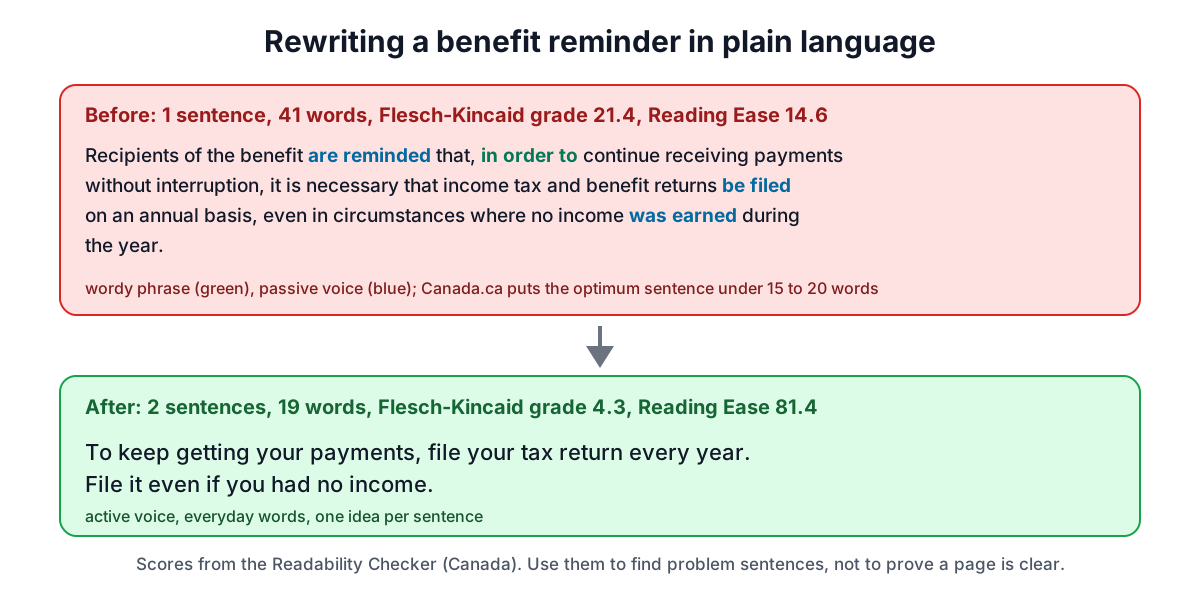
Recipients of the benefit are reminded that, in order to continue receiving payments without interruption, it is necessary that income tax and benefit returns be filed on an annual basis, even in circumstances where no income was earned during the year.
One sentence of 41 words, more than twice the guide's optimum. The checker gives Flesch Reading Ease 14.6 and Flesch-Kincaid grade 21.4, marks it very hard, and flags three passives ("are reminded", "be filed", "was earned") and the wordy "in order to". Rewritten:
To keep getting your payments, file your tax return every year. File it even if you had no income.
Two sentences and 19 words: Reading Ease 81.4, grade 4.3. The rewrite speaks to the reader, puts the action first and keeps the one condition that matters.
Worked example: a city water notice, and the a.m. trap
Residents are advised that, due to scheduled maintenance of the water distribution system, water service will be temporarily interrupted between the hours of 9 a.m. and 3 p.m., and it is recommended that an adequate supply of drinking water be stored in advance.
43 words, grade 21.2, Reading Ease 19.6, with four passives. A first rewrite:
We are repairing water pipes on your street. Your water will be off from 9 a.m. to 3 p.m. Fill some jugs with drinking water before then.
This is three sentences to a reader, but the checker counts two. Canadian usage writes "a.m." and "p.m." with periods, and a sentence that ends on "p.m." looks to the software like an abbreviation in mid-sentence, so it joins the last two sentences and reports grade 4.5. End the sentence on another word, "Your water will be off from 9 a.m. to 3 p.m. on Tuesday.", and the checker sees three sentences: grade 3.2, Reading Ease 89.1. The text barely changed; the count did. Every checker has quirks like this, which is one more reason the guide treats scores as a pointer rather than a verdict.
English and French
The formulas and their constants were fitted to English text. Canada.ca content must be provided in both official languages and professionally translated, and the French style guide is a separate document. Edit the English version for plain language first, then let the translation follow it; do not run the English formulas on French text.
How to use the scores on a Canadian project
- Pick one measure (Flesch-Kincaid or the checker's average grade) and track it across drafts.
- Split every sentence the checker marks very hard, and anything over 20 words.
- Swap wordy phrases: "in order to" to "to", "prior to" to "before", "facilitate" to "help".
- Turn passives into actions with a subject: "You must file" rather than "returns must be filed".
- Keep a technical term your readers use, and define it the first time.
- Test with readers when the content affects money, health or safety.
Tools for this job
- Readability Checker (Canada): scores, very hard sentences, passive voice and wordy phrases, with the Canada.ca sentence guidance built in.
- Word Counter: length and reading time.
- Online Diff Tool: see exactly what changed between drafts.
- Related: word count and reading time and comparing two versions of a text.
Frequently asked questions
Does the Government of Canada require a readability score?
No. The Canada.ca Content Style Guide requires plain language under the Directive on the Management of Communications, but it sets no grade or score. It asks writers to consider their audience's reading level and literacy needs, and says not to rely on readability tools to judge readability.
How long should a sentence be in plain language?
The Canada.ca guide puts the optimum under 15 to 20 words, with paragraphs of one main idea and no more than three sentences.
Why does the checker count my sentences wrong?
Sentence detection is guesswork around abbreviations. A sentence ending in "p.m." or "Dr." can be read as continuing, which merges two sentences and raises the grade. Rephrase so the sentence ends on a full word, or switch on line breaks as sentence ends for lists.
How many Canadians have low literacy?
In the 2022 PIAAC results released by Statistics Canada, 19% of adults aged 16 to 65 scored at the two lowest literacy levels, against 27% across participating OECD countries. The Canada.ca guide, citing 2012 data and literacy organizations, says almost 50% of Canadians have literacy challenges.
Sources and further reading
- Canada.ca Content Style Guide, Government of Canada. Sections 1.2 (readability and literacy), 1.3 (official languages), 2.0 (plain language requirement), 2.1 (readability tools), 2.6 (short sentences and paragraphs), 4.6 (numbers).
- Survey of Adult Skills, 2022 (PIAAC), Statistics Canada, The Daily. Canada's average literacy score of 271 and 19% at the two lowest levels.
- A new readability yardstick, Rudolf Flesch, Journal of Applied Psychology, 1948.
- Derivation of New Readability Formulas for Navy Enlisted Personnel, Kincaid and colleagues, 1975.
- A computer readability formula designed for machine scoring, Coleman and Liau, Journal of Applied Psychology, 1975.
More Writing Tools
Every tool in the Writing Tools section, free and in your browser.