
How EMI Is Calculated: Home Loan Interest and Principal
How Indian banks calculate EMI, why early EMIs are mostly interest, and what rate resets, prepayment and the KFS mean for a ₹50 lakh home loan.
By Redbison Dev · · 6 min read
India edition. Written for Indian borrowers: rupees in lakh, a ₹50 lakh home loan worked month by month, RBI's rules on floating-rate resets, no prepayment charges on floating-rate loans to individuals, and the Key Facts Statement with its APR. US edition
On a ₹50 lakh home loan at 8.5% for 20 years, the EMI is ₹43,391.16. In the first month ₹35,416.67 of it is interest and only ₹7,974.50 reduces the loan. Principal does not overtake interest until the 143rd EMI, almost 12 years in, and over the full tenure you pay ₹54,13,878.80 of interest, more than the amount you borrowed.
That shape comes straight from the EMI formula, and it explains the three decisions that matter most to an Indian borrower: how long a tenure to take, what to do when a floating rate is reset, and whether to prepay. This edition works through each with the India EMI calculator and RBI's current rules. It explains how loans work; it is not a recommendation about any lender or loan.
The EMI formula, step by step
An EMI loan is calculated on the reducing balance, the same way the calculator does it:
EMI = P × r × (1 + r)^n / ((1 + r)^n − 1)

P = loan amount             ₹50,00,000
r = annual rate / 12 / 100  8.5 / 1,200 = 0.0070833
n = tenure in months        240
- (1 + r)^n = 1.0070833^240 = 5.44124
- EMI = 50,00,000 × 0.0070833 × 5.44124 / 4.44124 = ₹43,391.16
RBI's Key Facts Statement circular of 15 April 2024 defines an EMI the same way: an equated instalment of principal and interest, paid monthly for a fixed number of months, that fully amortises the loan. Your bank's figure may differ by a rupee because it rounds each instalment.
Where each EMI goes
Each month the bank charges interest on what you still owe; the rest of the EMI reduces the balance.
interest this month  = outstanding balance × r
principal this month = EMI − interest
Month 1: ₹50,00,000 × 0.0070833 = ₹35,416.67 of interest, so ₹7,974.50 goes to principal. Year by year, the same ₹5,20,694 of EMIs splits like this:
| Year | Interest paid | Principal repaid | Balance at year end |
|---|---|---|---|
| 1 | ₹4,21,182.48 | ₹99,511.46 | ₹49,00,488.54 |
| 5 | ₹3,81,053.02 | ₹1,39,640.92 | ₹44,06,359.16 |
| 10 | ₹3,07,420.27 | ₹2,13,273.67 | ₹34,99,691.14 |
| 15 | ₹1,94,960.94 | ₹3,25,733.00 | ₹21,14,936.53 |
| 20 | ₹23,201.74 | ₹4,97,492.20 | ₹0.00 |
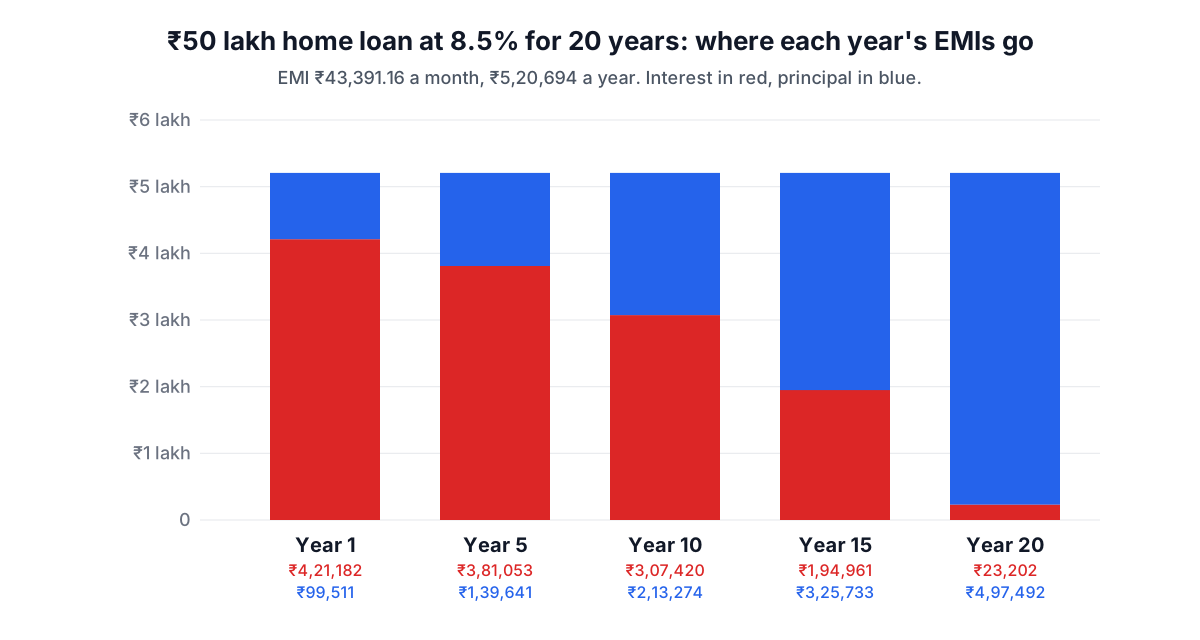
After five years of EMIs you still owe ₹44.06 lakh of the ₹50 lakh; after ten, ₹35 lakh. If you plan to sell the flat or switch lenders in a few years, that outstanding balance, not the EMI, is the number to look at. The calculator's schedule shows every month.
Tenure: the EMI against the total
| Tenure | EMI | Total interest |
|---|---|---|
| 15 years (180 months) | ₹49,236.98 | ₹38,62,656.02 |
| 20 years (240 months) | ₹43,391.16 | ₹54,13,878.80 |
| 25 years (300 months) | ₹40,261.35 | ₹70,78,406.25 |
| 30 years (360 months) | ₹38,445.67 | ₹88,40,442.70 |
Going from 20 to 30 years lowers the EMI by ₹4,945 a month and adds ₹34.3 lakh of interest. A longer tenure lowers the EMI relative to your income, which can help eligibility. That can be the right call when income is uncertain; just compare the total interest, not only the EMI.
When the floating rate is reset
A floating-rate home loan linked to an external benchmark such as the repo rate moves when the benchmark does. RBI's circular of 18 August 2023 on resetting floating rates on EMI-based personal loans (updated to 1 October 2025) sets out what the lender must do:
- At sanction, explain how a change in the benchmark could affect the EMI, the tenure or both, and leave headroom in its assessment for either to rise.
- At a reset, let you choose a higher EMI, a longer tenure or a mix of the two, and let you prepay in part or in full at any time. The lender may also offer a switch to a fixed rate under its board-approved policy.
- Never let a tenure extension cause negative amortisation, where the EMI does not even cover the month's interest.
- Send a quarterly statement showing principal and interest recovered so far, the EMI, the EMIs left and the annualised rate.
Suppose the rate on the ₹50 lakh loan rises from 8.5% to 9% after three years, when ₹46,74,300.42 is still outstanding with 204 EMIs to go:
| Your choice at reset | EMI | Remaining EMIs | Interest from year 4 |
|---|---|---|---|
| Raise the EMI, keep the end date | ₹44,817.37 | 204 | ₹44,68,444.05 |
| Keep the EMI, extend the tenure | ₹43,391.16 | 221 | ₹49,07,086.93 |
Keeping the EMI feels painless but adds 17 EMIs and ₹4.39 lakh of interest. Paying ₹1,426.21 more a month avoids both. If the lender extends your tenure without asking, the quarterly statement is where you will see it.
Prepayment: no charges on floating-rate loans
RBI's Pre-payment Charges on Loans Directions, 2025 (2 July 2025) apply to loans sanctioned or renewed from 1 January 2026. A lender cannot levy prepayment charges on a floating-rate loan given to an individual for a purpose other than business, whether you prepay in part or in full, from any source of funds, with no minimum lock-in. For a combined fixed and floating loan it depends on whether the loan is floating at the time you prepay, and any charge that does apply must be disclosed in the sanction letter, the loan agreement and the Key Facts Statement.
Because interest is charged on the outstanding balance, every rupee prepaid stops earning interest for the rest of the loan. On the ₹50 lakh loan:
| Prepayment, EMI unchanged | Loan ends at | Interest saved |
|---|---|---|
| None | month 240 | ₹0 |
| ₹5 lakh once, with the 24th EMI | month 195 | ₹14,57,300.66 |
| ₹5 lakh once, with the 180th EMI | month 224 | ₹2,22,181.67 |
| ₹1 lakh every year, with each 12th EMI | month 168 | ₹18,55,389.33 |
The same ₹5 lakh saves more than six times as much paid in year 2 as in year 15.
Reduce the EMI or the tenure?
After a prepayment the lender may ask which you want to reduce. On the ₹5 lakh paid with the 24th EMI:
- Reduce the tenure (keep ₹43,391.16): the loan ends at month 195 and total interest is ₹39,56,578.14.
- Reduce the EMI (keep 216 EMIs left): the EMI falls to ₹38,863.87 and total interest is ₹49,35,984.75.
Reducing the tenure saves ₹9.79 lakh more. Reducing the EMI is worth it only if you need the monthly cash flow.
The flat rate trap, and what the KFS shows
A loan quoted at a flat rate charges interest on the original amount for the whole tenure. ₹3 lakh at "10% flat" for three years is ₹90,000 of interest and an EMI of ₹10,833.33. Solve the EMI formula backwards for that EMI and the reducing-balance rate is about 17.9%.
RBI's Key Facts Statement circular requires lenders to give every retail and MSME term loan borrower a KFS in a standard format before signing, valid for at least three working days for loans of seven days or more. It must include an APR computation sheet and the full amortisation schedule. The APR is the annual cost of credit including interest and all other charges, including third-party charges such as insurance that the lender collects. A fee not shown in the KFS cannot be charged later without your explicit consent.
To see why the APR matters: a ₹5 lakh personal loan at 11% for 36 months has an EMI of ₹16,369.36. If the lender deducts a ₹10,000 processing fee, you receive ₹4,90,000 but repay the same EMIs, and the effective rate on the money you actually got is about 12.4%. That is the figure to compare between lenders.
A no-cost EMI
A no-cost EMI is a 0% instalment plan: ₹60,000 over six months is ₹10,000 a month, the price divided by the months. Check the bill for a processing fee and compare the EMI price with the cash price; a discount given only for paying in full is the interest in another form.
Tools for this job
- The India EMI calculator gives the EMI, total interest and the month-by-month schedule used above.
- The India simple interest calculator works out what a flat-rate quote charges.
- The India auto loan calculator handles car loans with a down payment.
- The India rent vs buy calculator puts the EMI next to rent, explained in the India rent vs buy guide. The India home loan guide covers eligibility and the other costs of buying.
Frequently asked questions
Why is most of my early EMI going to interest?
Because interest is charged on the outstanding balance, which is largest at the start. On ₹50 lakh at 8.5%, the first month's interest is ₹35,416.67 of a ₹43,391.16 EMI. Principal overtakes interest only at EMI 143 of 240.
Can my bank charge for prepaying a home loan?
Not on a floating-rate loan to an individual for a non-business purpose sanctioned or renewed from 1 January 2026, under RBI's Pre-payment Charges on Loans Directions, 2025, for part or full prepayment and with no lock-in. Fixed-rate loans can carry a charge if it is disclosed in the sanction letter, agreement and KFS.
Should I increase my EMI or tenure when the rate goes up?
Increasing the EMI saves more. In the example, a reset from 8.5% to 9% after three years costs ₹1,426.21 a month more as a higher EMI, or 17 extra EMIs and about ₹4.39 lakh more interest as a longer tenure. RBI's 2023 circular lets you choose either or a mix.
What is the APR in a Key Facts Statement?
The annual cost of the loan including the interest rate and every other charge the lender levies or collects, such as processing fees and insurance. RBI requires the KFS to show how the APR is computed, alongside the full repayment schedule, before you sign.
Sources and further reading
- Reset of Floating Interest Rate on Equated Monthly Instalments (EMI) based Personal Loans, Reserve Bank of India. Circular of 18 August 2023, updated to 1 October 2025.
- Reserve Bank of India (Pre-payment Charges on Loans) Directions, 2025, Reserve Bank of India. No prepayment charges on floating-rate loans to individuals for non-business purposes, from 1 January 2026.
- Key Facts Statement (KFS) for Loans and Advances, Reserve Bank of India. Circular of 15 April 2024: KFS, APR and the definition of EMI.
- 6.8 The Basics of Loans, OpenStax. The loan payment formula and amortisation tables.
- 6.3 Simple Interest, OpenStax. The arithmetic behind a flat-rate quote.
More Calculators
Every tool in the Calculators section, free and in your browser.
- Investment Calculator
- Compound Interest Calculator
- Simple Interest Calculator
- Interest Calculator
- EMI Calculator
- Retirement Calculator
- Time-Weighted Return Calculator
- Savings Goal Calculator
- Inflation Calculator
- CAGR Calculator
- ROI Calculator
- Present and Future Value Calculator
- NPV and IRR Calculator
- 401(k) Calculator
- Roth IRA Calculator
- APY and CD Calculator
- SIP Calculator
- Annuity Calculator
- Bond Price and Yield Calculator
- Currency Converter
- Dividend Calculator
- Stock Average Calculator
- RMD Calculator