
Dollar to Rupee Rates: Reference Rates, Markups and LRS
Why the dollar to rupee rate on a website, a remittance app and a card statement differ, how to measure the markup in rupees, and where the LRS limit comes in.
By Redbison Dev · · 7 min read
India edition. Indian edition in rupees with lakh and crore grouping, built on money sent home from abroad, card spending and fees paid abroad, the RBI's Liberalised Remittance Scheme limit of USD 2,50,000 a year, and ECB timings in IST. US edition
The dollar to rupee rate you see on a search page, the one a remittance app offers and the one on your credit card statement are three different numbers, and only the first is close to a neutral reference. On 6 November 2026 the European Central Bank's reference rates gave 1 USD = ₹93.9225, so USD 1,500 sent home was worth ₹1,40,883.79. A transfer service paying ₹93.20 per dollar would credit ₹1,39,800, which is ₹1,083.79 less, a 0.77% markup that never appears as a fee. Knowing how to measure that gap in rupees is the most useful thing an exchange rate tool can do for you.
This edition works through it in rupees with the Currency Converter to and from Rupees, which shows amounts in lakh grouping. The international version of this article is here.
Where the converter's rates come from
The converter uses the ECB's euro foreign exchange reference rates, which include the Indian rupee. The ECB sets them once each working day through a concertation between European central banks around 14:10 CET and publishes them at about 16:00 CET. In Indian time that is about 8:30 pm IST in the European winter and 7:30 pm IST in summer, so a rate you check in the morning in India is the previous working day's. There are no rates on weekends or TARGET holidays such as 25 December and 1 May.
The ECB says the rates are for information only and strongly discourages using them for transactions. That is exactly how to use them: as a dated, checkable middle rate to measure every quote against.
How a dollar to rupee rate is built
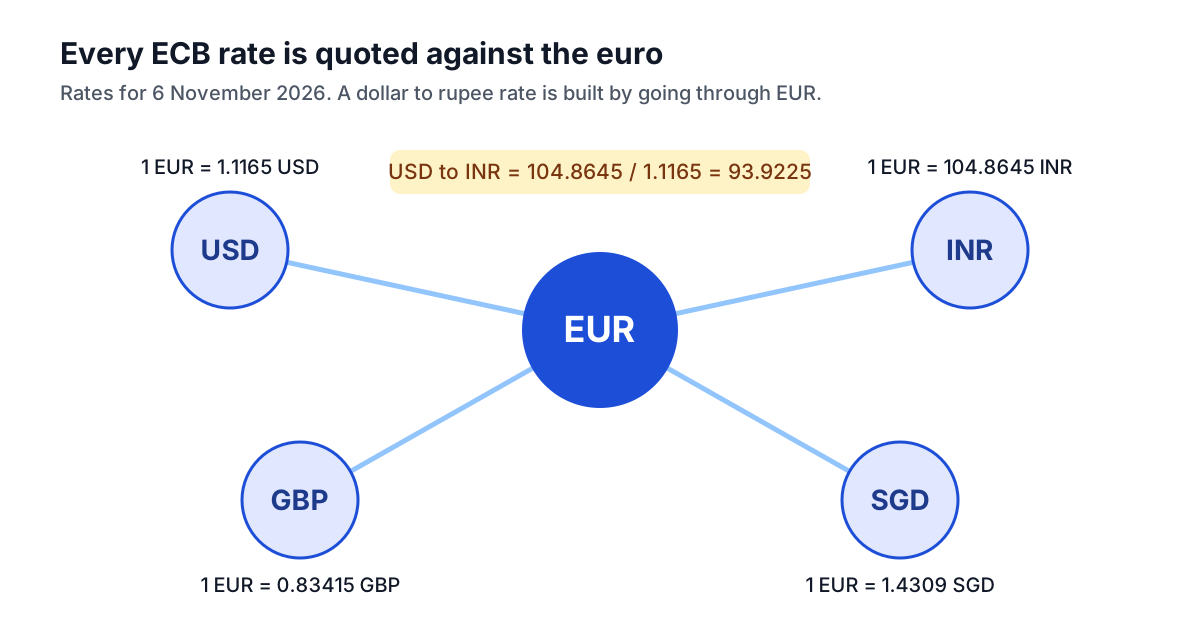
Every ECB rate is quoted against the euro, so USD to INR is worked out through the euro:
USD → INR = (EUR → INR) ÷ (EUR → USD)
          = 104.8645 ÷ 1.1165
          = 93.9225
The same day's table gives the other rates Indian families most often need:
| Currency | 1 unit in rupees | Example |
|---|---|---|
| US dollar | ₹93.9225 | USD 1,500 = ₹1,40,883.79 |
| Pound sterling | ₹125.7142 | GBP 2,000 = ₹2,51,428.40 |
| Singapore dollar | ₹73.2857 | SGD 3,000 = ₹2,19,857.08 |
| Australian dollar | ₹64.5320 | AUD 2,500 = ₹1,61,330.00 |
| Canadian dollar | ₹66.7714 |
Rates built from rounded euro quotes can differ from another site's in the last digit; that is rounding, not a different market.
The Gulf gap
The ECB does not publish rates for the UAE dirham, Saudi riyal, Qatari riyal, Kuwaiti dinar or Omani rial, so the converter cannot convert them. For money sent home from the Gulf, rely on the remittance provider's quote, and compare providers against each other on the rupees credited for the same amount sent.
Measuring a remittance markup in rupees
Money sent home is the clearest case. Compare what you are offered with the reference amount:
markup = (reference rate − rate offered) ÷ reference rate
       = (93.9225 − 93.20) ÷ 93.9225
       = 0.77%
On USD 1,500 that is ₹1,083.79. Many services also charge a flat fee. If the same provider takes USD 5 as a fee and converts the remaining USD 1,495 at ₹93.20, the family receives ₹1,39,334, which is ₹1,549.79 or 1.10% less than the reference amount. Put both quotes in those terms and the cheapest service is obvious, whatever its advertising says about "zero fees".
Rates move during the day, so compare quotes taken at the same time, and check the rate is the one applied when the money actually converts, not when you started the transfer.
Card spending abroad
When you spend abroad on an Indian credit or debit card, the card network converts the bill and the issuer usually adds a foreign currency markup, shown separately on the statement. Check your card's schedule of charges for the percentage and any taxes on it.
Take a €500 hotel bill. At the reference rate it is ₹52,432.25. If your card's total markup is 3.5%, you pay about ₹54,267.38.
Pay in euros or in rupees?
A terminal or ATM abroad may offer to charge you in rupees instead of euros. That is dynamic currency conversion (DCC): the merchant's provider picks the rate. Suppose it offers ₹55,500 for the €500 bill. That implies ₹111.00 per euro, 5.85% above the reference rate, and more than the 3.5% card markup in the example. Choosing to pay in the local currency lets your own card do the conversion, which is cheaper in most cases. Do the sum on the spot with the converter before you press the button.
Money going out: the LRS limit
Paying university fees, medical bills or gifts abroad from India falls under the RBI's Liberalised Remittance Scheme. Resident individuals, including minors, can remit up to USD 2,50,000 per financial year (April to March) for permitted current and capital account transactions combined, in any freely convertible currency. A PAN is mandatory for LRS transactions through banks and other authorised persons.
The limit is in dollars, so the rupee amount it covers moves with the rate. At 6 November 2026 rates, USD 2,50,000 was ₹2,34,80,631.44, about ₹2.35 crore. So:
- ₹2.1 crore of fees converts to about USD 2,23,588.54, inside the limit.
- ₹2.4 crore converts to about USD 2,55,529.76, over it.
If a large payment sits near the limit, plan it across financial years or talk to your bank first. Banks can also collect tax at source on some LRS remittances; ask your bank what applies to your purpose and amount.
When the rate date matters
For a household budget, a day-old reference rate is fine. For anything that must be checked later, an invoice from a foreign client, an expense claim or a gift document, write the source and date into it: "converted at the ECB reference rate of 6 November 2026". Anyone can then verify the figure. On days when the rupee moves sharply, a live bank rate can be well away from the last fixing.
The converter's 30-day trend line shows whether today's rate is unusual against the last month. It is not a forecast; if you are converting a large sum, splitting it over several dates reduces the risk of picking a bad day.
A short checklist
- Note the rate's source and date before relying on it.
- Measure every remittance or card quote as a markup on the reference rate, plus fees, in rupees.
- Decline DCC abroad unless its rate beats your card's.
- For Gulf currencies, compare providers on the rupees credited.
- For large payments abroad, check the LRS limit in dollars, not rupees.
Tools for this job
- Currency Converter to and from Rupees: ECB reference rates with Indian grouping, both directions.
- Percentage Calculator: turns the gap between two rates into a markup percentage.
- Cryptocurrency Unit Converter: for units such as satoshi and gwei, which the ECB does not publish.
Frequently asked questions
Why does my bank give a lower dollar rate than Google?
Search pages and the ECB show a middle reference rate. Banks and remittance services buy dollars from you below it and keep the gap, sometimes with a fee as well. At ₹93.20 against a reference of ₹93.9225, the markup is 0.77%, ₹1,083.79 on USD 1,500.
Should I pay in rupees or in local currency abroad?
In local currency, in most cases. Paying in rupees at the terminal is dynamic currency conversion, and its rate is set by the merchant's provider. A DCC offer of ₹55,500 for a €500 bill is 5.85% above the reference rate.
How much money can I send abroad from India in a year?
Under the RBI's Liberalised Remittance Scheme, a resident individual can remit up to USD 2,50,000 per financial year for permitted purposes combined, including studies, travel, medical treatment and gifts. At 6 November 2026 rates that was about ₹2.35 crore.
Can I convert dirhams or riyals to rupees here?
No. The ECB does not publish rates for the UAE dirham or the Saudi, Qatari, Kuwaiti and Omani currencies. Use your remittance provider's quote and compare providers on the rupees credited.
Sources and further reading
- Liberalised Remittance Scheme: FAQs, Reserve Bank of India. USD 2,50,000 per financial year; permitted purposes; PAN mandatory.
- Euro foreign exchange reference rates, European Central Bank. Currencies covered, publication time, information-only status.
- ECB daily reference rates (XML), European Central Bank. The latest day's table, including INR.
- Frankfurter: free exchange rate API, Frankfurter. Republishes the ECB rates and rebases them to any listed currency.
- lineofflight/frankfurter, Frankfurter project. The API's open-source code.
More Calculators
Every tool in the Calculators section, free and in your browser.
- Investment Calculator
- Compound Interest Calculator
- Simple Interest Calculator
- Interest Calculator
- EMI Calculator
- Retirement Calculator
- Time-Weighted Return Calculator
- Savings Goal Calculator
- Inflation Calculator
- CAGR Calculator
- ROI Calculator
- Present and Future Value Calculator
- NPV and IRR Calculator
- 401(k) Calculator
- Roth IRA Calculator
- APY and CD Calculator
- SIP Calculator
- Annuity Calculator
- Bond Price and Yield Calculator
- Currency Converter
- Dividend Calculator
- Stock Average Calculator
- RMD Calculator