
12V DC Wire Gauge for Cars, Boats and Off-Grid Solar
At 12 V the gauge is set by voltage drop, not amps. Size a fridge, windlass and solar run to the ABYC 3% and 10% limits, then check ampacity against the boat or auto table.
By Redbison Dev · · Updated · 9 min read
You are running a 12 V fridge to the back of a van, a windlass to the bow of a boat, or a cable from a solar charge controller to the battery, and the wire chart in the shop only lists amps. At 12 V the gauge is usually decided by voltage drop, not by how much current the wire can carry without overheating: size the run so the drop stays under 3% (0.36 V) or 10% (1.2 V). Those are the two limits in the American Boat and Yacht Council (ABYC) E-11 standard: 3% for main feeders, bilge blowers, electronic equipment and navigation lights, 10% for general lighting and other non-critical circuits. This post also treats fridges and chargers as 3% circuits, and the limits work just as well in vans and off-grid cabins.
The examples use the Voltage Drop Calculator, the Wire Size Calculator and the Solar Panel Calculator. This post covers low-voltage DC runs; for 120 V and 240 V circuits in a building, see How to Size Electrical Wire.
Why 12 V wiring is sized by voltage drop
Voltage drop is current times the resistance of the wire. In a DC circuit the current flows out on the positive and back on the negative, so the length that counts is the round trip:
Vd = 2 × I × R × L, where L is the one-way length and R the resistance per unit length.
Low voltage hurts twice. The same power at 12 V needs ten times the current it would at 120 V, so ten times the volts are lost, and those volts are divided by a supply one tenth the size. For the same load and wire, the percentage drop at 12 V is 100 times the drop at 120 V: a 60 W load on 20 ft of 14 AWG loses about 0.05% at 120 V and 5.2% at 12 V.
A 12 V battery also works over a window of only a couple of volts between full and flat, and fridges, inverters and chargers read the voltage at their own terminals. Lose 1 V in a cable and a healthy battery looks nearly empty to them.
ABYC E-11 sets two limits:
- 3% for panelboard main feeders, bilge blowers, electronic equipment, navigation lights and other circuits where drop should be kept to a minimum.
- 10% for lighting other than navigation lights and other circuits where drop is not critical.
A conductor must meet both its ampacity and the drop limit, and when the two give different sizes, the larger wins. At 12 V it is nearly always the drop that decides.
Worked example 1: a compressor fridge, 20 ft away
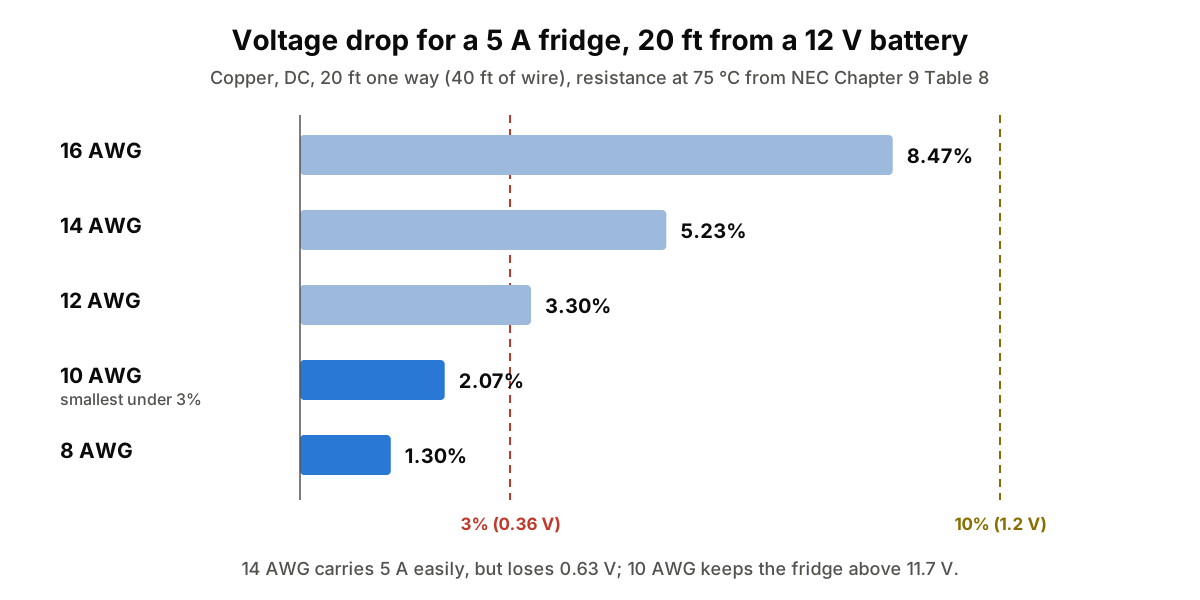
A 12 V compressor fridge draws about 5 A while the compressor runs (check the label). It sits 20 ft of cable from the battery. ABYC's list does not name fridges, but this post treats one as a 3% circuit because its low-voltage cutout and electronic controller react to the voltage at the fridge.
Open the Voltage Drop Calculator and set Circuit type: DC, Conductor Copper, Size system AWG / kcmil, Length 20 ft (one way, as the field asks), Load current 5 A, and press the 12 V button. Leave the conductor temperature at its default of 75 °C; real 12 V runs are cooler, so the answer errs slightly on the safe side. Pick each size, or read the table under the result:
| Copper size | Drop | Percent | Volts at the fridge |
|---|---|---|---|
| 16 AWG | 1.016 V | 8.47% | 10.98 V |
| 14 AWG | 0.628 V | 5.23% | 11.37 V |
| 12 AWG | 0.396 V | 3.30% | 11.60 V |
| 10 AWG | 0.248 V | 2.07% | 11.75 V |
| 8 AWG | 0.156 V | 1.30% | 11.84 V |
The calculator reads "Smallest copper size for 3% drop: 10 AWG", two sizes bigger than the 14 AWG that would carry 5 A without getting warm. That is why a fridge fed with thin wire can click off on a battery that still has plenty left.
To see ampacity and drop side by side, open the Wire Size Calculator: Load current 5, Continuous load No, keep 90 °C insulation and 75 °C terminals, Current-carrying conductors 2, then in the voltage drop check choose DC, Voltage 12, One-way length 20 ft, Max drop 3. It shows "Size for ampacity: 14 AWG" and "Recommended size: 10 AWG, governed by voltage drop". Its ampacity comes from NEC Table 310.16 for building wire; marine and automotive cable have their own tables (below), but at these currents the drop decides first.
Worked example 2: an anchor windlass, 25 ft to the bow
A windlass, the motorised winch that raises an anchor, is the opposite case: a high current for a minute at a time. Say the manual lists 80 A at working load, about 960 W, and the bow is 25 ft of cable from the battery. ABYC's list does not name windlasses; many windlass makers' cable tables allow up to 10%, so this example uses 10%, but follow the table in your own manual.
In the Voltage Drop Calculator, keep DC and 12 V, set Length 25 ft and Load current 80 A, and step through the sizes:
- 4 AWG: 1.232 V, 10.27%. Just over the limit, with 98.6 W turned into heat in the cable.
- 3 AWG: 8.17%, the smallest size under 10%.
- 2 AWG: 6.47%, leaving 11.22 V at the motor.
- 2/0 AWG: 3.22%. Holding the windlass to 3% would take 3/0 AWG.
On ampacity alone the Wire Size Calculator gives 4 AWG for 80 A, so again the drop sets the size.
Worked example 3: solar charging in a van
Here the current comes from the system design. Open the Solar Panel Calculator and enter Energy use 1.2 kWh/day, Peak sun hours 4, keep System losses at 14%, Panel rating 200 W, Days of autonomy 1, Battery bank voltage 12 V, and keep 80% depth of discharge and 95% inverter efficiency. It returns:
- 2 panels, 0.4 kW installed (0.349 kW minimum), about 1.38 kWh a day at 4 sun hours
- a 1.58 kWh battery, 131.6 Ah at 12 V
- an MPPT controller of 41.7 A: 400 W ÷ 12 V = 33.3 A, times 1.25
Controller to battery. The controller can push 33.3 A for hours, so treat it as continuous. In the Wire Size Calculator, set Load current 33.3, Continuous Yes (41.7 A design current) and One-way length 6 ft, keeping DC, 12 V and 3% from the fridge example; it gives 8 AWG. A 6 ft run of 8 AWG at 33.3 A drops 2.59%, inside 3%, so 8 AWG passes both checks. This post treats charging as a 3% circuit: volts lost in the cable make the battery look fuller to the controller, and it stops charging early.
Panels to controller. Suppose each panel's datasheet gives about 20 V and 10 A at maximum power (check yours). On 20 ft of 10 AWG:
- In parallel, 20 A at 20 V: 0.992 V lost, 4.96%.
- In series, 10 A at 40 V: 0.496 V lost, 1.24%.
Series wiring halves the current, which halves the volts lost, and doubles the voltage they are divided by, so the percentage falls to a quarter. Check that the string's cold-weather open-circuit voltage stays under the controller's maximum input. On a building, PV wiring falls under NEC Article 690, which sizes conductors from the panels' short-circuit current with two 125% factors (690.8), not from the operating current used here.
Ampacity still matters: marine and automotive tables
Very short, high-current cables, such as battery to inverter, can be limited by heat rather than drop. Use the table for the cable you are buying:
- Boats. US rules for boats with inboard gasoline engines (33 CFR 183, Subpart I) list allowable amperage in Table 5 of 183.425. For 105 °C boat cable: 16 AWG 25 A, 14 AWG 35 A, 12 AWG 45 A, 10 AWG 60 A, 4 AWG 160 A, 2 AWG 210 A. In an engine space multiply by 0.85 for 105 °C insulation, and by 0.70 again for three current-carrying conductors bundled together. A conductor run on its own must be at least 16 AWG. ABYC E-11 sets ampacity requirements for all boats.
- Cars and trucks. Automotive primary cable is made to SAE J1128, for systems of 60 V DC or less. It uses SAE size numbers, and some SAE sizes carry less copper than the AWG size with the same number, so a drop worked out with AWG resistance can be optimistic. Check the mm² on the datasheet and go up a size if it falls short.
- Fuses. Every positive cable needs a fuse or breaker close to the battery, rated to protect the cable. Follow ABYC E-11 or the vehicle maker for placement and size.
Common mistakes
- Entering the round trip as the length. The calculators ask for the one-way length and double it themselves. Entering 40 ft for a 20 ft run doubles the answer.
- Forgetting the negative. A thick positive with a thin return, or a chassis return through a corroded joint, puts the drop back. The return carries the same current.
- Sizing from an amps-only chart. "14 AWG: 20 A" is an ampacity figure. At 12 V it is only the first check.
- Treating cable size as the whole job. A loose or corroded lug can lose as much as the cable, so crimp, seal and tighten connections, and still fuse the cable.
This post is for planning. On a boat, follow ABYC E-11 and the equipment makers' instructions; on a vehicle, the vehicle maker's; and on anything tied into a building's wiring, the local code. Ask an ABYC-certified marine electrician or a licensed electrician to check a design you are unsure about.
Tools for this job
- Voltage Drop Calculator: volts and percent lost for any size, length and current, with a size table and the smallest size for 3%. Use DC and the one-way length.
- Wire Size Calculator: ampacity and voltage drop together, showing which one governs. Its ampacity is from NEC building tables, so cross-check it against the marine or automotive table.
- Solar Panel Calculator: array size, battery bank and charge controller current, which is what the battery cable has to carry.
For the ampacity steps of building wiring, read How to Size Electrical Wire. To size an array and battery in more depth, see How Many Solar Panels Do I Need?, and for Ohm's law behind the formula, the electronics basics guide.
Frequently asked questions
What gauge wire do I need for 12 V at 20 A?
It depends on the length. For a 3% drop, 20 A at 12 V on copper needs 10 AWG for a 5 ft one-way run, 8 AWG for 10 ft, 6 AWG for 15 ft and 4 AWG for 25 ft. Every doubling of distance doubles the drop, so enter your own length in the Voltage Drop Calculator.
Is a 10% voltage drop acceptable on 12 V?
ABYC E-11 allows up to 10% for general lighting and other non-critical circuits, but holds electronics, navigation lights, bilge blowers and main feeders to 3%. Anything with a low-voltage cutout or a charger behaves better on the 3% side.
Can I use automotive wire on a boat?
ABYC E-11 points to boat cable listed to UL 1426 for boat system conductors. SAE automotive cable is made for road vehicles and may carry less copper for the same size number, so it is acceptable only in limited cases. Check the standard and the cable's rating before using it below deck, and size it with its real cross-section.
Sources and further reading
- What Is Voltage Drop?, American Boat and Yacht Council. The 3% and 10% limits in ABYC E-11 and the rule that the larger of the ampacity and drop sizes is used.
- 33 CFR 183.425 Conductors: General, US Coast Guard via Cornell Legal Information Institute. Table 5 allowable amperage, engine-space and bundling factors, and minimum sizes.
- 33 CFR 183.401 Purpose and applicability, US Coast Guard via Cornell Legal Information Institute. Which boats the federal electrical rules cover.
- SAE J1128 Low Voltage Primary Cable, SAE International. The automotive cable standard for systems of 60 V DC or less.
- Marine Wire Terminal Tech Specs, West Marine. How UL 1426 boat cable and SAE automotive cable differ and when ABYC accepts each.
- NFPA 70, National Electrical Code, National Fire Protection Association. Chapter 9 Table 8 conductor resistance and Article 690 for PV systems; free read-only access.