
Buy Now, Pay Later: Pros, Cons and Hidden Costs
How pay-in-four and longer BNPL loans work, what late fees and "0% interest" fees really cost, how BNPL shows up on credit reports, and what three overlapping plans do to one month.
By Redbison Dev · · Updated · 10 min read
You are at checkout and the payment page offers to split the $200 total into four payments of $50, no interest. Buy now, pay later (BNPL) is a short loan: used on time, a pay-in-four plan costs nothing extra and spreads a purchase over six weeks. The costs show up in three places: late fees when a payment bounces, fees or interest on longer plans, and the squeeze when several plans are running at once and their payments land in the same month.
Below, the Budget Planner shows what three overlapping plans do to a tight month, and the APR Calculator turns a "0% interest" plan with a fee into the annual rate you would compare against a credit card. The figures are US rules and data from the Consumer Financial Protection Bureau (CFPB) and the Federal Trade Commission (FTC).
How pay-in-four and longer BNPL loans work
The common product is pay-in-four. The CFPB's 2022 market report describes it as splitting a purchase, usually between $50 and $1,000, into four equal interest-free payments: the first at checkout and the other three every two weeks, so the loan is paid off six weeks after you buy. The lender pays the merchant and charges the merchant a fee, which is how it can offer the loan without interest. Payments are usually taken automatically from a debit card, bank account or credit card.
Many BNPL lenders also offer longer loans: monthly payments over 6, 12 or more months for bigger purchases. These behave like ordinary installment loans. Some are interest-free, many charge interest, and the rate depends on the lender and your credit. Read the agreement for the APR before you accept.
The growth has been fast. The five lenders the CFPB studied made 180 million loans worth over $24 billion in 2021: more than ten times their 2019 number of loans, and twelve times the dollar volume.
The pros: when BNPL is reasonable
- No interest on pay-in-four when you pay on time. A $200 purchase costs $200. Compared with carrying the same amount on a credit card at a typical card rate, that is a real saving.
- A fixed end date and known amounts. You know every payment and its date at checkout. A credit card balance has no end date unless you set one.
- Often only a soft or light credit check for pay-in-four, so applying for one plan usually does not cost points on your credit score the way a new card application can. Check each lender's terms, because longer loans often use a full credit check.
Pay-in-four works best for a purchase you could pay for today, where you simply prefer to spread the cash over six weeks, and where all four payments fit in the budget you already have.
The cons and the hidden costs
Late fees. Pay-in-four has no interest, so the late fee is the main cost when something goes wrong. In the CFPB's data, 10.5% of borrowers were charged at least one late fee in 2021, up from 7.8% in 2020. The CFPB also found that at least one lender's policy allowed more than one late fee on the same missed payment.
Overdraft fees from your bank. Autopay from a debit card or checking account can overdraw the account if the money is not there, and your bank's overdraft fee comes on top of any late fee from the lender. The FTC lists this as one of the main risks.
Fees on "no interest" plans. The FTC notes that most plans charge some fees even when they advertise no interest, such as fees per payment, for rescheduling or for a late payment. A flat fee is still a cost of credit, and the worked example below shows how large it is as an annual rate.
Fewer protections than a credit card. Under Regulation Z, the US Truth in Lending rule, a lender counts as a creditor when it charges a finance charge or lends under a written agreement payable in more than four installments. An interest-free four-payment plan generally sits outside that definition, so it comes without the standard cost-of-credit disclosures. The CFPB also found weaker dispute handling for returns and faulty goods. In 2024 the CFPB issued an interpretive rule treating many BNPL lenders as credit card issuers for dispute and refund rights, then withdrew it in May 2025. If you return an item, keep paying the plan until the lender confirms the refund.
Stacking. Because each lender only sees its own loans, it is easy to have several plans running at once. In 2022 about 63% of BNPL borrowers had more than one loan open at the same time at some point in the year, and about a third had loans at more than one BNPL company. The CFPB calls stacking across lenders a particular blind spot, since no single lender sees the full picture.
Worked example: three overlapping plans in a tight month
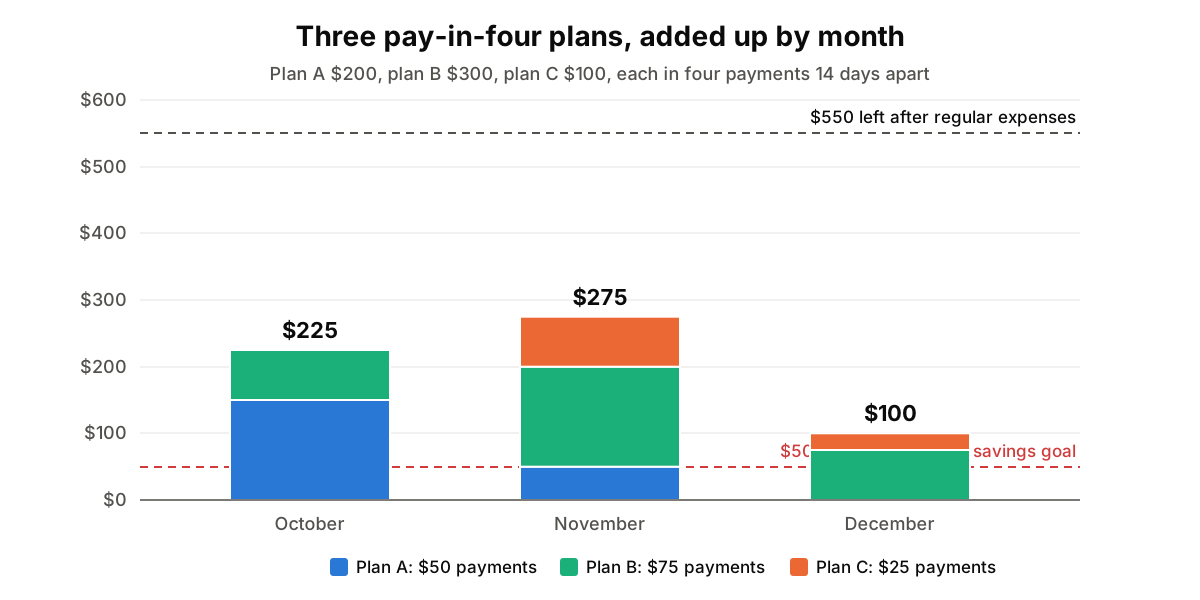
Say your household takes home $4,200 a month. Rent, utilities, a car loan, insurance, groceries, fuel, entertainment and a 401(k) contribution add up to $3,650, and you aim to save $500. In October you use pay-in-four three times:
| Plan | Purchase | Each payment | Payment dates (every 14 days) |
|---|---|---|---|
| A | $200 | $50 | 3 Oct, 17 Oct, 31 Oct, 14 Nov |
| B | $300 | $75 | 20 Oct, 3 Nov, 17 Nov, 1 Dec |
| C | $100 | $25 | 1 Nov, 15 Nov, 29 Nov, 13 Dec |
Added up by calendar month, they come to $225 in October, $275 in November and $100 in December: $600 in all, but bunched into November.
To see what that does to the budget, open the Budget Planner. Its sample household already has these expenses, so you only change the income:
- On the Setup tab, set Primary Salary to 4200 and Investment Returns to 0. Leave the savings goal at 500.
- Open the Analysis tab and read the result: Remaining Income $550, After Savings $50, an Expense Ratio of 86.9% and a budget health of Warning.
- On the Expenses tab, under Fixed Expenses, press + and add a line called BNPL payments with an amount of 275 (November's total). Set its category to Debt & Loans.
- Back on the Analysis tab, Remaining Income falls to $275, After Savings shows $-225 (you are $225 short of the savings goal), the Expense Ratio is 93.5% and the health changes to Critical.
October, at $225, also turns critical (92.3%). December, at $100, leaves you $50 short of the savings goal at 89.3%. Either the savings goal gives way or something goes on a card, which is exactly the overextension the CFPB describes. The fix is to add each BNPL payment to the month it falls in before you accept the next plan, not after.
Worked example: what a fee on a "0% interest" plan costs
Suppose a $600 purchase can be split into six monthly payments of $100 at 0% interest, with a $30 service fee charged at the start. The fee is easy to ignore because it is small next to the price. To compare it with other credit, convert it to an APR.
Open the APR Calculator and enter:
- Loan amount: 600
- Interest rate (note rate): 0
- Loan term: switch the unit to Months, then enter 6
- Origination and lender fees: 30
- Discount points: 0, with "Add fees and points to the loan balance" left off
The calculator shows a monthly payment of $100.00, an amount financed of $570.00 and an APR of 17.826%. The $30 is 5% of the price, but you only borrow the money for a few months on average, so as an annual rate it is close to 18%. The same $30 fee on a 12-month plan works out at 9.577%.
For a longer BNPL loan that charges interest, the same tool gives the payment and total cost. Enter a loan amount of 1200, an interest rate of 30, a term of 12 Months, fees 0 and points 0: the monthly payment is $116.98 and the total finance charge about $204, against $100 a month and nothing extra on a 0% plan. Enter your own offer's rate and fees before choosing between a BNPL loan, a credit card and waiting.
Does BNPL affect your credit score?
It depends on the lender and on what happens to the loan:
- Applying. Many pay-in-four lenders use a soft check, which does not affect your score. Longer loans often use a hard inquiry.
- Paying on time. Historically, most BNPL lenders did not report pay-in-four loans to the nationwide credit bureaus, so on-time payments did not help your score either. That is changing: some lenders now report, and in June 2025 FICO announced score versions (FICO Score 10 BNPL and 10 T BNPL) built to use BNPL data. Lenders choose which score version they use, so it will vary.
- Missing payments. The FTC warns that lenders might report late or missed payments to the bureaus, and an unpaid balance sent to collections can show up on your credit report.
Assume a missed payment can be reported, as it would be on a card.
A short checklist before you click "pay in 4"
- Could you pay the full price today from money you have? If not, the plan is borrowing against next month.
- Write down all four payment dates and add them to the month they fall in, next to any other plans you already have.
- Make sure the account the payments come from will have the money on each date, or use a card you pay off in full.
- Read the fee schedule: late fees, rescheduling fees and any interest on longer plans. Convert a fee to an APR before comparing.
This post covers US rules and general money management. It does not fit everyone: if you are already juggling several plans or missing payments, a nonprofit credit counselor can help you build a repayment plan, and the CFPB explains how to find one.
Tools for this job
- Budget Planner: add every BNPL payment as a line in the month it falls in and watch the money left after savings and the budget health before you take on another plan.
- APR Calculator: turn a flat fee on a "0% interest" plan into an APR, or check the payment and total interest on a longer BNPL loan, so you can compare it with a credit card or a personal loan.
For a simple way to split take-home pay into needs, wants and savings, read The 50/30/20 Budget: Needs, Wants and Savings in Practice. If BNPL payments sit on top of other debts, Car Loans, Leases and Paying Off Debt: The Numbers That Matter compares the avalanche and snowball payoff orders, and APY, Bond Yields and SIP Returns: Reading the Rate Correctly explains why an APR and the effective annual rate differ.
Frequently asked questions
Is buy now, pay later a good idea?
It can be for a purchase you could already afford, where you only want to spread the cash over six weeks and every payment fits your budget. It is a poor idea when it is the only way to afford the item, when you already have other plans running, or when the account it draws from could run short and trigger late and overdraft fees.
What happens if I miss a BNPL payment?
Most lenders charge a late fee, some retry the payment and may charge again, and your bank may add an overdraft fee if the attempt overdraws your account. The lender may block new purchases, and a missed payment or an unpaid balance sent to collections can be reported to the credit bureaus. Contact the lender before the due date if you know a payment will fail.
Can I return an item I bought with buy now, pay later?
Usually yes, under the store's return policy, but the refund goes through the BNPL lender and can take time. Keep making scheduled payments until the lender shows the refund on your plan, or you risk late fees on a purchase you already returned.
Do longer BNPL loans charge interest?
Many do. Monthly plans over six months or more often charge interest, while others are interest-free for qualified buyers. The APR must be shown in the loan agreement, so compare it with your credit card rate before you choose, and convert any flat fee to an APR too.
Sources and further reading
- Buy Now, Pay Later: Market trends and consumer impacts, Consumer Financial Protection Bureau. The 2022 report on how pay-in-four works, 2021 volumes and late-fee rates, and the risks it identifies.
- Consumer Use of Buy Now, Pay Later and Other Unsecured Debt, Consumer Financial Protection Bureau. January 2025 report on loan stacking: 63% of borrowers with simultaneous loans in 2022.
- Buy Now, Pay Later, Rent-to-Own, Lease-to-Own, and Layaway, Federal Trade Commission. Consumer advice on fees, autopay overdrafts, returns and credit reporting.
- Interpretive Rules, Policy Statements, and Advisory Opinions; Withdrawal, Federal Register. The May 2025 notice withdrawing the CFPB's 2024 BNPL interpretive rule among other guidance.
- Regulation Z, section 1026.2 Definitions, Consumer Financial Protection Bureau. The definition of a creditor, including the more-than-four-installments test.
- FICO Unveils Credit Scores That Incorporate Buy Now Pay Later Data, FICO. The June 2025 announcement of FICO Score 10 BNPL and 10 T BNPL.