
How to Check Your Social Security Earnings Record (US)
Find your earnings history in my Social Security, spot the gaps that cut your benefit, and correct a missing year with W-2s, Form SSA-7008 and the time limits.
By Redbison Dev · · 11 min read
To check your Social Security earnings record in the US, sign in to (or create) a my Social Security account at ssa.gov/myaccount, open your Statement, choose the full earnings record, and compare each year with your W-2s or tax returns. A year that shows $0 or too little matters because the Social Security Administration bases your retirement benefit on your highest 35 years of indexed earnings. For a worker who turns 62 in 2027 with an average of $6,000 a month across 35 years, one missing year of $55,000 in indexed earnings cuts the monthly benefit at full retirement age by $42.00 under SSA's own formula, for life.
Errors are fixable, often years later, if you have proof.
Getting the Statement
You need a personal my Social Security account, available from age 18. SSA now signs people in through Login.gov (an email address, a government-issued photo ID and a phone number) or ID.me (which needs a device with a camera, and is the route for people living outside the US).
If you are 60 or older and have no online account, SSA mails a paper Statement about three months before your birthday. The paper version, and the summary page online, combine your earlier years into blocks such as "1981-1990". You cannot spot a missing year inside a block, so use the full year-by-year record online.
Reading the earnings history
The earnings table has two money columns:
- Earnings taxed for Social Security. Only earnings up to the year's taxable maximum appear here. SSA's limit was $176,100 for 2025, is $184,500 for 2026 and will be $192,300 for 2027. A high earner whose column stops at exactly the limit has no error.
- Earnings taxed for Medicare. There has been no Medicare wage cap since 1994, so this column can be higher than the first. Above the limit a gap between the columns is normal. Below it they usually match, and where they differ, compare them with your W-2 for that year: Social Security earnings are box 3 (wages) plus box 7 (tips), and Medicare wages and tips are box 5.
Two entries that look wrong but usually are not:
- "Not yet recorded" for the latest year. SSA says the current and previous year may not be posted yet, and suggests checking in August that last year's amount is right.
- A small or zero year when you were self-employed. Self-employment income reaches SSA from your tax return, not from a W-2, so a year with no return filed shows nothing. See the time limit below before assuming it can be added.
The entries that do need action are a year with $0 or less than your W-2 shows in boxes 3 and 7 (Social Security wages and tips) and earnings you never had, which can mean someone else is using your number.
Why one missing year can cost you every month
SSA's formula, set out on its benefit formula page:
- Each year's earnings up to age 60 are indexed to the national average wage index, so a 1995 salary counts at the wage level of the year you turn 60. Earnings from age 60 on count at face value.
- SSA takes your highest 35 years of indexed earnings, adds them and divides by 420 (35 years of months), rounding down to the dollar. That is your average indexed monthly earnings (AIME).
- Your primary insurance amount (PIA), the benefit at full retirement age, is 90% of the AIME up to the first bend point, 32% between the two bend points and 15% above the second, rounded down to the dime. For people turning 62 in 2027 the bend points are $1,340 and $8,077 (2026: $1,286 and $7,749).
Take someone born in 1965, so 62 in 2027, with 35 years of indexed earnings totaling $2,520,000. Their AIME is $6,000 and their PIA:
| AIME | 90% band | 32% band | PIA | |
|---|---|---|---|---|
| Full record | $6,000 | $1,206.00 | $1,491.20 | $2,697.20 |
| One $55,000 year missing | $5,869 | $1,206.00 | $1,449.28 | $2,655.20 |
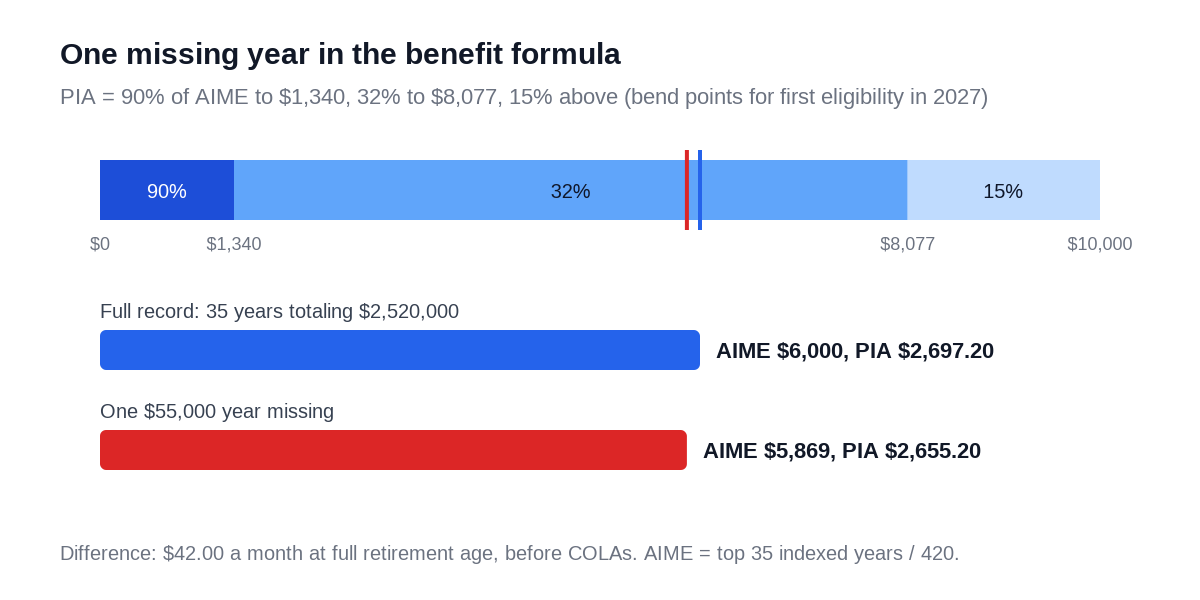
A $0 year in the top 35 costs $55,000 / 420, or $130.95 of AIME ($131 after SSA's rounding), and this worker gets 32 cents a month for each AIME dollar in their band: $41.92, or $42.00 once each PIA is rounded down to the dime. COLAs from age 62 then grow that gap along with the benefit. Two cases change the arithmetic:
- You worked more than 35 years. The 36th best year moves up to replace the missing one, so the loss is only the difference between the two.
- Your AIME is under the first bend point. Each lost AIME dollar costs 90 cents, so low earners lose proportionally more per missing dollar.
To see what $42 a month means for your savings, put the benefit into the Retirement Calculator as your Social Security benefit. Keep its other defaults, set current age 61, retirement age 67, life expectancy 92 and Inflation Rate 0 (so every figure stays in current dollars), and the savings needed is $830,900 with $2,697 of Social Security and $843,500 with $2,655. The missing year adds $12,600 to what you need to have saved. That is the plain sum of $42 a month for 25 years, not discounted, because the calculator assumes savings in retirement grow at about the rate of inflation.
How to correct a missing or wrong year
Start with proof. SSA's correction leaflet lists a W-2, a tax return, a pay stub or other wage records. With none of those, write down the employer's name and address, the dates you worked, roughly what you earned, and the name and Social Security number you used then. SSA names the usual causes as an employer using the wrong name or number, a name change after marriage or divorce never reported to SSA, an employer reporting incorrectly, and someone working under a number that was not theirs.
Then contact SSA:
- Online, for some people. In my Social Security, choose "Review your full earnings record now" and then "Request a correction online"; SSA's help page notes that not everyone is eligible.
- By phone or in person. Call 1-800-772-1213 (TTY 1-800-325-0778) or book an office appointment. Per the SSA Handbook (section 1420), SSA first asks for your evidence, then searches for the missing reports, and if it still cannot find them and you have no evidence, it writes to your employer.
- Form SSA-7008, Request for Correction of Earnings Record. SSA may ask you to complete it. You list each wrong year once, the employer, the correct Social Security (FICA) wages and the evidence enclosed (W-2 or W-2c). Self-employed years go in a separate section that asks whether you filed a tax return. If you cannot send evidence, you must explain why in the remarks.
If a name mismatch caused it, the employer's fix is a corrected W-2 (Form W-2c), which SSA then posts.
The time limit, and why it rarely stops a W-2 correction
The regulations set a time limit of 3 years, 3 months and 15 days after the year the earnings were paid (20 CFR 404.802). For 2012 wages that ran out on April 15, 2016. After it, SSA can still correct the record in listed cases (20 CFR 404.822), including:
- to agree with a wage report or tax return filed for that year ((b));
- to enter wages an employer paid you when the record shows none or too little ((e)(5));
- to fix clerical errors, entries for the wrong person or period, and fraud ((e)(2) to (e)(4)).
So a missing W-2 job from 15 years ago is correctable with evidence. Self-employment income is stricter: a return filed after the time limit can only remove or reduce earnings ((b)(2)(ii)), so a self-employed person who never filed for a year generally cannot add it back. Once you file, SSA's manual requires an initial decision within 3 years of receiving your request, with a stated goal of 6 months (POMS RM 03803.020).
Earnings that are not yours
If the record shows a job you never had, SSA's help page on removing earnings says it may ask you to declare under penalty of perjury that the earnings are not yours, and in some cases to complete Form SSA-7008. Extra earnings can mean identity theft: SSA corrects the record but does not handle identity theft, and sends you to the Federal Trade Commission at identitytheft.gov.
Checking the benefit estimate
The Statement shows estimated monthly benefits at nine starting ages, 62 to 70. Two assumptions sit behind those figures:
- They assume you keep earning your latest annual amount until you claim. If you have stopped work or plan to cut back, the real figure at 67 or 70 can be lower than shown, most of all for anyone with fewer than 35 years of earnings.
- They use current law, which SSA notes Congress has changed before.
After a correction posts, a restored top-35 year should raise the age-67 figure by roughly what the PIA arithmetic predicts. If you are married, also check your spouse's record, because spousal and survivor benefits are based on it.
Who this does not fit: pay not covered by Social Security (some state and local government jobs, railroad work under the Railroad Retirement Board) and foreign work under a totalization agreement are handled differently; ask SSA directly.
Tools for this job
- Retirement Calculator: enter your Social Security estimate as the Social Security benefit to see how much of your spending your savings must cover, and what a corrected record changes.
- Inflation Calculator: put an old salary into today's dollars when judging whether a year on your record looks right next to the others.
- Annuity Calculator: compare a monthly benefit increase with the lump sum it would take to buy the same income.
- US Retirement Records Checklist: the official US sites (SSA, Medicare, IRS, PBGC, FINRA) and what to check on each, as a list you can tick.
- Retirement Checklist: checking the earnings record is one step; the checklist orders the rest, from five years out to the year you claim.
The retirement savings guide explains how guaranteed income lowers your savings target, and the RMD guide covers the withdrawals that start later in retirement. ssa.gov is the first of the 11 US retirement websites to bookmark; the others cover Medicare, the IRS and lost pensions.
Frequently asked questions
Why does my Social Security earnings record say "not yet recorded"?
Employers report wages once a year after it ends, so the current and previous year are often not posted yet. SSA suggests checking in August that last year's amount is right. An older year showing nothing when you worked is the one to correct.
Is it too late to correct my Social Security earnings record?
Usually not for wages. The general limit is 3 years, 3 months and 15 days after the year, but SSA can still add wages an employer paid you, or match a filed wage report, after that. Self-employment income is the exception: a late return can only reduce what is on record.
Why are my Medicare earnings higher than my Social Security earnings?
Social Security tax stops at each year's taxable maximum ($184,500 for 2026), and that column stops with it. Medicare tax has had no cap since 1994, so the Medicare column keeps counting. The difference is not an error.
Do years with zero earnings lower my Social Security benefit?
Only if you have fewer than 35 years of earnings, or the zero replaces a real year that should be in your top 35. SSA divides the sum of your highest 35 indexed years by 420 months, so each missing $10,000 of indexed earnings lowers your average by about $23.81 a month.
Sources and further reading
- Social Security Benefit Amounts, Social Security Administration, Office of the Chief Actuary. AIME, the PIA formula and the 2027 bend points, with a link to the bend points for every year.
- Contribution and benefit base, Social Security Administration. The taxable maximum by year.
- How to Correct Your Social Security Earnings Record, Social Security Administration, publication 05-10081. Causes of missing earnings, evidence and how to contact SSA.
- Form SSA-7008, Request for Correction of Earnings Record, Social Security Administration.
- 20 CFR 404.822, correcting the record after the time limit ends, eCFR.
- my Social Security, Social Security Administration. Account creation through Login.gov or ID.me and what each needs.
- What do I do if I need to remove earnings that are not mine from my Social Security record?, Social Security Administration, FAQ KA-10123. The online correction request, the declaration and the FTC referral.
- Social Security Handbook, section 1420: Procedure for correcting earnings record, Social Security Administration. The evidence, search and employer-letter sequence.