
11 US Retirement Websites Worth Bookmarking
What ssa.gov, medicare.gov, irs.gov, PBGC, the DOL Lost and Found and six more let you check, in order of what costs money for life if missed.
By Redbison Dev · · 11 min read
You are retired or a few years away, and the paperwork is scattered across agencies you hear from once a year. Eleven official US websites hold most of what decides your retirement income: your earnings record, your Medicare deadlines, the IRS distribution rules, the pension and account databases for jobs you left decades ago, and the rules for long-term care. The order matters more than the list: one check carries a penalty that lasts for life, one protects a benefit paid for life, and the rest range from steep one-off penalties to money waiting to be claimed. The US Retirement Records Checklist turns all eleven into ticked items you can edit and export; this guide explains what each site lets you check, with every figure from the agency's own page for the year named.
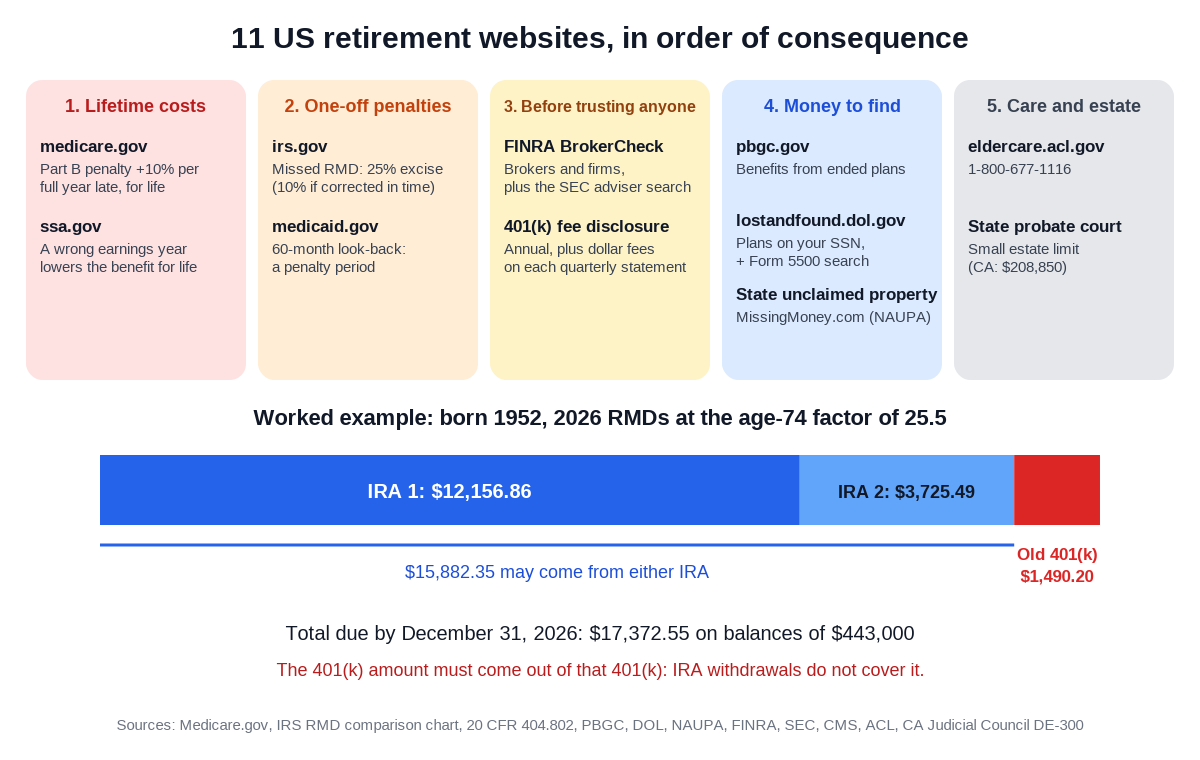
The order: lifetime costs first, then one-off penalties, then money to find
Ranked by what happens if you skip them:
- medicare.gov. A missed Part B enrollment adds 10% to the premium for each full 12 months you could have had it, for as long as you have Part B. On the 2026 standard premium of $202.90, two years late is $243.50 a month instead (Medicare.gov).
- ssa.gov. Your benefit is calculated from your earnings record, so a wrong year lowers it for life until it is fixed.
- irs.gov. A missed required minimum distribution (RMD) carries a one-off 25% excise tax on the shortfall, cut to 10% if you correct it within the correction window.
- medicaid.gov. Gifts made in the five years before you need long-term care can leave you without coverage for a penalty period.
- FINRA BrokerCheck, with the SEC's adviser search beside it. Before you hand anyone your savings.
- Your 401(k)'s fee disclosure. Small percentages that compound for decades.
- pbgc.gov. Pensions held after a plan ended.
- lostandfound.dol.gov, the Department of Labor's Retirement Savings Lost and Found, with its Form 5500 and Abandoned Plan searches for employers that changed name or closed.
- Your state's unclaimed property site, or MissingMoney.com, which NAUPA (unclaimed.org) runs for most states. Money in these three does not expire, but gets harder to trace.
- eldercare.acl.gov. Local services for older adults, by place.
- Your state probate court's website. The small estate procedure.
ssa.gov: your earnings record and the Statement
Download your Social Security Statement from a my Social Security account. SSA mails paper Statements only to workers aged 60 and over who have no online account, about three months before their birthday, so most people under 60 have never seen theirs.
The Statement shows benefit estimates at nine claiming ages, and your earnings year by year. The earnings are where the money is: a year recorded as zero, or short because an employer filed late, lowers the benefit for life. Compare each year with your W-2s or tax returns every year. The general time limit to correct a year is 3 years, 3 months and 15 days (20 CFR 404.802), but SSA can still fix a year that disagrees with a W-2 or tax return after it (20 CFR 404.822), so the real cost of waiting is evidence: an error from last year is routine, one from 15 years ago may need pay stubs you no longer have. How to check your Social Security earnings record walks through reading the Statement and correcting a year.
SSA also holds notices of vested benefits that private plans reported for you through the IRS. SSA sends this Notice of Potential Private Retirement Benefit Information on request and automatically when you claim benefits (SSA's operations manual, RM 03253.002). It is a list of plans you may have forgotten, and the starting point for the lost-pension search below.
medicare.gov: three windows, and one of them never reopens
Three dates matter:
- Initial Enrollment Period. Three months before the month you turn 65 to three months after. Miss it without a Special Enrollment Period (for example, coverage from a job you or your spouse still hold) and the Part B penalty applies.
- Medigap Open Enrollment Period. Six months, starting the first month you are 65 and have Part B. During it an insurer must sell you any Medigap policy it offers in your state, without medical underwriting. It does not repeat. If you sign up for Part B while still on employer coverage, the six months start anyway and can run out before you want a policy.
- Open Enrollment, October 15 to December 7 every year. Changes take effect January 1. This is when to enter your actual prescriptions into Medicare Plan Finder, because plans change their drug lists and prices yearly.
For budgeting, the standard Part B premium is $202.90 a month in 2026 and $209.40 in 2027, the Part B deductible is $283 in 2026 and $292 in 2027, and the Part D out-of-pocket cap is $2,100 in 2026 and $2,400 in 2027 (Medicare.gov). Higher incomes pay a surcharge called IRMAA, based on the tax return from two years earlier, so the first years of retirement are often billed on working income. SSA can recalculate it after a life-changing event such as retirement, using form SSA-44.
irs.gov: RMDs, contribution limits and an identity PIN
When do RMDs start? At 75 if you were born in 1960 or later, and at 73 if born from 1951 to 1958 (Internal Revenue Code 401(a)(9)(C)(v)). The statute's two clauses both describe people born in 1959; proposed regulations from July 2024 (89 FR 58644) give them 73, and the 2024 final regulations left that paragraph reserved, so for 1959 the answer rests on a proposed rule. The RMD guide covers the tables and the April 1 trap in full.
From which account? This is where a forgotten plan bites. The IRS RMD comparison chart says IRA RMDs can be added up and taken from any one or more IRAs, but each 401(k) or other defined contribution plan's RMD must come out of that plan.
How much can I still put in? If you are still working, the 401(k) deferral limit is $24,500 in 2026. At 60 to 63 the catch-up is $11,250 instead of $8,000, so the cap is $35,750; the 401(k) Calculator uses the same limits. For 2027 the IRS has announced $25,500 plus a catch-up of $11,750 at 60 to 63 (IR-2026-136). At 64 you drop back to the ordinary catch-up. One catch on the catch-up: from 2026, if last year's FICA wages from the employer sponsoring the plan topped $150,000 (2025 wages, for 2026; $155,000 of 2026 wages for 2027, per IRS Notices 2025-67 and 2026-66), catch-up contributions must go in as Roth (IRC 414(v)(7)).
Also consider an IRS Identity Protection PIN: a six-digit number, issued yearly, without which an e-filed return in your name is rejected. You request it and read each year's PIN in your IRS online account.
Worked example: three accounts, two rules
Take someone born in 1952, so 74 in 2026, who works through the checklist. The DOL Lost and Found search turns up a 401(k) from a job they left in 2008, which the plan confirms still holds $38,000 at December 31, 2025. They also have two IRAs worth $310,000 and $95,000 on the same date.
In the RMD Calculator, enter each balance with birth year 1952 and distribution year 2026. The Uniform Lifetime factor at 74 is 25.5:
| Account | Dec 31, 2025 balance | 2026 RMD | Where it must come from |
|---|---|---|---|
| IRA 1 | $310,000.00 | $12,156.86 | Any IRA |
| IRA 2 | $95,000.00 | $3,725.49 | Any IRA |
| Old 401(k) | $38,000.00 | $1,490.20 | This 401(k) only |
| Total | $443,000.00 | $17,372.55 |
The two IRA amounts, $15,882.35 together, can come out of either IRA. The $1,490.20 cannot: taking an extra $1,490.20 from an IRA instead leaves the 401(k) short, and the shortfall is what the 25% excise tax applies to. All three are due by December 31, 2026. If the 401(k) has been sitting unnoticed since this person's RMDs began, earlier years were missed too; the lost pension guide works through that case and the Form 5329 waiver.
pbgc.gov, the DOL Lost and Found and unclaimed property
PBGC's search (last name and the last four digits of your SSN) finds benefits it holds because a plan ended without paying them. The DOL Lost and Found lists private plans linked to your SSN with the administrator's contact details, behind an ID-proofed Login.gov account, and leaves out IRAs. State unclaimed property goes to the state of your last known address on the holder's records under Texas v. New Jersey, so search each state you have lived in. The lost pension guide runs all of them in order, with the Form 5500 search and the forced rollover IRAs that none of the databases show.
Checking people and fees
Before anyone manages your money, look them up on FINRA BrokerCheck (brokers and brokerage firms) and the SEC's Investment Adviser Public Disclosure site (registered investment advisers, with their Form ADV). If they use the CFP mark, the CFP Board's verify page lists anyone it has publicly disciplined. How to check a financial advisor in the US covers what each search shows and the questions Form CRS makes them answer.
Your own 401(k) owes you two fee documents under 29 CFR 2550.404a-5: an annual disclosure of each investment option's costs, and a quarterly statement with the dollar amount actually charged to your account. To see what one percentage point a year costs, run your balance through the Compound Interest Calculator at two rates a point apart, and see how to read your 401(k) fee disclosure for where each figure sits on the notice.
Long-term care and the estate
medicaid.gov is where the federal rules for long-term care coverage live, and the one to read before helping family with money. Assets given away or sold below value in the 60 months before applying can delay coverage (Social Security Act section 1917(c)). For married couples the spouse at home keeps protected resources, from $32,532 to $162,660 in 2026 depending on the state, and the home equity limit is $752,000 to $1,130,000 (CMS informational bulletin of April 27, 2026). States must also seek to recover long-term care costs from the estates of enrollees aged 55 or older, except while a spouse, a child under 21 or a disabled child survives.
eldercare.acl.gov is the Administration for Community Living's Eldercare Locator: your local Area Agency on Aging and services for older adults, by place, with trained staff on 1-800-677-1116.
Your state's probate court website explains the small estate procedure, which lets heirs collect property by affidavit below a dollar limit. Every state sets its own; California's is $208,850 for deaths on or after April 1, 2025 (Judicial Council form DE-300). The Estate Planning Checklist covers the will and the documents that keep the estate out of court.
This guide is a map of the records, not advice for your situation. Anyone with a missed RMD of several thousand dollars, or planning transfers with long-term care in mind, should speak to a tax professional or an elder law attorney.
Tools for this job
- US Retirement Records Checklist: every check above as an editable list you can tick, reword and export as PDF.
- RMD Calculator: the amount for each account and year, and the projection after it.
- 401(k) Calculator: what the 60 to 63 catch-up adds if you are still working.
- Retirement Calculator: whether the accounts you have found are enough for the income you want.
- Compound Interest Calculator: what a fee difference costs over a retirement.
For the accounts themselves, the retirement accounts guide explains 401(k)s, Roth IRAs and annuities, and the retirement savings guide covers how much is enough.
Frequently asked questions
Is unclaimed.org the place to search for unclaimed money?
It is the site of NAUPA, the association of state unclaimed property administrators, and it links to each state's official program and to MissingMoney.com, the multi-state search NAUPA runs for most states. The state's own site is the authority for its records, so search it too.
Does every estate have to go through probate?
Not always. States set a dollar limit below which heirs can use a simpler route, often an affidavit, instead of a full court case, with their own rules on what counts toward it. California's is $208,850 for deaths on or after April 1, 2025. Your state probate court's website has the current figure and the forms.
Can I check these sites for a parent?
Only partly. Lost and Found searches only your own SSN, through your own Login.gov account, and my Social Security is for the account holder. Sit with the parent while they sign in.
Which of these checks should I repeat every year?
Four are dated: the Social Security Statement around your birthday, Medicare Plan Finder between October 15 and December 7, the RMD before December 31, and the IRS Identity Protection PIN, which changes each year. Repeat the searches for lost money every few years; PBGC updates its data quarterly.
Sources and further reading
- Get your Social Security Statement, Social Security Administration. Who receives a mailed Statement and what it shows.
- Medicare costs, Centers for Medicare & Medicaid Services. Premiums, deductibles and the Part D cap for 2026 and 2027.
- Avoid late enrollment penalties, Centers for Medicare & Medicaid Services. The Part B penalty with worked examples.
- RMD comparison chart (IRAs vs. defined contribution plans), Internal Revenue Service. Which RMDs can be combined.
- 401(k) limit increases to $25,500 for 2027, IRA limit remains $7,500, Internal Revenue Service. IR-2026-136.
- Retirement Savings Lost and Found, US Department of Labor. What the database contains and its limits.
- Updated 2026 SSI and Spousal Impoverishment Standards, Centers for Medicare & Medicaid Services. Resource and home equity limits.
- Eligibility policy, Centers for Medicare & Medicaid Services. Transfers of assets and estate recovery.
Open the US Retirement Records Checklist
More Money & Tax
Every tool in the Money & Tax section, free and in your browser.
- Tax Year End Checklist
- Self-Employment Setup Checklist
- Emergency Fund Checklist
- Mortgage Application Checklist
- Insurance Review Checklist
- Debt Payoff Checklist
- Pension Review Checklist
- US Retirement Records Checklist
- Annual Money Review Checklist
- First Investment Account Checklist
- Monthly Budget Checklist
- Invoice Chasing Checklist
- Expense Claim Checklist