
Validating a Startup Idea: Interviews, Surveys and Competitors
Turn an idea into testable assumptions, interview without leading (The Mom Test), write survey questions that measure something, and map the alternatives you compete with.
· 8 min read
Ask ten friends whether they would use your app and eight will say yes. Ask them to pay $20 today and maybe one will. The gap between those two answers is what customer validation is about: getting evidence that reflects what people do, not what they say to be kind. This guide covers three parts of that work. First you turn an idea into assumptions that can fail. Then you talk to customers and write surveys without leading them. Finally you map the alternatives they already use.
If you are still deciding which idea to pursue, start with the startup idea selection guide. If you want the whole business on one page first, see the Lean Canvas guide. This guide assumes you have an idea and want to know whether it holds up.
Write the plan before you test anything
The Idea Validation Framework has four tabs: Idea & Problem, Market & Risk, Validation Plan and Success Metrics. The order matters. You describe the problem and the customer first, list the assumptions the idea depends on, pick methods to test them, and set pass criteria before any result comes in.
Most ideas rest on three or four assumptions:
- The problem happens often enough, and hurts enough, that people look for a fix.
- You can reach the people who have it at a reasonable cost.
- They will pay roughly the price you need.
- You can deliver the solution.
Write each one so it could turn out false, and put a number in it. "Freelance designers lose at least two hours a week chasing late invoices" can be checked in interviews. "Designers hate invoicing" cannot.
Then write the success criteria. "At least 12 of 20 interviewees describe invoice chasing as a top-three annoyance without being prompted" is a criterion. Writing it down before the interviews stops you from deciding afterwards that 6 out of 20 was encouraging. The framework's readiness score (0 to 100) only checks that each section is filled in. A complete plan scores 100 whether or not the idea is any good.
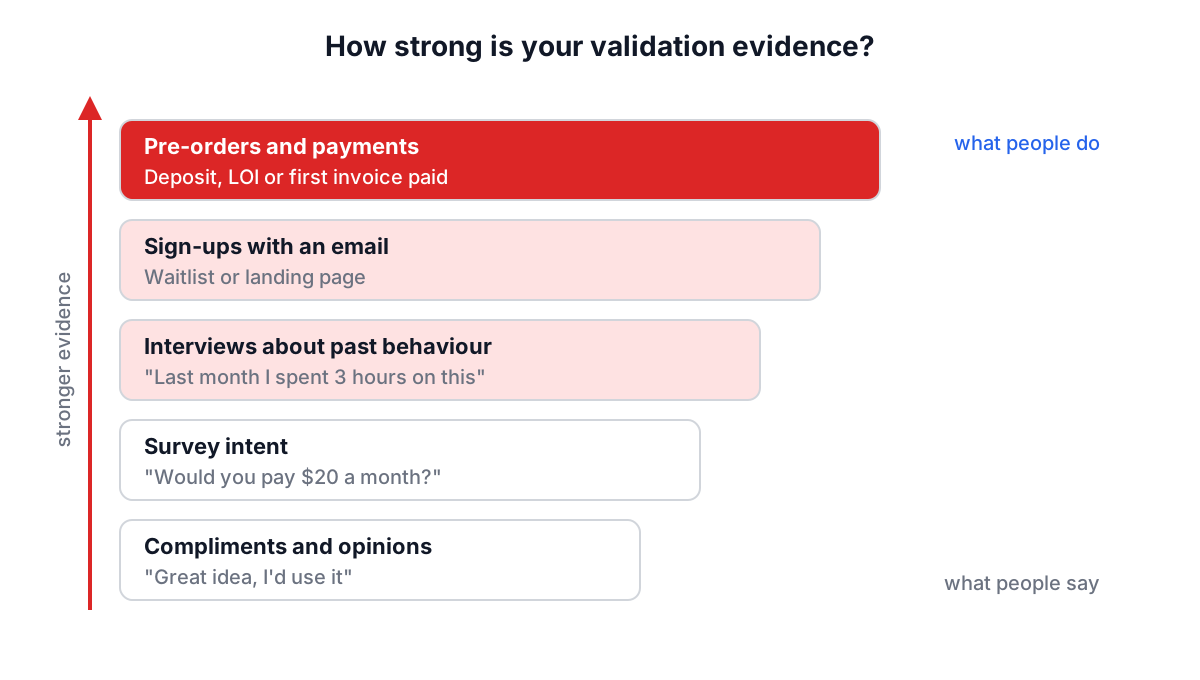
Methods differ in what they can prove. Interviews tell you whether the problem is real and how people handle it now. Surveys tell you how common an answer is, once you know which answers to offer. Landing pages, waitlists and pre-sales measure an action, which is the strongest evidence short of real revenue. Pick the cheapest method that would change your decision.
Interviews first: The Mom Test
Rob Fitzpatrick's book The Mom Test is the standard reference for early customer conversations. The title is the rule: ask questions that even your mother could not lie to you about, because they are about facts, not your idea. Three habits follow from it.
- Talk about their life, not your idea. Ask "How do you handle invoices today?" rather than "Would you use an app that chases invoices?".
- Ask about specifics in the past. "When did this last happen? What did you do? How long did it take?" Past behaviour is data. Hypothetical future behaviour is a guess.
- Look for money and effort already spent. If someone has already bought a tool, hired help or built a spreadsheet to solve the problem, it is real. If they have never tried to solve it, it may not be painful enough.
Compliments ("that's a great idea") and vague future promises ("I'd definitely use that") are not evidence. Steer back to what they actually did.
Five to ten interviews with the right people usually show whether the problem is real. They also give you something a survey cannot: the words customers use and the options that matter. You need both before writing a survey.
Writing survey questions that measure something
Surveys answer "how many" questions: how common a problem is, which current tool is most popular, what price band people expect. They are poor at "why" and at discovering problems you have not heard of. Use them after interviews, not instead.
The User Survey Designer gives you five question types (Short Text, Long Text, single choice, multiple choice and a 1 to 5 rating scale), three starter templates, a preview, and text or JSON export. The templates load every question as Long Text. Open questions are fine for a first round. For a survey sent to 100 or more people, convert the countable questions to multiple choice so you can tally the answers.
The wording of each question decides whether the answers mean anything:
| Problem | Biased version | Better version |
|---|---|---|
| Leading | How much do you love the new dashboard? | How would you rate the new dashboard? |
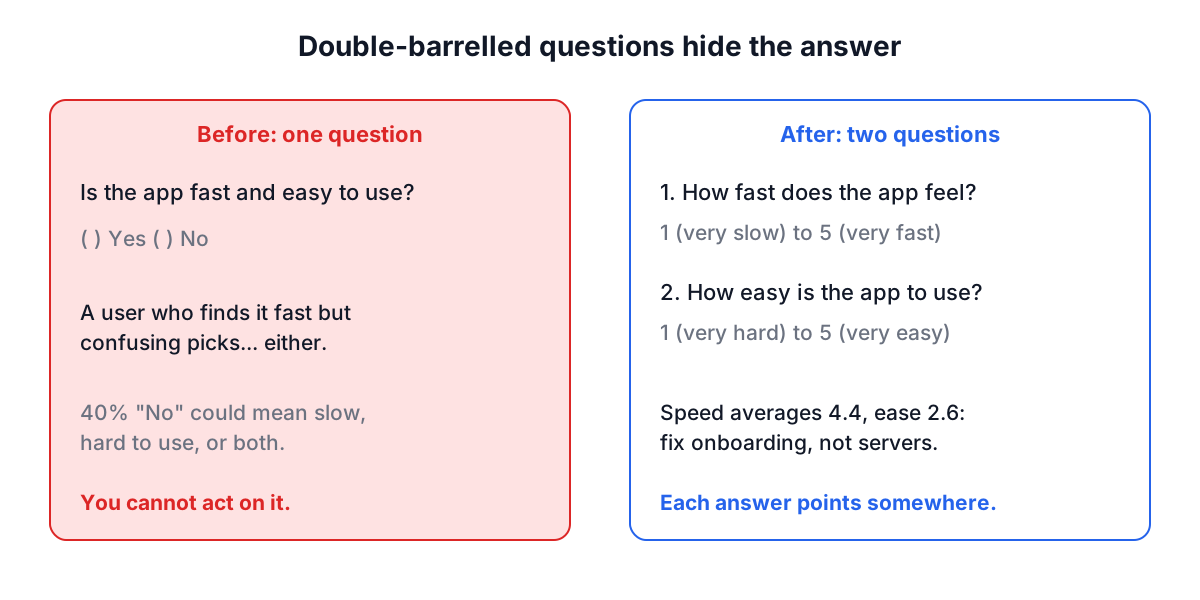
| Double-barrelled | Is the app fast and easy to use? | Two questions: How fast...? How easy...? |
| Hypothetical | Would you pay $20 a month for this? | What do you currently pay to solve this? |
| Loaded assumption | What do you dislike about your current CRM? | Which tools do you use to track customers? |
| Missing options | Daily / Weekly / Monthly | Daily / Weekly / Monthly / Rarely / Never |
A few more rules that save rework:
- Keep it short. Ten questions or fewer. Every extra question lowers the share of people who finish.
- One idea per question. If the question contains "and", check whether it should be two.
- Balanced scales. A 1 to 5 scale needs a neutral middle and labelled ends. The designer's copied text labels the scale 1 (Strongly Disagree) to 5 (Strongly Agree), so phrase rating questions as statements people can agree or disagree with.
- Pair ratings with a why. A 2 out of 5 tells you something is wrong. A follow-up open question tells you what.
- Survey the right people. 100 answers from your target segment beat 1,000 from a general panel.
On export validity: the designer does not host forms or collect answers. Copy Text produces a numbered plain-text version, with ( ) for single-choice options and [ ] for multiple-choice ones, that you can paste into Google Forms, Typeform or an email. Export saves JSON with each question's number, type, text, required flag and options. Choice questions always carry at least two options, and switching a question back to text drops its old options so the export stays clean.
Mapping the competition
Customers compare you with whatever they use today, and that is often not a startup like yours. It might be a spreadsheet, an assistant, an agency or simply putting up with the problem. Your interviews tell you which alternatives matter. The Competitor Analysis Tool is where you record them.
Each profile holds name, website, market share, pricing, target audience, strengths, weaknesses, key features, marketing strategy and notes. The Analysis Overview totals the market shares you wrote as percentages and averages the first number in each pricing field, so "$9.99/month" counts as 9.99 and "Contact sales" is left out. Download Report saves everything as Markdown.
Three things make a competitor map useful rather than decorative:
- Include the non-product alternatives. If 8 of 12 interviewees use a spreadsheet, the spreadsheet is your main competitor. Write its strengths honestly (free, flexible, already open).
- Write weaknesses in the customer's words. "Took two weeks to set up" from an interview beats "poor onboarding" from your own guess.
- Look for shared gaps. A weakness most rivals share, such as no plan below $100 a month, is the space your positioning can claim.
When the map is done, a SWOT analysis turns it into strengths and threats for your own plan. Market size is a separate question, covered in the market sizing guide.
Common mistakes in early validation
- Pitching during interviews. Once you describe your solution, people start being polite. Save the demo for the end, or for a second meeting.
- Surveying before interviewing. You end up offering the options you imagined rather than the ones customers have.
- Moving the goalposts. Criteria set after the results always pass.
- Treating sign-ups as sales. An email address is a weak commitment. A deposit or a signed letter of intent is a strong one.
- Validating with the wrong segment. Friends, other founders and people who like gadgets are rarely the buyers.
A practical sequence
Write your three or four riskiest assumptions and pass criteria in the Idea Validation Framework. Run five to ten interviews about past behaviour. Record the alternatives people mention as competitor profiles. Then write a short survey, using the words and options you heard, to measure how common each answer is. If the evidence clears the bars you set, run a test that asks for money or real effort before you build anything.