
How to Find a Lost Pension or Old 401(k) in the US
Five free searches, from the DOL Lost and Found to PBGC and Form 5500, the forced rollover IRA they all miss, and what to do about missed RMDs.
By Redbison Dev · · 10 min read
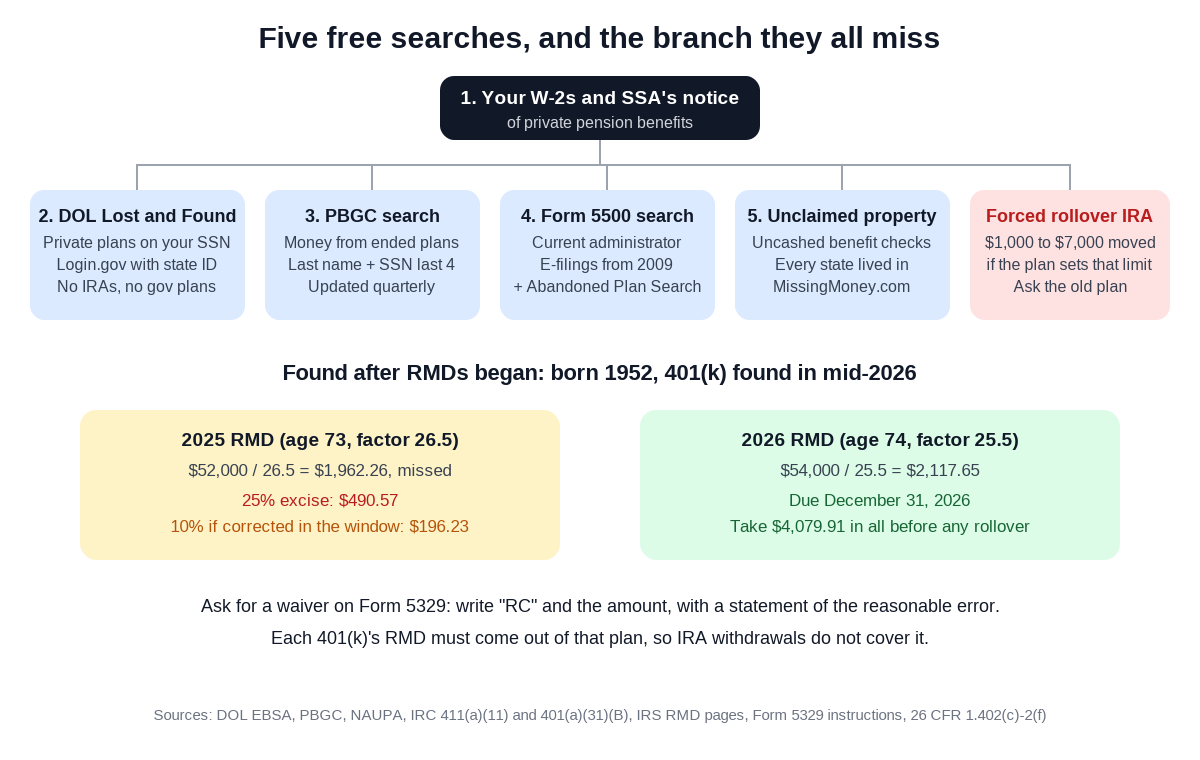
You remember a pension from a factory job in the 1990s, or a 401(k) from a company that was bought twice and no longer has your address. In the US there is no single register of retirement accounts, so finding it means running five searches that each see part of the picture: the Department of Labor's Retirement Savings Lost and Found, PBGC's unclaimed pension search, the plan's own Form 5500 filing, your state's unclaimed property office, and the notice SSA keeps of benefits private plans reported for you, starting with that notice and your own papers. None charges a fee. Run all five, because a small balance moved into an IRA years ago will not show up in the federal databases at all, and if you are already past your RMD start age, a found 401(k) comes with missed distributions to deal with.
Search 1: your own records and SSA's pension notice
Before any database, collect what points at the plan: the employer's name as it appeared on your W-2, the years you worked there, any old benefit statement, and the name of the plan if you ever saw it ("XYZ Corp Retirement Savings Plan"). Employers change names, and the plan name is often what the later records use.
Then ask SSA. Plans that hold a vested benefit for someone who has left must report it to the IRS on Form 8955-SSA, and the IRS forwards the data to SSA. SSA sends a Notice of Potential Private Retirement Benefit Information on request, and automatically when you file for Social Security (SSA's operations manual, RM 03253.002). SSA does not verify what the plan reported and cannot answer questions about the plan; the notice is a list of names to chase.
Search 2: the DOL Retirement Savings Lost and Found
SECURE 2.0 (section 303) told the Department of Labor to build a national database of plans people may have been in. It is at lostandfound.dol.gov. According to the site:
- What it covers: private-sector employer and union plans linked to your SSN, both pensions and 401(k)-type plans, drawn from historical Form 8955-SSA filings and from data administrators now submit through an intake portal.
- What it leaves out: IRAs, plans of government employers and certain religious organizations, and Social Security.
- What you get back: plans you were in and the administrator's contact details. Not balances, and not confirmation that anything is still owed. Contact details can be old.
- How to sign in: an ID-proofed Login.gov account, which needs your legal name, date of birth, SSN, a mobile phone (or a landline that is not VoIP), and photos of the front and back of a driver's license or state ID. A passport or military ID is not accepted yet.
Only you can search your SSN. DOL staff cannot run it for you, and you cannot search for a deceased spouse. EBSA's Benefits Advisors on 1-866-444-3272 can still help you track down a former employer or administrator without the database.
Search 3: PBGC's unclaimed pensions
PBGC holds benefits that were not paid when a plan ended: a former employer may have transferred your money to PBGC rather than keep looking for you. The search at pbgc.gov takes your last name and the last four digits of your SSN, covers money from pension and some 401(k)-type plans under PBGC's control, and is updated quarterly (the most recent update was November 3, 2026). A match is the first step only; you then call PBGC to confirm your identity, and the further details may not match.
PBGC and Lost and Found overlap less than you would expect. Lost and Found tells you a plan existed; PBGC tells you PBGC is holding money from one that ended. Run both.
Search 4: the plan's Form 5500, when the employer has changed
Most plans file a Form 5500 every year, and the filings are public. The EBSA search at efast.dol.gov finds them by sponsor name, plan name or the employer's EIN, for electronic filings from 2009 onward. The filing names the plan sponsor and the plan administrator with their contact details, which is what you need when the company on your W-2 was bought: search the old name, open the last filing, and follow the administrator.
If the filings stop, the plan may have been abandoned by an employer that went out of business. EBSA's Abandoned Plan Search shows whether a plan is being, or has been, wound up and names the Qualified Termination Administrator responsible. That administrator, not the defunct employer, is who pays the benefits.
The small-balance trap: a forced rollover IRA
This is the route most searches miss. When you leave a job, a plan may pay out a small vested balance without asking you. SECURE 2.0 section 304 let plans set that limit as high as $7,000 for distributions after December 31, 2023, up from $5,000 (Internal Revenue Code 411(a)(11)), so the $7,000 applies only if your plan adopted it; the IRS's own "termination of employment" page still says $5,000. If the amount is over $1,000 and you made no election, the plan must move it into an IRA in your name rather than send a check (IRC 401(a)(31)(B)), and tell you in writing, at the address it had.
Once the money is in that IRA, it is no longer in a plan, so Lost and Found will not list it and PBGC never held it. The only record of where it went is the old plan's distribution paperwork. Ask the administrator for the name of the IRA provider and the date of the transfer, then contact the provider. Under the Department of Labor's safe harbor rule (29 CFR 2550.404a-2), the plan's summary plan description has to give a contact for its automatic rollovers, so an old SPD is worth digging out. Balances under $1,000 could be sent as a check, which, if never cashed, can end up in state unclaimed property.
Search 5: state unclaimed property
Uncashed benefit checks, dividends from employer stock and forgotten bank accounts are reported to a state's unclaimed property office: the state of the owner's last known address on the holder's records, or the holder's state of incorporation when there is no address, under the rule the Supreme Court set in Texas v. New Jersey (1965). MissingMoney.com, run by the state administrators' association NAUPA, searches most states at once; each state's own site is the authority for its records. Searching is free on both, so anyone asking for a fee to search is charging for a few minutes of work. Search every state you have lived or done business in.
Worked example: a 401(k) found after RMDs began
Take someone born in 1952 who finds, in mid-2026, a 401(k) from a job left in 2002. They turned 73 in 2025, so their first RMD was for 2025, due by April 1, 2026, and they had no idea this plan still held anything. The administrator confirms balances of $52,000 on December 31, 2024 and $54,000 on December 31, 2025.
Each 401(k)'s RMD must come out of that plan, so taking extra from an IRA does not cover it (IRS RMD comparison chart). In the RMD Calculator, enter each balance with birth year 1952:
| Year | Age | Balance used | Factor | RMD | Status |
|---|---|---|---|---|---|
| 2025 | 73 | $52,000 (Dec 31, 2024) | 26.5 | $1,962.26 | Missed, due April 1, 2026 |
| 2026 | 74 | $54,000 (Dec 31, 2025) | 25.5 | $2,117.65 | Due Dec 31, 2026 |
The 2025 shortfall of $1,962.26 is subject to the 25% excise tax, $490.57, or 10%, $196.23, if it is taken and reported within the correction window, which runs to the end of the second tax year after the year the tax is imposed, unless the IRS acts first (Form 5329 instructions). Better than either: the IRS can waive the tax when the shortfall was due to reasonable error and you are taking reasonable steps to fix it. You take the missed amount, file Form 5329, write "RC" with the amount you want waived, and attach a statement of explanation. Not knowing the account existed, then correcting it promptly once found, is the kind of explanation the waiver is for, but the IRS decides each request.
Both amounts come out of this plan in 2026, $4,079.91 in all, before any rollover. The tax rules treat the first dollars a plan pays in a year as RMD until that year's amount, plus any earlier amount that was required and not paid, is out, and none of it can be rolled over (26 CFR 1.402(c)-2(f)). Ask the plan to pay $4,079.91 to you first and roll over the rest. A tax professional is worth paying when several years or large sums are involved.
Once you have found it
Confirm before you act. The administrator, not any database, says whether a benefit is owed: it may have been paid, rolled over or bought as an annuity years ago. Ask for a written statement of the balance or the pension amount and the options.
Take any RMDs first. If you are past your RMD start age, the current year's RMD and any missed ones have to come out before any rollover, because an RMD cannot be rolled over (IRS, "Rollovers of retirement plan and IRA distributions").
Move money trustee to trustee. If you roll a 401(k) into an IRA or a new plan, ask for a direct rollover. A check paid to you usually has 20% federal tax withheld, and unless you make up that 20% from other money within 60 days, it is taxed, and possibly penalized if you are young enough (IRS, "Retirement topics: termination of employment"). Leaving the money in the old plan is also allowed, but then update your address with the administrator, since a missing address is how it got lost in the first place.
For a pension, read the options. A defined benefit plan may offer a monthly annuity or a lump sum. The Annuity Calculator shows what a lump sum would pay as income at a given rate, for comparison with the monthly figure the plan quotes.
This guide covers private-sector plans. Federal employees use the Thrift Savings Plan and OPM, and state and local government plans are not in Lost and Found, so contact the retirement system directly.
Tools for this job
- RMD Calculator: the RMD for each year a found account owes, using the balance the administrator gives you.
- US Retirement Records Checklist: all five searches as ticked items, alongside the Social Security, Medicare and IRS checks.
- Annuity Calculator: turns a pension lump sum into a monthly income for comparison.
- Compound Interest Calculator: what a found balance could be worth by the time you need it, at a rate you choose.
The 11 US retirement websites guide puts these searches in the context of the yearly Medicare and IRS deadlines, the retirement accounts guide explains how a 401(k) and an IRA differ once the money is moved, and the RMD guide covers the tables, the start ages and the April 1 rule in depth.
Frequently asked questions
Can I find a deceased parent's or spouse's old 401(k)?
Not through Lost and Found, which searches only your own SSN. Contact the plan administrator as the beneficiary or the estate's representative, with the death certificate, and check the state unclaimed property office, where heirs can claim. If a pension ended, PBGC also pays survivors who are owed a benefit.
What if the company that ran my plan went bankrupt?
ERISA requires plan assets to be held in trust, separate from the employer's own money, so the company's failure does not take them. If the plan was abandoned, EBSA's Abandoned Plan Search names the administrator winding it up. If a pension plan ended without enough money, PBGC takes it over and pays benefits up to legal limits.
Will a lost 401(k) still be invested?
Usually, if it stayed in the plan: it remains in whatever investment it was in and keeps paying plan fees. A forced rollover IRA under the DOL safe harbor must be invested in a product designed to preserve principal and provide a reasonable rate of return, so years of growth may have been small. Ask the administrator or provider for the investment and the fees.
Does it cost anything to claim lost retirement money?
Not from the official routes. The Department of Labor says it charges no fee to recover funds, and searching state unclaimed property is free. Be wary of anyone who contacts you about money you are owed and asks for a fee, a password or a one-time code first.
Sources and further reading
- Retirement Savings Lost and Found, US Department of Labor, EBSA. What the database contains, sign-in requirements and help lines.
- Search for unclaimed pensions, Pension Benefit Guaranty Corporation. The search and how matches are confirmed.
- Abandoned Plan Search, US Department of Labor, EBSA. Plans being wound up and their termination administrators.
- RM 03253.002 SSA-L99-C1, Notice of Potential Private Retirement Benefit Information, Social Security Administration. When SSA sends the notice.
- 26 US Code 411: Minimum vesting standards, Legal Information Institute, Cornell Law School. The $7,000 cash-out limit in section 411(a)(11).
- Retirement topics: Required minimum distributions (RMDs), Internal Revenue Service. The 25% and 10% excise tax.
- Instructions for Form 5329, Internal Revenue Service. The correction window and the reasonable-cause waiver.
- Search for your unclaimed property, NAUPA. Free searching and checking every state.