
How to Find Unclaimed Money in the US
Search every state you have lived in, claim free from the state, and check the federal money no state holds: IRS refunds, failed banks, FHA refunds and savings bonds.
By Redbison Dev · · 10 min read
A final paycheck you never cashed, a utility deposit from an apartment you left, a dividend sent to an old address: in the US, money like this goes to a state unclaimed property office once the business holding it loses touch with you, and you claim it back from that state for free. Search the official site of every state you have lived or worked in, or MissingMoney.com, which searches most states at once. Then check the federal programs no state holds, because an undelivered IRS refund, a deposit at a failed bank or an old savings bond will not show up in a state's public search.
When money becomes "unclaimed"
A business (the "holder") that owes you money and hears nothing from you for a set period has to report it to a state and hand it over. NAUPA, the association of state unclaimed property administrators, describes that dormancy period as one year or longer. Each state sets its own, by type of property:
- California: generally three years with no activity or owner contact (California State Controller's Office).
- Texas: up to five years, depending on the property (Texas Comptroller).
Bank accounts, uncashed payroll and dividend checks, refunds and credit balances, utility deposits, insurance proceeds, stocks and safe deposit box contents are the common types.
Two details catch people out. Texas says automatic drafts and interest payments "are not considered manual transactions", so a savings account you never touch can be reported while it earns interest; make one manual transaction a year. And California's State Controller writes to owners of stocks, safe deposit box contents or property worth $50 or more before it is transferred, naming the business. If you get that letter, contact the business by its deadline and it can reactivate the account, free.
Which state has it
Not necessarily the state you live in now. In Texas v. New Jersey (1965) the Supreme Court held that unclaimed intangible property goes to the state of the owner's last known address on the holder's books. If the holder has no address for you, the state where the holder is incorporated takes custody, until a state with a better claim comes forward.
So a deposit refund from an Ohio apartment goes to Ohio if the landlord had your Ohio address, even after you move to Arizona. NAUPA's search page simplifies this to "the state in which the company or organization resides", which is the fallback rule, not the first one. Search every state you have had an address in, plus the state where a big employer or bank you dealt with is incorporated.
Where to search, and what each site is
- Each state's official program is the authority. Searching and claiming through it is free. Find yours from the map at unclaimed.org, NAUPA's site.
- MissingMoney.com is a free multi-state search sponsored by NAUPA. NAUPA says most states take part, not all. A match sends you to the holding state's site to claim.
Search the way a clerk might have typed your name: maiden and married names, with and without a middle initial, common misspellings, a former business name, and each old address. A hit on your name alone proves nothing: the VA, for one, warns that a name match on its unclaimed insurance list does not confirm the money is yours.
Claiming it
NAUPA lists the usual proof: identity (a copy of a driver's license, passport or Social Security number) and a link between you and the property, such as a pay stub or a utility bill. A name change needs the marriage certificate or court order; California asks for exactly those.
Timing varies. California's law allows up to 180 days from a complete claim, and its State Controller says cash-only owner claims can take 30 to 60 days. Neither California nor Texas sets a deadline to claim; the money stays until someone proves ownership.
For a parent who died, the heir, trustee or estate representative files, with the documents the state asks for. Rules differ: California takes claims from heirs, trustees and personal representatives, and Illinois follows the Illinois Probate Act. The 11 US retirement websites guide covers the small estate route through the probate court.
Stocks and safe deposit boxes do not wait for you. Texas may sell securities as soon as it receives them (Texas Property Code 74.601(e)) and then pays the sale proceeds plus dividends accrued before the sale, and it auctions most safe deposit box contents after about a year. California sells securities 18 to 20 months after the holder actually filed its report, under Code of Civil Procedure 1563(b); the Controller's FAQ counts from the report's due date instead. This guide follows the statute, and either way it is under two years. Once sold, you get the sale price, not today's.
Do states pay interest? A worked example
Mostly not, and it varies by state:
| State | What it pays on a claim |
|---|---|
| California | No interest on any claim (Code of Civil Procedure 1540(c)) |
| New York | Interest on items that were interest-bearing (bank accounts, utility refunds, some court funds), for five years from receipt, at a rate the state tax department sets quarterly |
| Illinois | Interest on property held as money from the day the state receives it (never before August 22, 2017), at the greater of the CPI-U rise or the fund's return, for up to 10 years |
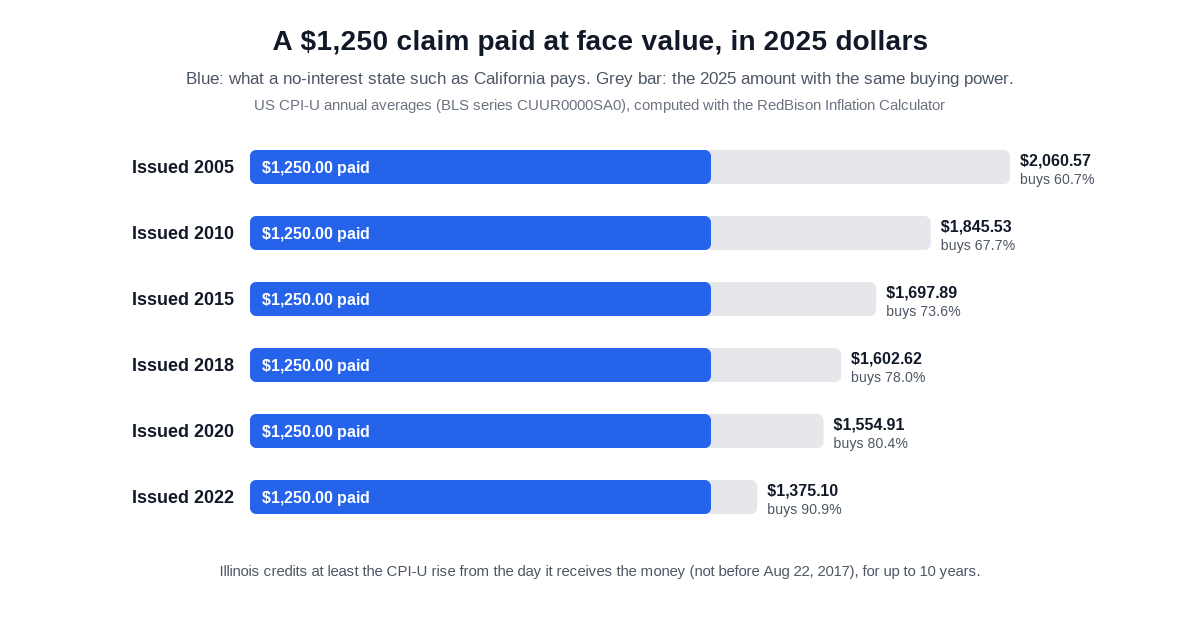
To see what a no-interest claim costs you, take a $1,250 final paycheck from a job left in 2018, never cashed and later reported to California. California pays $1,250. In the Inflation Calculator, choose US CPI history and enter 1250, from 2018, to 2025 (the latest full year of CPI-U data):
| Inflation Calculator result | Value |
|---|---|
| 1,250 dollars of 2018, in 2025 dollars | $1,602.62 |
| Price rise, 2018 to 2025 (CPI-U 251.107 to 321.943) | 28.21% |
| Average inflation a year | 3.614% |
| Buying power lost on a $1,250 claim | $352.62 |
| Share of 2018 buying power you get back | 78.0% |
The older the money, the bigger the gap. A $1,250 check from 2005 would need $2,060.57 in 2025 dollars to buy the same, so paying $1,250 returns 60.7% of it. Illinois's floor tracks the CPI-U from the day it receives the money (not before August 22, 2017), for up to 10 years, so a claim there keeps more of its value; California keeps none of the inflation. Search now rather than at retirement.
Finders, fees and scams
Heir finders and asset locators use the same free databases and offer to claim for a percentage. Some states cap that:
- California: no more than 10% of the property returned, and no contract at all before the property reaches the state, when you can still recover it free from the business (Code of Civil Procedure 1582). The Controller's FAQ adds that the cap does not apply to county probated estates.
- Texas: finders must be licensed by the Department of Public Safety's Private Security Bureau, and their fee cannot exceed 10% of the property recovered, expenses included.
A signed contract can still bind you if you then claim on your own, so read before signing. The FTC's warning is plainer: every state searches for free, and a caller who wants a "processing" fee or your personal details before releasing funds is running a scam, sometimes under a real-sounding agency name. Look the money up yourself before replying to any letter, call or text, and report fakes at ReportFraud.ftc.gov. A state may now write about an old savings bond (below); a genuine letter will match the state's official site, so call the number listed there, not the one in the letter.
Federal money no state holds
USA.gov's unclaimed money page is a useful map, but it still sends readers to Treasury Hunt for matured savings bonds, which TreasuryDirect retired on September 30, 2025. Go to each agency:
| Money | Where to look |
|---|---|
| IRS refund check returned or never received | Where's My Refund or the refunds line, 800-829-1954; file Form 8822 if you moved |
| Refund on a return you never filed | Usually three years to file, then it becomes the Treasury's; tax year 2022's window closed April 15, 2026 (IRS) |
| Deposit at a failed bank | FDIC unclaimed funds search by name or check number |
| FHA mortgage insurance refund | HUD refund search by last name or FHA case number; call 1-800-697-6967 on a match |
| Paper savings bonds | Treasury Hunt is gone; for bonds you hold or lost, claim with FS Form 1048, signed before a notary or certifying officer |
| VA life insurance (older policies, not SGLI or VGLI) | VA unclaimed insurance search |
| Bankruptcy court payments | US Courts unclaimed funds locator, then the court unit that holds the money |
| Pensions and old 401(k)s | PBGC and the DOL Lost and Found, in how to find a lost pension or old 401(k) |
A failed bank's insured depositors have 18 months to claim from the FDIC or the bank that took over the deposits; after that it goes to a state as unclaimed property, and if nobody claims it there within 10 years it reverts to the FDIC and the claim is gone (12 US Code 1822(e)). And an EE savings bond earns interest for 30 years, so one bought in 1995 stopped growing in 2025. Under SECURE 2.0, Treasury shares records of paper bonds more than three years past final maturity and never redeemed with states that sign an information-sharing agreement (final rule of December 18, 2024). The records cannot be made public, so you still cannot search them, but a state office may contact you (Treasury's report to Congress). HUD says you do not need to pay anyone to collect an FHA refund.
This guide covers searching and claiming. If the amount is large, the owner has died without a will, or two heirs disagree, a probate or estate lawyer in that state is worth the fee.
Tools for this job
- Inflation Calculator: what a found amount from a past year is worth today, so you can see the cost of a no-interest claim.
- US Retirement Records Checklist: the unclaimed property search alongside the Social Security, Medicare, PBGC and Lost and Found checks.
- Date Difference Calculator: how long is left before a deadline, such as the 10 years a failed bank's deposit can stay with a state.
How inflation erodes savings explains the CPI figures behind the worked example, and the lost pension and 401(k) guide runs the five retirement searches state databases miss.
Frequently asked questions
Is MissingMoney.com legitimate?
Yes. It is a free search sponsored by NAUPA, the association of state unclaimed property administrators, and it hands you to the holding state's official site to claim. NAUPA says most states take part, so a state that does not appear there still needs its own search. Sites that charge to search, or that ask for a fee before showing results, are not part of it.
How do I claim unclaimed money for a parent who died?
File with the holding state as the heir, trustee or estate representative. Expect to show the death certificate, your identity, and your right to inherit or act for the estate. Each state sets its own list. Search under your parent's every address, not just the last one.
Can unclaimed money run out if I wait too long?
Money a state holds usually does not: California and Texas set no deadline to claim. Two kinds do. A failed bank's deposit reverts to the FDIC 10 years after reaching the state, and the claim ends. Securities and safe deposit contents may be sold, so you receive the sale price rather than today's value.
Is unclaimed money taxable?
Interest the state adds is reported: Illinois issues a 1099-INT when it pays $10 or more of interest, and New York when interest reaches $600 in a year. California withholds no tax from claim payments. Whether the amount itself is taxable depends on what it was, such as wages you never reported or a stock sale, so ask a tax adviser.
Sources and further reading
- Search for your unclaimed property, National Association of Unclaimed Property Administrators. Official searches and MissingMoney.com.
- Texas v. New Jersey, 379 U.S. 674 (1965), Legal Information Institute, Cornell Law School. The last-known-address rule and the state-of-incorporation fallback.
- Frequently asked questions: claiming property, California State Controller's Office. Time limits, heirs, securities and the investigator cap.
- Unclaimed property FAQ, Texas Comptroller of Public Accounts. Dormancy, finder licensing and fees, securities.
- Unclaimed property FAQs, Illinois State Treasurer. Interest and the 1099-INT.
- Taxes and interest, Office of the New York State Comptroller. Interest on interest-bearing items for five years.
- How to handle unexpected calls about unclaimed funds, Federal Trade Commission. Free state searches and the upfront-fee scam.
- 12 US Code 1822: Corporation as receiver, Legal Information Institute, Cornell Law School. Failed bank deposit deadlines.