
How an FSA Works and How Much to Put In
US health and dependent care FSA rules: the limits, carryover or grace period, run-out, day-one access, and how much to elect when medical costs are uncertain.
By Redbison Dev · · 10 min read
Your benefits form wants one number: how much to put in a flexible spending account. In the US, a health FSA takes up to $3,400 of salary in 2026 ($3,500 in 2027) before income tax and FICA, the whole election is available from the first day of the plan year, and what you have not spent by the deadline is forfeited, except for a carryover of up to $680 ($700 in 2027) or a grace period of up to two and a half months, whichever your employer chose, never both. A dependent care FSA takes up to $7,500 per household from 2026. The rule for the number: elect a dollar only if the chance you will spend it is higher than one minus your tax rate, about 65% for someone paying 22% federal, 5% state and FICA, and the worked example below shows how a carryover changes the answer.
The limits
| US FSA limits | 2026 | 2027 |
|---|---|---|
| Health FSA, salary reduction per employee | $3,400 | $3,500 |
| Health FSA carryover, if the plan allows it | $680 | $700 |
| Dependent care FSA, per household ($3,750 married filing separately) | $7,500 | $7,500 |
Sources: Rev. Proc. 2025-32 section 3.15 for 2026, Rev. Proc. 2026-35 section 3.16 for 2027, and the IRS child and dependent care credit page for dependent care.
The health FSA limit applies per employee, so two spouses with their own employer plans can each elect the full amount. Your employer can set a lower cap. The dependent care limit was $5,000 through 2025; Public Law 119-21 raised it to $7,500 from 2026, with no inflation indexing, and the higher figure applies only if your employer's plan adopted it. Contributions skip federal income tax and FICA (Publication 969), and state income tax wherever the state follows the federal treatment. New Jersey is an exception: its NJ-1040 instructions do not exclude salary-reduction cafeteria plan contributions from state wages.
Use it or lose it, and the three ways round it
A health FSA is "generally use-it-or-lose-it" (Publication 969): money unspent at the end of the plan year is forfeited. Three plan features soften that, and they are easy to confuse.
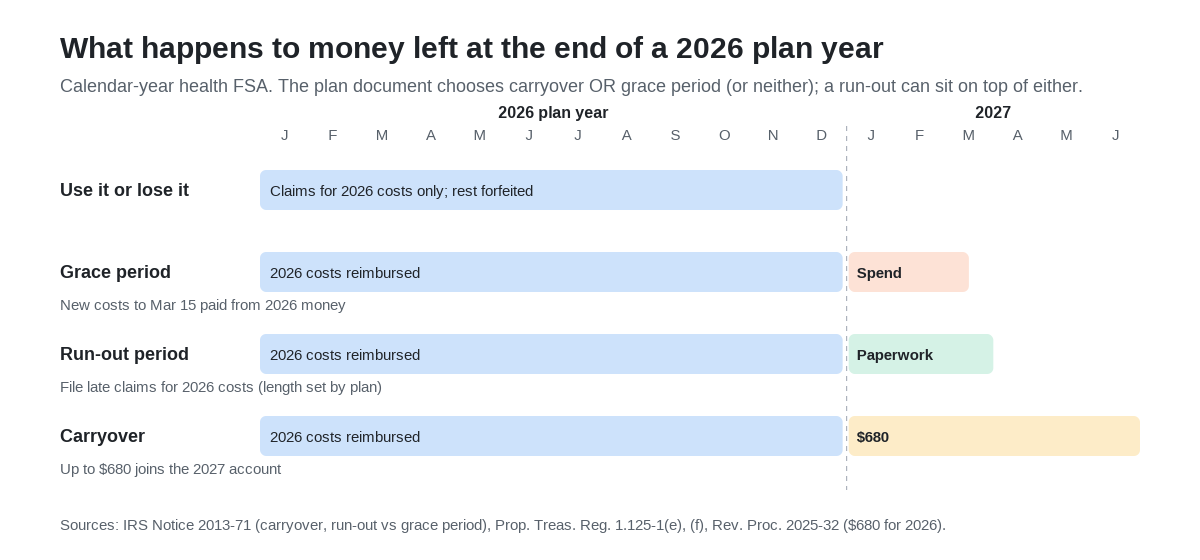
- Carryover. Up to $680 of unused 2026 money moves into the 2027 plan year, where it pays any eligible cost. It does not count against the 2027 election limit (IRS Notice 2013-71), so you could have $3,500 plus $680 available in 2027.
- Grace period. Up to two months and 15 days after the plan year ends (to March 15 for a calendar plan) in which leftover money pays for new costs incurred during that window.
- Run-out period. A window after the year ends to file claims for costs you already incurred during the plan year. It adds no spending time: a February appointment is not covered by a run-out. Its length is whatever the plan sets.
A plan may offer a carryover or a grace period, not both, and a run-out can sit alongside either (Publication 969; Notice 2013-71). Your summary plan description says which you have. A run-out only helps if you have unfiled receipts.
Uniform coverage: the whole election on day one
"The maximum amount of reimbursement from a health FSA must be available at all times during the period of coverage" (Prop. Treas. Reg. 1.125-5(d), which the IRS lets employers rely on). Elect $2,600, have a $1,400 crown in January, and the plan pays $1,400 even though only one paycheck's worth, $100, has come out of your pay. Your deductions cannot be sped up to catch up either; they stay at $100 a paycheck.
If you leave the job in March after spending your full election, you have had more reimbursed than you paid in, and that is the employer's risk under this rule, not yours. The rule covers health FSAs only: it "does not apply to FSAs for dependent care assistance" (same proposed regulation, preamble), so a dependent care FSA may pay only up to what you have contributed so far; your plan document says which.
How much to elect when costs are uncertain
Each dollar you put in and spend saves your full marginal rate. Each dollar you put in and forfeit costs you what it would have been as take-home pay. So, with r as your combined marginal rate:
gain = r × (dollars reimbursed) − (1 − r) × (dollars forfeited)

elect one more dollar only if  P(you spend it) ≥ 1 − r
To find r, use the Paycheck Calculator: a single earner on $70,000 a year, biweekly, age 35, 5% state tax. Entering $46.15 a paycheck ($1,199.90 a year) as pre-tax benefits lowers take-home by only $30.16 a paycheck, $784.13 a year. The $415.77 difference is the tax saved, 34.65% of the election: 22% federal, 5% state and 7.65% FICA. The table below uses round annual elections at that rate. Every FSA election from $1,200 to $3,400 saves exactly 34.65% for this earner, since taxable income stays in the 22% bracket for 2026. The break-even chance is 1 − 0.3465 = 65.35%.
Now the costs. Contact lenses, prescriptions and copays come to $1,200 for sure. The dentist says a $1,400 crown is likely "at some point": call it a 50% chance of falling in this plan year, so spending is either $1,200 or $2,600.
| 2026 election | Spend $1,200 | Spend $2,600 | Expected gain, no carryover | Expected gain, $680 carryover |
|---|---|---|---|---|
| $1,200 | +$415.80 | +$415.80 | $415.80 | $415.80 |
| $1,880 | −$28.58 (no carryover) | +$651.42 | $311.42 | $651.42 |
| $2,600 | −$499.10 (no carryover) | +$900.90 | $200.90 | $540.90 |
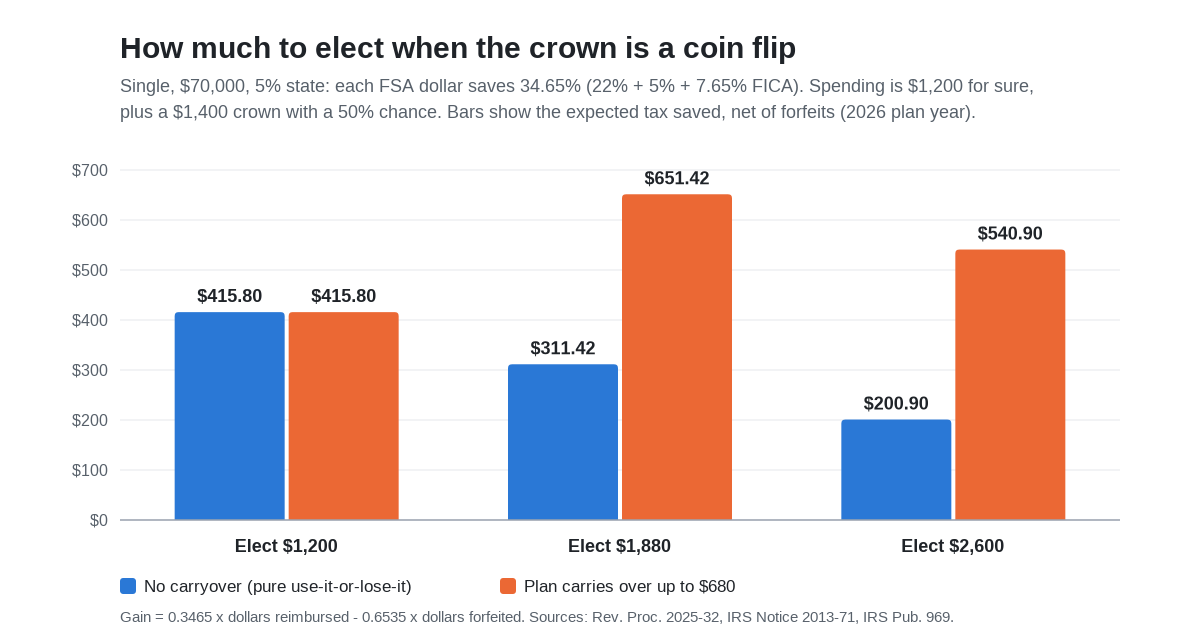
Without a carryover, the crown dollars have a 50% chance of being spent, below the 65.35% bar, so each one lowers the expected gain: elect $1,200. If the crown happens, pay it with after-tax money or a flexible payment plan with the dentist.
With a carryover, the first $680 above your sure spending cannot be forfeited this year, because it rolls into 2027 and is spent there (assuming you stay and re-enroll). So elect $1,880: you save $651.42 whether or not the crown happens. Beyond $1,880 the 50% odds apply again, and $2,600 does worse at $540.90. A grace period works like the carryover, but only for costs you can actually schedule by March 15.
A higher tax rate lowers the bar: in the 24% bracket plus 5% state, r is 36.65% and the break-even chance is 63.35%. An expense you control (glasses, a planned procedure) has a probability close to 1, so it belongs in the election.
Limited-purpose FSA: the one that works with an HSA
A general-purpose health FSA is "other coverage" that makes you ineligible for an HSA, even if it is your spouse's, if it can pay your costs. A limited-purpose FSA pays only for dental, vision and preventive care, so it is compatible (Publication 969), and lets HSA holders shelter those costs without touching the invested HSA. A post-deductible FSA, which pays medical costs once the HDHP deductible is met, is also compatible.
Watch the carryover when switching to an HDHP. An IRS Chief Counsel memo (CCA 201413005) concluded that a carryover into a general-purpose FSA blocks HSA contributions for the whole following year, even after the carried money is spent, but that a plan may move the carryover into a limited-purpose FSA instead. Spend down, decline the carryover, or ask for it to go to the limited-purpose FSA. The HSA guide covers the HSA side.
Dependent care FSA, briefly
From 2026 a dependent care FSA can shelter $7,500 a year of day care, preschool, before- and after-school care or day camp for children under 13 while you work, up from $5,000. You cannot use the same dollars for the child and dependent care credit: every FSA dollar reduces the $3,000 (one child) or $6,000 (two or more) of expenses the credit can use, so electing the full $7,500 leaves no credit (Example 2 in the IRS's draft 2026 Publication 503). The credit itself rises to 50% of expenses at low incomes from 2026, so for families on modest incomes it can be worth more than the FSA; compare the two at your own tax rate before enrolling.
Eligible expenses and changing your election mid-year
A health FSA pays medical care as defined in Code section 213(d) and listed in Publication 502: copays, deductibles, dental and vision work, prescriptions, over-the-counter medicine whether or not prescribed, and menstrual care products (Publication 969). It cannot pay insurance premiums, long-term care or costs another plan covers (Publication 969), and Publication 502 rules out gym memberships, cosmetic surgery, and vitamins or supplements unless a doctor recommends them for a diagnosed condition.
Your election is locked for the plan year unless you have a change in status: marriage or divorce, a birth or adoption, a change in your or your spouse's employment, a dependent gaining or losing eligibility, or a move that changes coverage (26 CFR 1.125-4). The change must be consistent with the event. A rise in prices is never a reason to change a health FSA; for dependent care, a cost increase from a provider who is not a relative is.
This is general information for US federal tax. If your plan document differs, the plan document governs, and a tax adviser can help when a dependent care FSA and the credit both look close.
Tools for this job
- Paycheck Calculator: enter the election as a pre-tax benefit to see your marginal rate and the take-home cost per paycheck.
- Budget Planner: plan the year's predictable medical, vision and child care costs before you pick a number.
- Compound Interest Calculator: what the same money would grow to if you are choosing an HSA instead.
The take-home pay guide explains how the paycheck lines are worked out, and the retirement accounts guide covers the pre-tax 401(k) deferrals that sit next to an FSA on the same benefits form.
Frequently asked questions
Can I have an FSA and an HSA at the same time?
Only if the FSA is limited-purpose (dental, vision and preventive care) or post-deductible. A general-purpose health FSA, yours or a spouse's that can pay your costs, blocks HSA contributions for its whole plan year, and a carryover into one blocks the next year too. Ask for the carryover to go into a limited-purpose FSA instead, or spend it down before switching.
What happens to my FSA if I leave my job?
Your election generally stops with your last paycheck, and costs incurred after you leave are not covered unless you elect COBRA for the health FSA, where the plan offers it. Because of the uniform coverage rule, if you have already been reimbursed more than you contributed, the plan cannot speed up your deductions to recover the difference. Submit receipts for costs incurred before you left within the plan's run-out period.
Can I spend FSA money on my spouse or children?
Yes. A health FSA covers eligible costs of your spouse and the dependents you claim. A dependent care FSA covers care for children under 13, or a spouse or dependent who cannot care for themselves, so that you (and your spouse) can work.
Does an FSA reduce my Social Security benefits?
Slightly. Salary put into a health or dependent care FSA skips Social Security tax, so it is not credited to your earnings record. For a few thousand dollars a year the effect on a future benefit is small compared with the 7.65% FICA saved now, but it is not zero.
Sources and further reading
- Publication 969, Health Savings Accounts and Other Tax-Favored Health Plans, Internal Revenue Service. Health FSA rules, carryover, grace period and eligible items.
- Rev. Proc. 2025-32, Internal Revenue Service. Section 3.15: the 2026 health FSA limit of $3,400 and carryover of $680.
- Rev. Proc. 2026-35, Internal Revenue Service. Section 3.16: the 2027 limit of $3,500 and carryover of $700.
- Notice 2013-71, Internal Revenue Service. The carryover, why it excludes a grace period, and the run-out period.
- Employee Benefits: Cafeteria Plans (proposed regulations), Federal Register. Prop. Treas. Reg. 1.125-1(e) and (f) on grace and run-out periods, and 1.125-5(d) on uniform coverage.
- Publication 503, Child and Dependent Care Expenses (draft 2026), Internal Revenue Service. The $7,500 dependent care exclusion and Example 2, where it leaves no credit.
- Publication 502, Medical and Dental Expenses, Internal Revenue Service. Which medical costs qualify.
- 26 CFR 1.125-4, Permitted elections for cafeteria plans, eCFR. Mid-year changes in status.