
How an HSA Works, From Eligibility to Medicare
US HSA rules with real numbers: who qualifies after the bronze plan change, the limits, the FICA saving through payroll, receipts and Medicare at 65.
By Redbison Dev · · 11 min read
Open enrollment offers a high-deductible plan with a health savings account beside a richer plan. In the US, an HSA takes up to $4,400 for self-only coverage or $8,750 for family coverage in 2026 ($4,500 and $9,000 in 2027), plus $1,000 a year from age 55, if you are covered by a qualifying high-deductible health plan (HDHP) and nothing else. The money goes in untaxed, grows untaxed and comes out untaxed for medical costs; paid through payroll it also skips the 7.65% FICA tax, which a 401(k) deferral does not.
Who can contribute: the HDHP test and the bronze plan change
You are an "eligible individual" for any month in which, on the first day, you are covered by an HDHP, have no other health coverage that pays before the deductible, are not enrolled in Medicare, and cannot be claimed as someone else's dependent (IRS Publication 969). A plan is an HDHP if its deductible and out-of-pocket cap fall inside the IRS figures:
| US HDHP thresholds | 2026 self-only | 2026 family | 2027 self-only | 2027 family |
|---|---|---|---|---|
| Minimum annual deductible | $1,700 | $3,400 | $1,750 | $3,500 |
| Maximum out-of-pocket (not premiums) | $8,500 | $17,000 | $8,700 | $17,400 |
Sources: Publication 969 for 2026; Rev. Proc. 2026-24 for 2027.
The One, Big, Beautiful Bill Act (Public Law 119-21, July 4, 2025) widened eligibility in three ways, explained in IRS Notice 2026-5:
- Telehealth before the deductible no longer breaks HDHP status, permanently, for plan years beginning after 2024.
- Bronze and catastrophic plans count as HDHPs for months beginning after December 31, 2025, even when their deductible is below the table above. The plan must be available as individual coverage through a Marketplace; buying the same plan off-Exchange, or through an individual coverage HRA, still counts. A small employer's SHOP bronze plan generally does not, unless it meets the normal thresholds.
- Direct primary care no longer disqualifies you, if it covers only primary care for a fixed periodic fee of no more than $150 a month ($300 if it covers more than one person) in 2026 and 2027. Procedures needing general anesthesia, prescription drugs other than vaccines and labs a primary care office would not normally run fall outside it. Fees you pay yourself can be reimbursed from the HSA; fees your employer pays, including through salary reduction, cannot (Notice 2026-5, A-18).
The disqualifier people miss is a general-purpose health FSA. Yours or your spouse's, if it can reimburse your costs, blocks HSA contributions for the whole plan year, and a carryover into one blocks the next year too. A limited-purpose FSA for dental and vision is compatible; the FSA guide covers how to switch.
The limits, catch-up and timing
| US HSA contribution limit | 2026 | 2027 |
|---|---|---|
| Self-only HDHP coverage | $4,400 | $4,500 |
| Family HDHP coverage | $8,750 | $9,000 |
| Catch-up, age 55 or older (fixed by statute) | $1,000 | $1,000 |
Employer contributions count toward the limit. Contributions for a year can be made until the tax filing deadline, April 15 of the following year. If you are eligible for only part of the year, the limit is prorated by month, unless you are eligible on December 1, in which case the last-month rule gives you the full year's limit. The price is a testing period: stay eligible through December of the next year, or the extra is added to income with a 10% additional tax (Publication 969).
The three tax breaks, in one paycheck
Contributions are excluded or deducted from income, growth is never taxed inside the account, and withdrawals for qualified medical costs are tax-free (Publication 969). One example shows the size. A single 40-year-old on $85,000, paid biweekly, in a state with a flat 5% income tax, puts the 2026 self-only maximum of $4,400 in through payroll: in the Paycheck Calculator, enter those figures with an HSA contribution of $169.23 per paycheck ($4,399.98 a year). Take-home falls by $110.59 a paycheck, $2,875.39 a year, so about $1,524.59 of the contribution is tax saved: about $968 federal (22%), $220 state (5%) and $336.60 FICA (7.65%). The take-home pay guide explains each paycheck line.
Payroll contributions under a cafeteria plan skip Social Security and Medicare tax (Publication 15-B). Paying the provider directly gets the income tax deduction on Form 1040 but not the $336.60, and the same $4,400 as a 401(k) deferral costs $3,212.00 of take-home because deferrals still pay FICA. Wages that skip Social Security tax also do not count toward your earnings record, a small effect at this size.
Investing the balance
An HSA is not use-it-or-lose-it: the balance rolls over every year and stays yours when you change jobs (Publication 969). It sits in cash until you pick investments with the provider, and some providers require a minimum cash balance first. Money spent on anything other than medical costs is taxed as income plus a 20% additional tax before 65; from 65 the 20% falls away and it is taxed like a traditional 401(k) withdrawal (Publication 969). So at worst an invested HSA held to 65 matches a 401(k), and it got there without paying FICA.
Pay now, reimburse decades later
You can pay a medical bill from your own pocket today and reimburse yourself from the HSA in any later year, with no deadline, as long as the expense was incurred after the HSA was opened and you can prove it (IRS Notice 2004-50, Q&A 39). A $1,850 dental bill paid in cash in 2026 leaves $1,850 invested: at 6% for 25 years that is $7,940 in the HSA, and you can still take the original $1,850 out tax-free in 2051.
The same Q&A puts the burden on you to show the expense was a qualified medical cost and was not paid or reimbursed from somewhere else. Keep, for each bill:
- the itemized receipt or explanation of benefits, with the date and who the care was for;
- proof you paid it (card or bank statement);
- a note that it was not reimbursed by insurance or an FSA and not claimed as an itemized deduction.
File them by year with the date the HSA opened, since earlier costs never qualify.
At 65: Medicare and the six-month look-back
Your HSA limit becomes zero from the first month you are enrolled in Medicare, including any months of retroactive coverage (Publication 969). That retroactive part is the trap. Premium-free Part A starts up to six months before the month you apply for Medicare or Social Security, but no earlier than the month you turn 65, and Medicare's own enrollment booklet tells HSA holders to stop contributing six months before they apply (Enrolling in Medicare Part A and Part B, page 27).
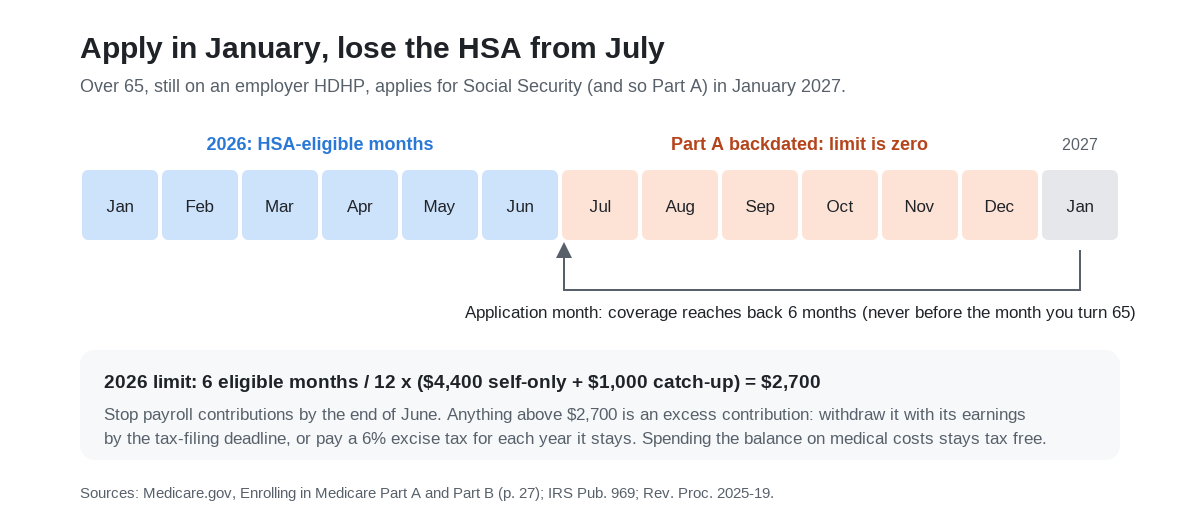
Someone over 65 still working with an employer HDHP who applies for Social Security in January 2027 gets Part A backdated to July 2026. They were eligible for six months of 2026, so their limit is 6/12 of $5,400 ($4,400 plus the $1,000 catch-up), or $2,700. Anything contributed above that is an excess contribution: take it and its earnings out by the filing deadline, or pay a 6% excise tax for every year it stays in.
Working past 65 without signing up for any part of Medicare or Social Security keeps you eligible, and an HDHP from your or your spouse's current job may give you a Special Enrollment Period for Part B later without the late penalty (page 27 of the same booklet). At an employer with fewer than 20 employees, Medicare usually pays first, so check with the plan before delaying Part B (Who pays first?, Medicare.gov). After you enroll, the balance still pays deductibles and coinsurance tax-free, and premiums for Medicare and other health coverage, except a Medicare supplement (Medigap) policy (Publication 969). The 11 US retirement websites guide lists the Medicare and Social Security pages to watch around that date.
States that tax HSAs: California and New Jersey
California's 2025 Schedule CA instructions say the state "does not conform": the HSA deduction is added back, employer contributions in W-2 box 12 code W are added to wages, and interest, dividends and gains inside the HSA are taxed every year (FTB). New Jersey's 2025 NJ-1040 instructions list Archer MSAs among the income exclusions and do not list HSAs, and say a cafeteria plan that is taxable for New Jersey must be added back to state wages (NJ Division of Taxation). In both, the state line of the paycheck example does not fall. These are two examples whose instructions say so outright, not a complete list; elsewhere, your state's resident return instructions settle it.
This is general information for US federal tax. If you are self-employed, covered by a spouse's plan, or near 65 with a complicated enrollment history, a tax adviser can check the months and the limit before you contribute.
Tools for this job
- Paycheck Calculator: the HSA's effect on take-home pay, with federal, state and FICA lines separated.
- 401(k) Calculator: the employer match and the 2026 deferral limits, to decide how the HSA fits around them.
- Compound Interest Calculator: what a receipt's worth of money grows to if it stays invested, as in the $1,850 example above.
The retirement accounts guide covers the 401(k) and IRA rules an HSA sits beside, and the retirement savings guide shows how much to save in total.
Frequently asked questions
Can I contribute to an HSA if I change from an HDHP partway through the year?
Yes, for the months you were eligible. The limit is figured month by month: eligible for five months on self-only coverage in 2026 means 5/12 of $4,400, or $1,833.33. The exception is the last-month rule: if you are eligible on December 1 you may contribute the full year's amount, but you must then stay eligible through the following December or pay tax and a 10% additional tax on the extra.
Can I keep contributing to an HSA after 65 if I am still working?
Yes, as long as you are covered by an HDHP and not enrolled in any part of Medicare. Applying for Social Security enrolls you in Part A, backdated up to six months, so stop contributions six months before you apply for either. After enrollment the limit is zero, but the existing balance can still be spent tax-free on medical costs.
Can I use my HSA for my spouse's or children's medical bills?
Yes. Qualified medical expenses include those of your spouse and any dependents you claim on your tax return, and the 20% additional tax applies only to money spent on something else. The contribution limit, though, depends on your own HDHP coverage: family coverage for the $8,750 limit in 2026, self-only for $4,400.
What happens to an HSA when the owner dies?
It depends on the beneficiary. A spouse named as beneficiary simply takes it over as their own HSA. Anyone else receives it as taxable income: its fair market value, less any of the owner's medical expenses they pay within one year of the death, is taxed to them in the year of death. Naming the beneficiary on the provider's form, rather than leaving it to the estate, is what decides this.
Sources and further reading
- Publication 969, Health Savings Accounts and Other Tax-Favored Health Plans, Internal Revenue Service. Eligibility, the 2026 limits and HDHP thresholds, the testing period, Medicare and the 20% tax.
- Rev. Proc. 2026-24, Internal Revenue Service. The 2027 HSA limits, HDHP thresholds and direct primary care fee cap.
- Notice 2026-5, Expanded Availability of Health Savings Accounts under the OBBBA, Internal Revenue Service. Telehealth, bronze and catastrophic plans, and direct primary care.
- Notice 2004-50, Internal Revenue Bulletin 2004-33, Internal Revenue Service. Q&A 39 on reimbursing earlier expenses and keeping records.
- Publication 15-B, Employer's Tax Guide to Fringe Benefits, Internal Revenue Service. HSA contributions through a cafeteria plan and FICA.
- Enrolling in Medicare Part A and Part B, Centers for Medicare and Medicaid Services. Page 27 on HSAs and the six-month backdating of Part A.
- Instructions for Schedule CA (540), California Franchise Tax Board. How California taxes HSA contributions and earnings.
- Form NJ-1040 instructions, New Jersey Division of Taxation. Income exclusions and cafeteria plan wages.